
Lifting Point
A vehicle location designated to receive upward force while the vehicle is being raised.
- Its reinforcement suits a defined contact shape
- Front and rear loads can differ greatly
- Corrosion or damage may make it unusable
Vehicle lifting equipment matters because raising a car converts ordinary weight into stored gravitational energy. The jack, lift arm, saddle, support point, stand, floor, and wheel restraints form one load path; a weakness or wrong contact anywhere can let the vehicle shift or fall.
Safe access requires more than a jack with a large tonnage label. The equipment must reach the designated location, remain stable through the lifting arc, fit the vehicle structure, and support the actual end or corner load without side force. Hydraulic devices lift, while approved stands or locked lift mechanisms provide sustained support. Before anyone enters the crush zone, the vehicle must be restrained, supported redundantly as required, and deliberately tested for stability.
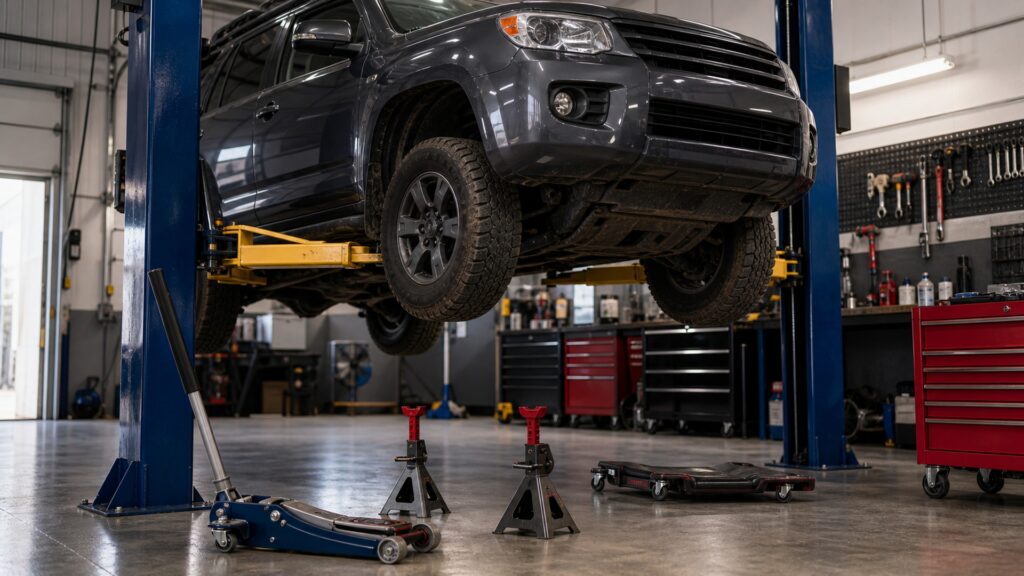
The lift is credible only when every interface—from vehicle structure through saddle and frame to the surface below—remains rated, aligned, and stable.
Tip: Plan both ascent and descent before touching the vehicle. Removed powertrain parts, suspension work, an opened door, or force on a breaker bar can move the center of gravity after the first stability check.
These terms describe the load path and the moments when lifting becomes support.
A vehicle location designated to receive upward force while the vehicle is being raised.
A location approved to carry vehicle weight after lifting equipment has created working clearance.
The maximum load equipment is designed to handle under its stated orientation and operating conditions.
The continuous route by which vehicle weight passes through structure, adapters, lifting equipment, and floor.
A positive engagement that supports a raised lift independently of hydraulic pressure alone.
Any space a person could occupy that the vehicle or equipment can enter after movement or failure.
Tip: A capacity label applies only within the equipment maker's setup, geometry, condition, and surface requirements.
Pinch welds, frame pads, subframes, axles, and manufacturer lift fixtures are engineered differently. A narrow or misplaced saddle can concentrate force into floorpan, plastic, battery enclosure, brake line, or corroded metal instead of the intended reinforcement.
The strongest jack cannot make an unapproved body seam into a support point.
A floor jack's saddle travels through an arc while its casters move; a lift arm rotates; suspension droop shifts geometry. The surface must let the equipment move as designed without pulling the saddle sideways or tilting a stand.
Preventing equipment motion can be as hazardous as allowing unintended vehicle motion.
Hydraulic seals, valves, hoses, and pump circuits can leak or fail. Once height is established, lower the vehicle onto correctly placed stands or engage the lift's mechanical locks according to instructions, then unload hydraulic pressure where the procedure requires.
A hydraulic column is a motion device, not permission to work underneath.
Taking out an engine, axle, battery pack, transmission, bed, or loaded component shifts weight. Pulling on seized hardware creates horizontal force. Doors, tailgates, ramps, and suspended parts can also alter the moment around supports.
A setup stable at teardown may be unstable halfway through the job.
Tools, drain pans, stands, people, wheel chocks, and disconnected components can obstruct lowering. The operator needs a full view, clear communication, and a slow release while watching every contact and tire as load returns.
The task is not complete until the vehicle carries its own weight safely again.
Correct structure, saddle, geometry, restraint, support, floor, and changing center of gravity must all remain credible.
The vehicle maker's points, equipment ratings, pad geometry, surface, wheel restraint, and expected load shifts are resolved before ascent.
Raised weight rests on approved positive supports or locked lift mechanisms, stability is tested, and the descent path is controlled before the crush zone is entered.
Unknown or corroded lift points, sloped or soft ground, damaged equipment, inadequate reach, side-loaded saddles, missing adapters, uncertain vehicle mass, or shifting cargo require another method.
No tonnage label makes stacked lumber, concrete blocks, improvised stands, a leaking jack, partial lift locks, or a vehicle supported only by hydraulic pressure safe for underbody work.
Lifting myths focus on the jack while ignoring the structure, motion, support, and changing balance that decide whether the raised vehicle stays put.
The rating assumes correct orientation and does not prove reach, saddle fit, floor strength, lift-point condition, or stability. One contact may also carry a disproportionate load as vehicle weight distribution and repair geometry change.
A hydraulic jack can leak, roll, shift, or be disturbed. Approved positive supports carry sustained weight; a jack may remain only as additional redundancy when its position does not side-load or obstruct the support system.
Subframes, rails, battery trays, rocker panels, and underbody braces can look substantial while lacking approved local reinforcement. Consult exact service information and inspect for corrosion, collision damage, coverings, lines, and incompatible saddle contact.
Lifting one corner changes normal force at the other tires and can reduce the effectiveness of Park or a parking brake. Correct transmission position, parking brake use, chocking, surface, and procedure remain essential.
Tip: Trace the complete load path and every planned force during the job before accepting any point or device as adequate.
These answers cover lift-point research, stand sizing, ramps, uneven ground, stability checks, and the effects of high-voltage battery locations.
Start with the owner's manual and current service information for the exact model and lift type. Body labels or diagrams may supplement them; never infer from another model, a plastic notch, or an online photograph without verification.
Use the stand maker's rating and instructions, considering the actual load carried by the supported end, height, saddle fit, surface, and stand pair configuration. Do not divide total vehicle weight mechanically without understanding distribution.
Quality ramps can provide simple wheel-supported access when load, tire width, approach angle, surface, restraint, and clearance fit. They are unsuitable when wheels must be removed or the vehicle can climb, slide, or overrun them.
Hot or thin asphalt can deform under concentrated caster or stand loads, causing tilt or sinking. Use equipment only on surfaces allowed by its manufacturer; a properly engineered load-spreading solution must remain flat, stable, and non-slip.
Yes. Battery enclosures, coolant lines, cables, mass distribution, approved pads, and disabled-system procedures can differ. Follow model-specific service information and use required adapters; contact with a high-voltage enclosure can cause costly or dangerous damage.
Vehicle lifting equipment matters because it converts a car's weight into a temporary load path that must remain centered, rated, restrained, positively supported, and stable while the repair changes forces and balance.
Use exact lift information, inspect every interface, separate raising from supporting, test stability, and control descent; never enter the crush zone on hydraulic pressure, guesswork, or improvised structure.
The next explainers compare common jack architectures, place lifting inside a complete garage system, and show how tool selection controls force after the vehicle is safely supported.
Compare low-profile rolling reach with compact vertical lift, including minimum height, side-load sensitivity, saddle travel, and field stability.
Place lifting inside diagnosis, hazard control, measured assembly, ventilation, and post-repair verification.
Build the PPE, fire, ventilation, spill, lighting, and exclusion controls that protect the work area around a raised vehicle.
Choose a retailer
Prices checked regularly. We may earn a commission at no cost to you.