Why Garage Safety Equipment Matters

Garage safety equipment matters because automotive repair concentrates hazards that rarely arrive one at a time. A raised vehicle may sit beside fuel vapor, hot coolant, a charging battery, spinning tools, compressed springs, sharp metal, exhaust, and a slippery floor. The equipment must interrupt each credible path to injury.

PPE is the last personal barrier, not the whole system. The bay needs stable lifting, guarding, source-capture ventilation, fire protection, useful lighting, spill containment, chemical information, electrical isolation, and a clear exit. Selection follows a task-specific hazard assessment: safety glasses cannot control carbon monoxide, gloves cannot stabilize a jack, and an extinguisher cannot make an unknown fuel leak safe to continue.

By: Review Streets Research Lab
Updated: August 31, 2026
Explainer · 8-12 min read
garage safety equipment explainer hero image for Review Streets
What You'll Learn

Protect the Bay in Layers

Start by eliminating or isolating the hazard, then add engineering controls, orderly work practices, and PPE for the exposure that remains.

  • Identify every stored-energy source
  • Capture exhaust and vapor at the source
  • Keep fire control reachable behind the exit path
  • Separate people from moving or raised equipment
  • Match PPE to splash impact noise and chemistry
  • Preserve lighting housekeeping and emergency access

Tip: Stand at the work position and trace how you would leave if fuel ignited, the vehicle shifted, coolant sprayed, or a battery vented. Reposition equipment that forces escape toward the hazard.

Definitions

Key Concepts That Define Garage Safety Equipment

These terms distinguish personal protection from controls that remove or contain the hazard for everyone in the bay.

Hazard Assessment

A task-specific review identifying credible energy, chemical, motion, fire, exposure, and environmental routes to injury.

  • It determines which controls are needed
  • Vehicle state can change the hazards
  • The review must include emergency actions

Engineering Control

A physical measure that removes, captures, guards, contains, or separates a hazard before it reaches a person.

  • Local exhaust removes contaminants at source
  • Guards block contact with moving parts
  • Rated supports control gravitational energy

Personal Protective Equipment

Wearable protection selected for residual exposure after stronger controls have been applied where feasible.

  • Lens rating must match impact or splash
  • Glove material must suit the chemical
  • PPE needs fit inspection and training

Energy Isolation

A verified process preventing electrical, mechanical, hydraulic, pneumatic, thermal, or gravitational energy from acting unexpectedly.

  • Switch position alone may be inadequate
  • Capacitors and pressure can remain stored
  • Release and reconnection need procedures

Local Exhaust Ventilation

A system capturing exhaust, vapor, dust, or fumes close to where they are generated.

  • Source capture is stronger than dilution
  • Discharge must reach a safe location
  • Airflow and hose condition need verification

Exclusion Zone

A defined area kept clear of people who are not protected from movement, ejection, spray, fire, or collapse.

  • Impact-tool reaction can extend it
  • Lift movement changes its boundaries
  • Barriers and communication support control

Tip: Safety equipment is effective only when inspected, accessible, compatible, and paired with training for the exact event.

Gravity Gets Hardware, Not Hope

Rated Supports and Clear Zones Control the Largest Stored Energy

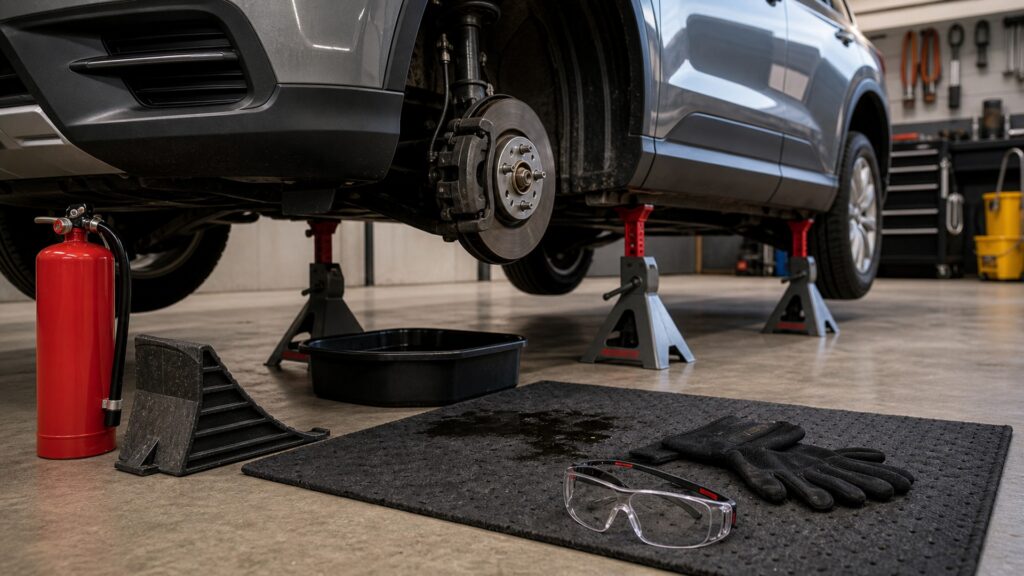
Jacks raise; approved stands or locked lifts support. Wheel chocks, lift points, arm restraints, floor condition, component supports, and a stability check protect the crush zone. No eye protection compensates for a falling vehicle.

  • Use vehicle and equipment lift instructions
  • Keep everyone clear during ascent and descent
  • Support removed driveline components independently
  • Recheck balance after mass changes

The first safety system in an underbody job is the load path to the floor.

Air Quality Can Fail without a Visible Cloud

Exhaust and Vapor Need Source Capture and Monitoring

Carbon monoxide is colorless and can accumulate quickly. Fuel, solvent, welding, refrigerant, and battery processes add different airborne hazards. Open doors or household fans may not provide designed capture; the control must suit the contaminant and discharge safely.

  • Connect rated exhaust extraction before running
  • Never idle for cabin heat
  • Use monitors where the assessment requires
  • Stop for headache dizziness or alarm

A garage that smells acceptable can still contain a dangerous atmosphere.

Fire Control Begins before the Extinguisher

Remove Ignition, Contain Fuel, and Keep the Exit behind You

Disconnect and isolate as specified, catch fluids in compatible containers, cap open lines, control sparks, and store flammables correctly. Extinguishers need the right rating, inspection, access, and trained use on only an incipient fire with a clear escape.

  • Locate shutoffs and exits before work
  • Move charging and grinding away from fuel
  • Keep spills out of drains and traffic
  • Evacuate when fire is growing or uncertain

An extinguisher is a last opportunity, not permission to normalize fuel vapor.

PPE Must Match the Specific Exposure

Impact, Splash, Heat, Noise, and Chemistry Are Different Problems

Safety glasses, goggles, face shields, hearing protection, gloves, footwear, and protective clothing have distinct ratings and limitations. A face shield usually supplements eye protection; loose gloves can be hazardous near rotating equipment; chemical breakthrough times vary.

  • Read product and safety-data guidance
  • Inspect lenses seals and straps
  • Remove jewelry and control loose clothing
  • Replace contaminated or impact-damaged PPE

More layers are not automatically safer when they create entanglement, heat stress, or lost dexterity.

Rescue Equipment Must Be Reachable after the Incident Starts

Eyewash, First Aid, Lighting, Communication, and Housekeeping Preserve Options

An eyewash hidden behind parts, extinguisher beyond the fire, or phone beneath a vehicle does not support emergency response. Clean aisles, bright portable lighting, labeled storage, spill kits, first aid, and another informed person can shorten the path from incident to help.

  • Keep exits and panels unobstructed
  • Test emergency equipment on schedule
  • Store heavy items below head height
  • Communicate lone-work and vehicle status

Readiness is measured from the injured person's position, not from the inventory list.

Quick Reality Check

Safety Equipment Must Break the Actual Injury Chain

Controls should prevent energy release, capture exposure, separate people, and protect remaining contact in that order.

A Bay Ready for the Task

The hazard assessment covers gravity, motion, electricity, pressure, heat, chemicals, exhaust, fire, noise, sharp debris, and emergency escape for the exact service procedure.

Rated supports, guards, ventilation, containment, lighting, PPE, extinguishers, eyewash, spill response, and communication are inspected, reachable, and understood before the vehicle is disabled.

Reasons to Stop or Relocate Work

Unknown fuel or refrigerant release, inadequate ventilation, unstable lifting, damaged electrical isolation, incompatible PPE, blocked exits, uncontrolled ignition, missing containment, or lone work beyond the plan require another facility or professional response.

No consumer safety kit makes airbag, high-voltage, fuel-tank, refrigerant-recovery, welding, machining, spring, paint-isocyanate, or heavy-lift work safe without the required training, equipment, and environmental controls.

Common Myths

Misconceptions About Garage Safety Equipment

Garage safety myths treat PPE as permission to leave the source, energy, or work area uncontrolled.

An open garage door provides enough exhaust ventilation

Natural airflow varies with wind, temperature, door geometry, and vehicle position. Exhaust should be captured and discharged by equipment designed for the source; carbon-monoxide monitoring may provide an additional warning, not replace ventilation.

A face shield replaces safety glasses

A shield protects much of the face from selected splash or impact but can leave paths around the edges and beneath. Many tasks require rated safety glasses or goggles underneath, selected from the actual hazard assessment.

Nitrile gloves protect against every automotive chemical

Glove formulations and thicknesses have different permeation, breakthrough, heat, cut, and tear limits. Consult chemical safety information and glove data; change contaminated gloves promptly and avoid gloves near rotating machinery when entanglement is possible.

One extinguisher makes hot work safe

Fire prevention still requires removing combustibles, controlling vapors, isolating lines, shielding sparks, monitoring hidden spaces, maintaining an exit, and sometimes a fire watch. The extinguisher only addresses a limited early-stage event.

Tip: Evaluate how the hazard reaches a person and choose the highest practical control before relying on what the person can wear or grab afterward.

FAQ

Frequently Asked Questions About Garage Safety Equipment

These answers address eye protection, respirators, carbon-monoxide alarms, fire extinguishers, battery work, and how a small garage should prioritize limited safety spending.

What eye protection is appropriate for garage work?

Use rated safety eyewear selected for impact, dust, splash, optical, and side-protection needs. Grinding, chemicals, compressed air, and overhead work can require goggles or a face shield in addition; inspect fit and damage.

Is a dust mask enough for automotive chemicals?

No universal mask exists. Respirator selection requires contaminant identification, exposure assessment, approved cartridges or filters, medical evaluation, fit testing, training, change schedules, and oxygen-sufficient conditions. Ventilation or professional controls may be necessary instead.

Where should a carbon-monoxide alarm be placed?

Follow the alarm manufacturer, building codes, and workplace assessment. A monitor warns of accumulation but does not capture exhaust or authorize engine operation; test it regularly and treat every alarm or illness symptom as a stop condition.

Which fire extinguisher belongs in a garage?

Select ratings for credible fuels and electrical hazards with local fire guidance, mount it visibly near an escape route, inspect it, and obtain hands-on training. Evacuate and call emergency services when the fire is not incipient.

What should a small garage buy first?

Prioritize safe lifting and restraint, rated eye protection, bright lighting, ventilation or exhaust control, appropriate extinguisher, spill containment, first aid, and task-specific PPE. Delay work whose hazards exceed the available controls rather than buying decorative equipment.

Bottom Line

Garage safety equipment matters because automotive work combines gravity, motion, electricity, pressure, heat, chemicals, exhaust, fire, and sharp debris in one confined operating space.

Assess the exact task, control hazards at their source, separate people from stored energy, match PPE to residual exposure, and keep escape, fire control, eyewash, lighting, and communication reachable after something goes wrong.

Next Steps

Build Controls around the Hazard, Not the Shelf

Related explainers connect bay safety to the raised-vehicle load path, the complete service workflow, and selecting equipment by risk rather than convenience.