
Footwell Barrier
A shaped surface that intercepts wear, solids, and liquid across an occupant floor area.
- Locate the footwell barrier
- Observe footwell barrier changes
- Verify the footwell barrier
Floor protection and car phone mounts both restrain an accessory inside the cabin, but they face different loads and safety boundaries. A mat or liner receives feet, grit, water, salt, and abrasion across a footwell. Its retention prevents the barrier from migrating into pedals, seats, vents, or trim.
A phone mount holds a discrete device against gravity, vibration, braking, cornering, touch force, and temperature. Its position must preserve sightlines, airbags, controls, and a low-demand glance and reach path. A secure phone cradle cannot contain wet footwear, while a retained floor liner cannot position a display. Each product requires a different vehicle interface, failure test, and maintenance routine.
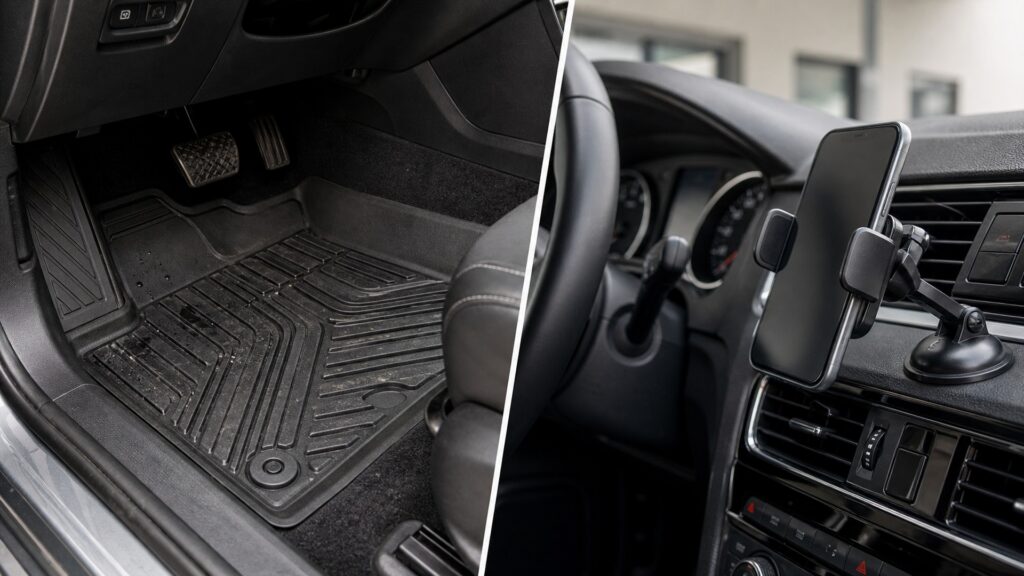
The comparison follows inputs, attachment forces, safety envelopes, evidence, failure, and maintenance.
Tip: A product that stays put still succeeds only if its location and released load remain safe.
These definitions preserve the boundary between a distributed barrier and a discrete device holder.
A shaped surface that intercepts wear, solids, and liquid across an occupant floor area.
The gripping or supporting interface that locates a phone within a mount and resists release.
The dynamic separation between floor protection and the driver's full control and footwear envelope.
Any mount, phone, cable, or accessory area that blocks required forward, side, mirror, display, or control visibility.
Resistance to translation, rotation, peel, pullout, or release under the loads expected at an installed interface.
The new path, obstruction, distraction, spill, or loose object created when the product moves, breaks, or releases its load.
Tip: Name the load, mounting surface, and safety envelope for each.
A liner handles shoe pressure and dispersed material over an area. A mount supports phone mass plus concentrated touch and inertial loads at a bracket, adhesive, vent, cup holder, or other attachment.
Load form determines attachment geometry and the harm created by failure.
Floor systems use contour, backing, and positive anchors against heel forces. Phone systems combine a vehicle attachment, arm or joint, cradle, magnet or clamp, and sometimes a cable under vibration and temperature.
Retention is only as strong as the weakest interface in its chain.
The driver floor requires full pedal travel and unimpeded foot transitions. Device placement requires visibility, reach, cable routing, control access, and airbag-deployment separation under the exact seating position.
Cabin location is part of function because movement can invade a critical path.
A floor trial checks debris, liquid, anchors, removal, and carpet condition. A mount trial checks device insertion, hold, adjustment, screen stability, touch force, cable strain, visibility, and release without unsafe reach.
A stable accessory must also produce the intended information or protection outcome.
Clean liners without slippery residue, then restore anchors and pedal clearance. Clean mount pads, clamps, magnets, joints, cases, and cables; inspect heat-softened adhesives, loose pivots, worn grips, and vent damage.
Maintenance restores holding capacity without moving either product into a new hazard zone.
A firmly attached mat can still contact a pedal, and a firmly attached phone can still block a view, airbag, control, or safe reach path.
The barrier contains representative material while staying anchored and clear of controls.
Loaded removal leaves the carpet dry and the protector reinstallable.
The phone stays readable and retained without unsafe reach or obstruction.
The device and cable remain controlled if a joint, cradle, or attachment releases.
These myths confuse one kind of secure attachment with complete cabin safety.
Magnetic hold addresses only one interface. Placement can still block vision, displays, controls, airbags, vents, or safe reach, while the vehicle attachment, arm, case, cable, and phone mass create additional failure points.
A displaced liner can alter pedal use, seating posture, or the driver's urgency and attention, while loose cables or a dropped phone can enter the footwell. Combined cabin failures can therefore interact across categories.
Parking omits vibration, braking, cornering, temperature, touch force, repeated entry, footwear loading, cable pull, and material aging. Test likely forces safely and inspect the installed interfaces again after representative driving.
A glossy treatment may reduce shoe traction on a floor surface, while solvents can weaken adhesives, coatings, cases, or grip pads on a mount. Follow separate material guidance and remove residue before retesting.
Tip: Test the load and hazard envelope unique to each product.
These answers clarify placement, testing, combined use, cleaning, and replacement.
Secure one intended layer, operate all pedals fully, apply representative foot motion and contamination, inspect containment and movement, remove the load without spilling, check underlying carpet, reinstall, and repeat the complete pedal-clearance check.
With the normal seat position and device, verify forward and side visibility, airbag and control clearance, insertion, adjustment, screen stability, cable routing, touch force, release, vibration, heat behavior, and recovery if the phone falls.
A tall or flexible arm and its cable can enter shifting, reach, or foot paths, while the base may obstruct controls or storage. Test seat positions, passenger movement, cable slack, emergency access, and liner removal together.
Remove a liner that shifts, curls, cracks, leaks, slips, or loses anchors. Remove a mount with weakened attachment, loose joints, damaged cradle, unstable display, unsafe obstruction, heat-degraded adhesive, cable damage, or repeated device release.
Keep the phone and cable out of footwells, preserve pedal and sightline envelopes, avoid shared pressure on trim or vents, test each accessory alone, then repeat entries, driving loads, adjustment, removal, and cleaning with both installed.
Floor barriers and phone holders control different loads.
Evaluate distributed contamination and pedal clearance separately from device grip, visibility, reach, airbags, and release. Combined use succeeds only when neither accessory or its failed load can enter the other's safety envelope.
These explainers deepen the footwell mechanism and the broader accessory boundaries surrounding it.
Follow wear, contamination, retention, containment, and cleanout through the floor barrier.
Verify vehicle contour, anchors, pedals, seats, vents, trim, and removal paths.
Place phone mounts and floor coverings within the whole cabin system of controls, visibility, occupants, and trim.
Choose a retailer
Prices checked regularly. We may earn a commission at no cost to you.