
Gooseneck Ball
A bed-mounted spherical coupling that carries vertical and pulling forces through a matching trailer socket.
- Its compact interface preserves bed space
- Ball size and rating must match
- Lubrication follows coupler instructions
Gooseneck and fifth-wheel hitches both move the coupling point forward of a pickup's rear bumper, usually near the rear axle. A gooseneck trailer drops a socket onto a bed-mounted ball; a fifth-wheel trailer inserts a horizontal kingpin into locking jaws beneath a broad hitch plate.
That interface changes the installation, inspection, and daily use. Gooseneck hardware can leave more bed floor available after removal and commonly serves equipment or livestock trailers. Fifth-wheel hardware occupies more bed space but provides a visible plate-and-jaw coupling used widely by large recreational trailers. Neither architecture adds payload or towing capacity. Truck structure, hitch rating, pin weight, axle loads, bed clearance, trailer brakes, and exact manufacturer approval govern both.
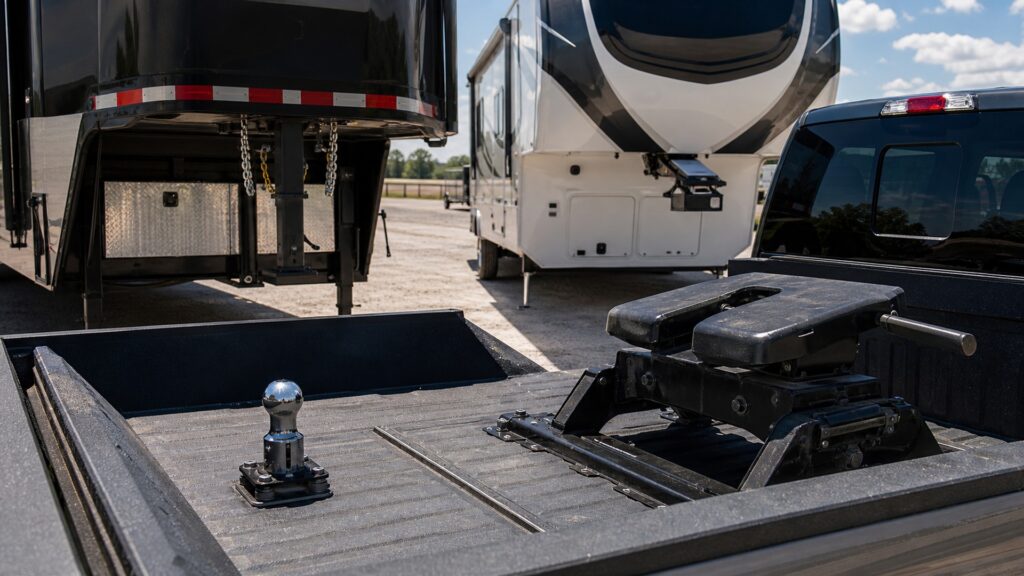
The meaningful difference is how vertical load, fore-aft force, articulation, and lock confirmation pass through the trailer neck, coupler, bed hardware, and truck frame.
Tip: Before buying an adapter, inspect the trailer maker's approval. Moving load through a different coupler or lever arm can change frame stress, clearance, warranty, and braking connections even when the truck rating looks adequate.
These terms locate the mechanical differences at the coupling and truck bed.
A bed-mounted spherical coupling that carries vertical and pulling forces through a matching trailer socket.
A vertical steel pin projecting below the trailer plate and captured by hitch jaws.
The broad fifth-wheel surface supporting trailer plate load while permitting yaw articulation.
The loaded vertical force applied by the trailer at the in-bed coupling point.
Frame-mounted brackets or crossmembers transferring hitch forces beneath the pickup bed.
Space allowing truck and trailer to pitch, roll, and yaw without striking cab, bed rails, tailgate, or hardware.
Tip: Treat every adapter, rail, ball, jaw, plate, and under-bed bracket as a rated link in one installation.
The gooseneck operator lowers a coupler over the ball and secures its latch. The fifth-wheel operator backs the plate beneath the trailer plate so the kingpin passes into jaws. Each needs a visual and physical lock check before load leaves the landing gear.
A closed handle is not proof that the load-bearing surfaces engaged correctly.
A turnover or removable gooseneck ball can leave a flatter bed, while fifth-wheel rails or pucks support a heavier plate-and-jaw assembly. Removal weight, stored components, bed holes, grease, cargo interference, and reinstallation checks affect real utility.
The emptier-looking bed can still contain structural brackets and rated attachment requirements.
Fifth-wheel plate contact spreads vertical support across a broad sliding surface; a gooseneck ball concentrates articulation at a spherical joint. Trailer structure, suspension, pin box, hitch play, lubrication, truck wheelbase, and load dominate ride more than labels alone.
A smoother claim without the exact truck-trailer combination is incomplete.
The coupling may sit near the axle, but the trailer nose sweeps toward the cab and its lower structure approaches bed rails on grades. Short-bed sliders, offset balls, and adapters alter geometry and require explicit approval.
A parking-lot turn does not prove clearance at a campsite crest.
Goosenecks are common on livestock, flatbed, and equipment trailers; fifth-wheels dominate many large RVs. Availability does not establish suitability: the trailer frame, truck preparation, payload, coupling instructions, brakes, breakaway, and local rules decide.
The correct hitch begins with the trailer design, not a preference for bed space.
Both relocate coupling forces but remain bounded by truck payload, axles, tires, structure, hitch components, trailer ratings, and measured pin weight.
The approved trailer uses a ball coupler, work frequently needs a clear pickup bed, and the vehicle-specific under-bed system meets load, clearance, chain, and installation requirements.
Loaded pin and axle weights remain within every limit, and the operator can verify the compact latch despite mud, cargo, lighting, or limited sightlines.
The trailer is engineered around a kingpin and plate, coupling visibility and RV-specific ride options matter, and the truck can carry the larger removable hitch assembly plus pin weight.
Neither choice corrects insufficient payload, cab contact, weak brakes, unstable cargo, wrong trailer attitude, damaged frames, unapproved adapters, or missing breakaway and electrical connections.
Hitch myths assign universal ride or capacity advantages to the visible coupler while ignoring trailer structure and measured loads.
Some gooseneck systems carry high ratings, but truck payload, axle, GCWR, hitch, ball, coupler, trailer, tire, and legal limits still govern. Coupler style alone cannot raise the lowest applicable rating.
Locating load near the rear axle can improve combination geometry, but poor loading, tires, speed, wind, suspension, or steering can still create instability. Hitch type never replaces correct pin weight and cargo placement.
An adapter changes coupler height, leverage, clearance, and frame loading. Use one only when truck, hitch, adapter, and trailer manufacturers explicitly approve the exact configuration and every resulting rating and instruction remains satisfied.
Removable hardware may clear the cargo floor, but under-bed brackets, pucks, holes, safety-chain anchors, fasteners, and bed deformation remain part of the installation and require inspection before the hitch returns.
Tip: Compare approved installations and the complete connection sequence before treating bed space or marketing familiarity as the deciding fact.
These answers address bed use, ride, short-bed trucks, safety chains, coupling checks, and the limits of converting a trailer from one architecture to the other.
A removable gooseneck ball usually leaves the least obstruction, although turnover sockets and chain anchors remain. Some fifth-wheel puck systems also remove cleanly, but the hitch assembly is larger and requires safe lifting and storage.
There is no universal winner. Hitch play, pin box or coupler design, trailer frame, suspension, tires, truck wheelbase, load distribution, road inputs, and approved cushioning determine fore-aft impacts, pitch, and transmitted vibration.
Only with verified cab and bed clearance. Approved sliders, rotating pin boxes, or offset components may help specific combinations, but they also change geometry and procedures. Measure dynamic clearance and follow every manufacturer involved.
Requirements vary by jurisdiction and equipment, but many gooseneck systems use rated chains attached to dedicated anchors. Follow applicable law and all hitch and trailer instructions; fifth-wheel secondary-connection rules can differ.
Inspect full ball-and-socket or kingpin-and-jaw engagement, secure every latch and pin, connect electrical, breakaway, and required chains, raise landing gear, then perform the specified tug or lift test before entering traffic.
Gooseneck hitches use a compact bed ball and trailer socket; fifth-wheel hitches use a kingpin, locking jaws, and broad support plate, creating different coupling, clearance, bed-use, and inspection routines.
Choose the architecture the trailer and truck explicitly support, then verify pin weight, axles, structure, articulation, brakes, locks, and every rated component; neither interface creates towing capacity or makes an adapter automatically safe.
Related explainers connect in-bed geometry to the complete towing combination, capacity limits, and the safety systems that must survive separation or connection error.
Build the truck's complete payload, axle, GCWR, hitch, tire, and performance envelope before comparing coupling styles.
Place either hitch inside measured loading, braking, cargo restraint, lights, chains, breakaway, and departure checks.
Verify chains, breakaway, lighting, locks, jacks, tires, and emergency hardware for the exact connection.
Choose a retailer
Prices checked regularly. We may earn a commission at no cost to you.