
Towing Capacity
The manufacturer-stated maximum trailer weight for a defined vehicle configuration and operating assumptions.
- Configuration can change the value
- Other limits can bind first
- Actual trailer weight includes cargo and fluids
Towing capacity is a boundary for a specific configuration under stated assumptions, not the amount any trailer can be attached to any version of a model. Drivetrain, cooling, brakes, hitch, body, options, passengers, and cargo can change the applicable rating.
Towing loads several limits at once. Tongue or pin weight consumes payload and shifts axle loads; the hitch has its own rating; combined weight must remain below GCWR; tires and wheels carry their measured shares. A trailer can sit below the advertised maximum while the truck is over rear GAWR or payload. Use exact equipment data, load for travel, obtain axle weights, and keep performance margin for heat, grade, altitude, wind, and stopping.
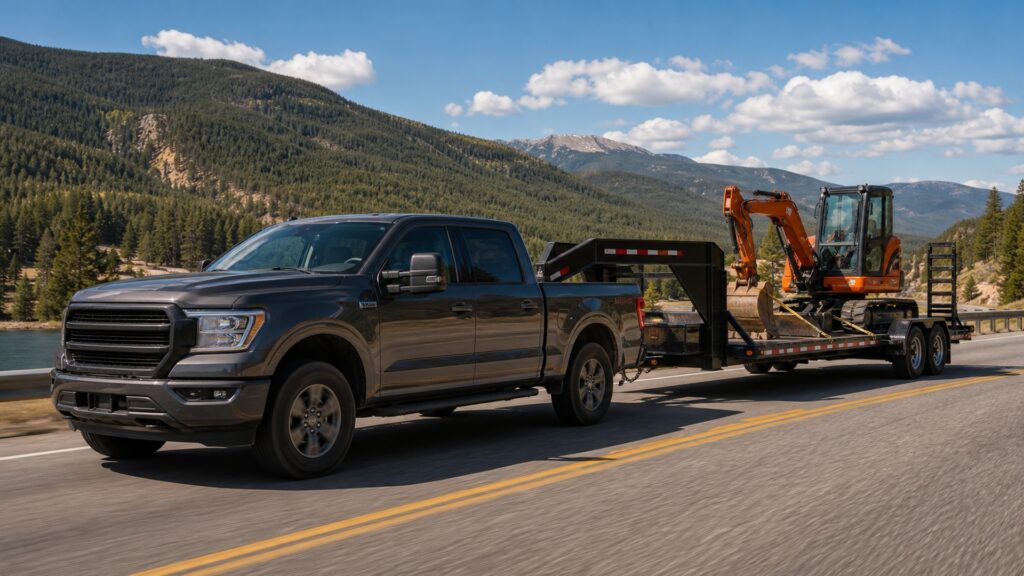
List each applicable vehicle, axle, hitch, tire, trailer, and combination rating beside the measured travel weight it governs.
Tip: Create a one-page scale worksheet. If a value cannot be traced to the certification label, owner's information, hitch marking, tire data, trailer plate, or scale ticket, it is not ready to support the towing decision.
These terms prevent payload, trailer weight, and combined capacity from being added or substituted incorrectly.
The manufacturer-stated maximum trailer weight for a defined vehicle configuration and operating assumptions.
Maximum permitted combined weight of loaded tow vehicle and loaded trailer for the specified configuration.
Maximum permitted loaded weight of the tow vehicle itself.
Maximum load permitted on a specified front or rear axle system.
Allowable combined weight of occupants, cargo, accessories, hitch hardware, and vertical trailer load within the vehicle.
Projected area presented by trailer and load to airflow, affecting drag and power demand.
Tip: Ratings are upper boundaries, not targets or transferable capacity between components.
Two visually similar trucks can carry different tow, payload, axle, tire, and hitch limits. Factory tow packages may add cooling, wiring, brake integration, alternator capacity, mirrors, suspension, gearing, or structural preparation.
The correct number belongs to one built vehicle, not the advertising nameplate.
Conventional tongue weight and fifth-wheel pin weight sit on the tow vehicle. Passengers, tools, bed covers, fuel additions, auxiliary tanks, and hitch assemblies consume the same payload and can push the rear axle over GAWR.
A lighter trailer does not guarantee available payload if its vertical load is high.
The vehicle tow rating cannot raise a lower receiver, ball mount, ball, coupler, safety-chain anchor, trailer GVWR, axle, tire, or wheel rating. Extensions and adapters can reduce capacity or change leverage.
The combination stops at the lowest applicable limit.
Within ratings, a tall trailer climbing in heat can stress cooling, transmission, brakes, and tires far more than a light flatbed on level roads. Downhill energy, not engine pull, can become the controlling problem.
Legal weight does not guarantee comfortable or repeatable performance in every environment.
Weigh the loaded truck alone and the connected combination, obtaining front, rear, and trailer axle groups. Compare actual values with GVWR, GAWR, GCWR, payload, hitch, trailer, tire, and wheel limits while keeping stable cargo distribution.
Measured distribution is the final authority on how the load reached each axle.
Payload, axle, combined, hitch, tire, trailer, and performance limits can become controlling long before the advertised maximum.
The exact vehicle configuration and all installed components are documented, the loaded truck and trailer have axle-scale evidence, and every rating retains meaningful margin.
Tongue or pin weight supports stability without exceeding payload or rear GAWR, while brakes, cooling, tires, mirrors, controller, hitch mode, and route demands match the duty.
Staying under one tow number cannot establish stable cargo distribution, sufficient braking, good tires, acceptable sway, driver experience, cooling performance, legal equipment, safe wind exposure, or suitable hitch geometry.
A weight-distribution hitch, suspension helper, programmer, bigger tires, lower gear, or aftermarket receiver cannot increase manufacturer GVWR, GAWR, GCWR, payload, or the lowest component rating.
Capacity myths convert a multidimensional rating system into one trailer-weight comparison.
Tow rating limits trailer weight under defined conditions; payload limits weight carried by the tow vehicle, including occupants, cargo, hitch equipment, and vertical trailer load. Either one can be exhausted first.
Packages vary and may be only one prerequisite. Cab, bed, wheelbase, drive type, axle ratio, engine, tires, options, and GVWR determine the exact rating. Verify build data rather than package terminology.
Spring bars redistribute axle effects but cannot increase GVWR, GAWR, GCWR, payload, receiver attachment, tires, wheels, brakes, or manufacturer towing capacity. Scale results must remain under every original boundary afterward.
Acceleration proves little about payload, axle overload, emergency braking, cooling on grades, tire heat, crosswind stability, or long descents. Ratings and scales address conditions that a short flat test cannot reproduce.
Tip: Keep each rating beside the exact measured object it governs so unused capacity in one column never hides an overload in another.
These answers cover VIN-specific research, payload labels, scale passes, tongue-weight estimates, tow packages, and why terrain and trailer shape matter after every weight number passes.
Use the owner's information and manufacturer towing guide for the exact model year, engine, drivetrain, axle ratio, wheelbase, body, and equipment. Confirm certification labels, receiver markings, and any VIN-specific lookup or dealer documentation.
Start with the vehicle's configuration-specific payload information or measured available difference to GVWR, then subtract occupants, cargo, accessories, hitch hardware, and actual vertical trailer load. Confirm front and rear axle limits separately.
Weigh the tow vehicle in travel trim and the connected loaded combination, recording front axle, rear axle, trailer axle groups, and totals. Additional passes can isolate tongue load or weight-distribution effects when performed consistently.
It is only an early reference. Options, batteries, propane, water, fuel, cargo, tools, food, and dealer accessories increase actual weight and change tongue or pin load. Final decisions require travel-ready measurements.
Aerodynamic drag rises strongly with speed and exposed area. Tall or wide trailers can increase engine, transmission, cooling, fuel, and stability demands even when scale weight is modest, particularly in headwinds and crosswinds.
Towing capacity matters because a trailer must fit a stack of configuration-specific vehicle, payload, axle, combined, hitch, tire, wheel, and trailer limits—not one advertised maximum.
Identify the exact build, measure the travel-ready combination by axle, preserve stable tongue or pin weight, and plan for grade, heat, wind, braking, and frontal area; easy acceleration never proves the complete envelope.
Related explainers apply the limit stack to the full towing system, hitch selection, and trailer safety equipment.
Assemble ratings, loads, brakes, cargo restraint, lights, tires, chains, and departure checks into one articulated system.
Choose weight carrying or distributing only after capacity and axle effects are measured.
Verify the equipment that prevents separation, warns traffic, applies breakaway brakes, and supports roadside inspection.
Choose a retailer
Prices checked regularly. We may earn a commission at no cost to you.