
Position Estimate
A receiver's calculated location, velocity, time, and uncertainty based on satellite measurements and models.
- It can be degraded
- It contains no street names
- Map matching interprets it
A GPS navigation device turns radio timing and map data into an estimated road position, a calculated path, and a sequence of maneuvers. Its central question is where the vehicle is relative to a destination and what instruction should come next under the selected routing model.
A car audio system answers a different question: which sound source should be heard, how should it be decoded and processed, and how will electrical power become acoustic output at the speakers? Navigation may send spoken prompts into that audio chain, and an in-dash receiver may house both systems. The prompt handoff is real, but the upstream transformations and failure evidence remain distinct.
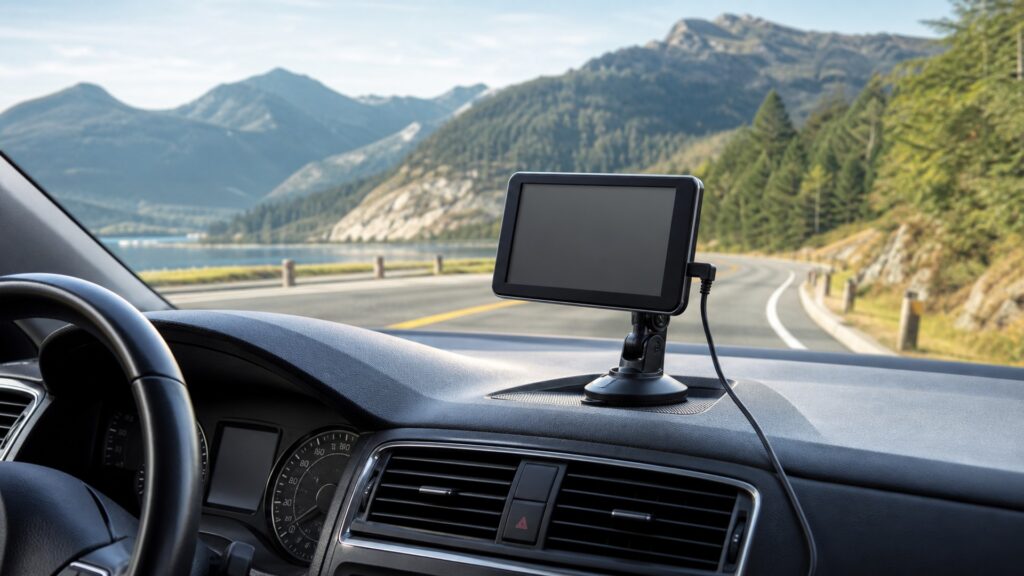
The comparison follows inputs, transformations, outputs, time behavior, controls, and failure proof instead of treating every dashboard screen as one technology.
Tip: Ask whether the required result is a route decision or an acoustic waveform. That distinction identifies the controlling chain even inside one enclosure.
These definitions identify the navigation and audio artifacts that meet only at a controlled prompt interface.
A receiver's calculated location, velocity, time, and uncertainty based on satellite measurements and models.
A search through mapped road connections using destination, restrictions, avoidances, profile, and cost preferences.
A route-derived instruction associated with a place, direction, timing window, and presentation priority.
A radio, file, stream, phone, microphone, prompt generator, or other input selected for reproduction.
The circuit that increases an audio signal's power so a compatible speaker load can produce useful sound.
The interface where a navigation system supplies a scheduled spoken instruction or alert to an audio playback path.
Tip: Keep the calculated maneuver and its cabin reproduction as separate test objects.
Navigation begins with satellite measurements, destination input, map attributes, and optional traffic or vehicle-profile data. Audio begins with a selected program such as radio, media, a call, or the navigation prompt handed across the interface.
The two systems can share controls while consuming fundamentally different input evidence.
Navigation solves position, infers a road, evaluates a graph, and schedules actions. Audio decodes content, sets level, routes channels, filters or delays signals, and prepares them for power amplification. One transformation produces guidance; the other shapes a waveform.
A correct maneuver can sound poor, and excellent sound can deliver a wrong maneuver clearly.
A navigation device succeeds when it presents a timely, understandable next action tied to a plausible route position. A car audio system succeeds when the chosen program reaches intended speakers at useful level and quality without objectionable noise or distortion.
The shared moment at the driver's ear does not combine the underlying acceptance criteria.
Navigation continuously updates position, progress, upcoming maneuvers, and route departure. Audio follows samples and control changes with tight continuity. Route recalculation tolerates a different time scale than dropouts, clipping, latency, or synchronization in reproduced sound.
Different clocks and state changes produce different fault signatures.
An integrated unit can render maps, compute routes, decode media, control amplification, and schedule navigation speech. Its priority manager may lower music for a prompt, but navigation, audio, vehicle integration, and display layers still need independent diagnosis.
Integration adds interfaces; it does not remove functional boundaries.
The words and timing originate with the route state, while intelligibility and cabin level depend on source routing, processing, amplification, and speakers.
The wrong road, destination, maneuver, timing, or recalculation appears visually and audibly.
Position status, maps, restrictions, or route settings point upstream.
The maneuver is correct on screen but speech is missing, distorted, too quiet, misrouted, or fails to duck media.
Other sources reveal the same channel, noise, amplifier, or speaker problem.
These myths assign every screen or spoken prompt to one system and hide the real failure boundary.
Navigation requires satellite measurement, position estimation, map matching, road-graph search, and maneuver logic. A stereo can reproduce its prompts, but source decoding, signal processing, amplification, and speakers do not perform those navigation transformations.
An audio system can reproduce an incorrect maneuver perfectly. Route validity depends on position, map data, destination, restrictions, traffic, and routing settings. Confirm the visual route and actual road conditions separately from speech quality.
The device may have a valid position and visible maneuver while prompt volume, mute state, wireless routing, priority, decoder, amplifier, or speaker output fails. Check the navigation event first, then follow the audio handoff.
The same chassis may contain radio, navigation, display, vehicle interfaces, audio processing, and amplification. Test a non-navigation audio source, the route visually, prompt handoff, channel output, and retained vehicle functions as distinct contracts.
Tip: Compare the calculated information with the reproduced sound.
These answers clarify offline use, spoken prompts, shared screens, upgrades, and how to isolate a fault.
Visual positioning and routing may continue if the navigation device has power, maps, and reception. Spoken prompts may be muted or unavailable when their audio path is off, depending on whether the device has its own speaker.
Navigation prompts may use a separate source path, level, channel, wireless profile, codec, or processing preset. Confirm the prompt event and settings, then trace its handoff rather than assuming the main media source proves every path.
Yes physically, and often at the software interface, but it still performs separate position, route, display, source, processing, amplification, and vehicle-integration functions. Combined packaging should make coordinated testing easier, not erase those boundaries.
Start with navigation: verify position quality, destination, map version, region, route preferences, vehicle profile, and restrictions. Audio hardware cannot correct road data or route logic, although it can improve how accurate spoken guidance is heard.
Confirm that a maneuver exists and is spoken in the device preview or internal speaker. Then inspect mute and prompt levels, wireless or wired routing, priority ducking, amplifier state, selected channels, and speaker output.
GPS navigation devices differ from car audio systems because they transform timed position and map information into route decisions, while audio systems transform selected programs into controlled acoustic output.
A spoken maneuver crosses both paths: navigation owns its content and schedule; audio owns its reproduction. Diagnose and accept those artifacts separately even when one receiver houses every component.
These explainers trace position-to-guidance operation, receiver audio transformation, and display presentation so shared interfaces can be tested without losing ownership.
Follow timed satellite measurements through position, map matching, route search, and maneuver scheduling.
Trace audio sources through decoding, control, processing, outputs, and vehicle interfaces.
See how display presentation differs from the car-audio chain when a shared touchscreen creates another apparent overlap.
Choose a retailer
Prices checked regularly. We may earn a commission at no cost to you.