
Combustion Initiation
The triggering of a self-propagating burn in a prepared air-fuel mixture at a controlled crank angle.
- Spark creates the initial kernel
- Mixture quality governs growth
- Timing shapes cylinder pressure
Ignition components prepare a brief electrical event inside a spark-ignition engine. Position signals and the control module time coil charging and discharge; secondary voltage crosses the plug gap; a flame kernel begins combustion that can produce crankshaft work. The system repeats across cylinders and operating conditions.
Brake components answer a different command. Pedal or automated input creates hydraulic or electromechanical force, friction torque opposes wheel rotation, and vehicle kinetic energy becomes heat while tires react against the road. Their shared status as replacement parts does not merge their hazards, tests, or release criteria. Misfire evidence belongs to combustion diagnosis; pedal, friction, and deceleration evidence belongs to braking.
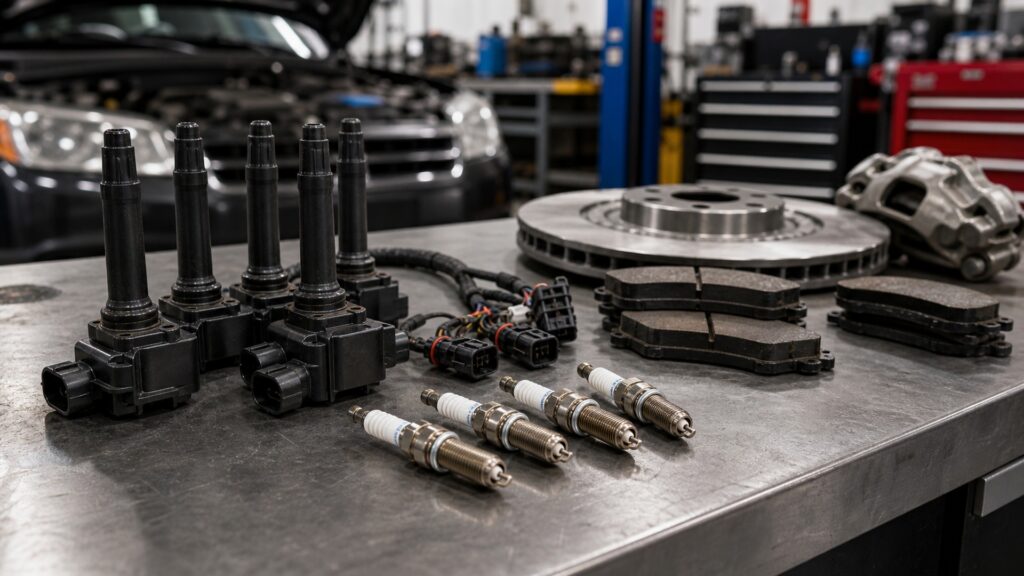
Ignition owns precisely timed combustion initiation; brakes own deceleration and restraint through force, friction, heat, and tire-road interaction.
Tip: If stopping behavior or pedal reserve is abnormal, control that road-safety hazard before using acceleration tests to investigate an ignition complaint.
These terms distinguish a millisecond cylinder event from a vehicle-level force response.
The triggering of a self-propagating burn in a prepared air-fuel mixture at a controlled crank angle.
High potential produced by ignition-coil field collapse and applied across the plug circuit.
The crank-angle command for ignition relative to piston position, speed, load, temperature, and knock margin.
Brake-fluid pressure carrying a pedal or actuator command through lines and hoses to wheel-end pistons.
Rotational resistance produced as pads or shoes press against rotors or drums at an effective radius.
A mechanical or electromechanical function intended to hold a stationary vehicle through designated brake hardware.
Tip: Do not let a shared warning visit combine the diagnoses; voltage problems can affect modules while mechanical brake or ignition faults still require independent proof.
Battery-supported primary current becomes coil magnetic energy, then a high-voltage pulse across the spark gap. The resulting flame releases fuel energy; ignition itself does not provide the fuel or mechanical work.
Ignition opens the combustion event without carrying the vehicle's kinetic energy.
Master cylinders, boosters, valves, calipers, friction pairs, parking mechanisms, and tires build opposing torque. Mass, speed, grade, temperature, and traction define the demand on that chain.
Brakes manage vehicle motion rather than cylinder flame timing.
Ignition faults often appear by cylinder, engine load, heat, cranking, or moisture. Brake faults often follow pedal application, coasting after release, wheel rotation, repeated stops, or parking use.
When the symptom occurs is often the cleanest boundary between the systems.
Plugs and coils must operate near combustion and underhood heat without insulation or electrode failure. Brakes intentionally generate large heat loads that rotors, drums, fluid, and airflow must absorb and dissipate.
Both face heat, but only brakes routinely create it as their primary energy-conversion output.
Ignition repair uses synchronization, current, misfire, timing, codes, and load behavior. Brake repair uses pedal reserve, leakage, dimensions, torque, warnings, release, bedding, and controlled stopping.
A smooth idle cannot release brake work, and a straight stop cannot prove spark energy.
Ignition creates a timed combustion trigger, while brakes create vehicle-level deceleration and restraint through force and friction.
Position and timing data, coil current and dwell, secondary insulation, plug specification and gap, cylinder misfire behavior, combustion inputs, and load-dependent confirmation.
A causal link between spark generation or delivery and the failed combustion event after fuel, air, compression, wiring, and control alternatives are tested.
Pedal response, hydraulic containment, friction dimensions, hardware movement, wheel-end temperature, parking restraint, chassis faults, tires, and repeatable deceleration behavior.
Neither category is justified by a generic warning, noise, vibration, age, or maintenance schedule when the responsible event and measured failed output remain unidentified.
The systems meet only indirectly through shared electrical supply, vehicle controls, and the driver's operating environment.
Ignition timing can affect engine output and engine braking, but service brakes create the commanded wheel torque for normal stopping. A weak spark cannot substitute for hydraulic integrity, friction reserve, tires, or parking restraint.
Dragging calipers or parking hardware can remain applied after pedal release, causing heat, sluggish acceleration, and increased consumption. Event timing, wheel temperature, free rotation, and friction inspection distinguish drag from ignition misfire.
Controllers report monitored conditions and may share voltage or network dependencies. Read codes and live data, test the physical function, and confirm causation before selecting plugs, coils, pads, sensors, or hydraulic parts.
Ignition diagnosis may require controlled engine load while brake verification requires safe low-speed pedal and deceleration checks before greater demand. Each test has distinct hazards, instruments, limits, and abort conditions.
Tip: Keep the central ideas in one home: ignition explains combustion initiation; brakes explain deceleration and holding.
These answers cover overlapping symptoms, shared electrical supply, hybrid vehicles, and cases where both systems require attention.
Yes. Weak supply can reduce coil charging and disturb chassis modules, but it does not prove plugs, coils, hydraulic hardware, or friction parts failed. Stabilize voltage, retrieve data, then test each system.
Both can reduce acceleration, but misfire often changes engine sound, cylinder data, and exhaust behavior, while drag produces wheel heat and reduced coast. Compare engine and wheel evidence without prolonged unsafe driving.
Battery-electric propulsion has no spark-ignition engine, so it uses neither spark plugs nor ignition coils. Hybrids with gasoline engines retain an ignition system, while all road vehicles still require braking and restraint systems.
Address the condition with the highest immediate consequence: unsafe braking, fuel leakage, severe catalyst-heating misfire, electrical arcing, or loss of control can all halt operation. Then preserve evidence for separate diagnosis.
List separate complaints, tests, measurements, parts, torque values, codes, fluid work, spark findings, brake dimensions, final engine behavior, final stopping checks, and unresolved limits. Do not merge two release decisions.
Ignition components initiate combustion through timed high-voltage discharge; brake components create deceleration and parking restraint through force, friction, heat, and tire-road reaction.
Use cylinder and spark evidence for ignition, and pedal, hydraulic, friction, and stopping evidence for brakes. Verify both independently whenever one service visit includes the two systems.
Related explainers map the complete ignition chain, the complete brake chain, and the diagnostic boundaries that prevent overlapping symptoms from becoming noun-swapped repairs.
Follow crank position, dwell, coil field collapse, plug-gap breakdown, and flame-kernel formation.
Follow pedal input, hydraulic pressure, friction torque, heat rejection, and tire-road force.
Use codes and live data to direct tests rather than name replacement parts.
Choose a retailer
Prices checked regularly. We may earn a commission at no cost to you.