
State of Charge
An estimate of chemical energy presently available within a rechargeable battery's managed operating range.
- Resting voltage needs stabilization
- Temperature changes interpretation
- Charging history affects readings
A vehicle battery is an electrical source and buffer. In a gasoline vehicle it supports the starter, modules, accessories, and coil primary circuits, while the charging system restores energy after starting. State of charge, internal resistance, temperature, connections, and load determine its delivered voltage and current.
Ignition components use a small, timed portion of that supply to initiate combustion. The controller charges a coil, interrupts primary current, creates a secondary pulse, and directs the discharge through a plug gap at a selected crank angle. A weak battery can reduce ignition margin during cranking, but slow cranking does not prove a coil fault, and a load-dependent misfire does not prove the battery failed. Test source and timed converter separately.
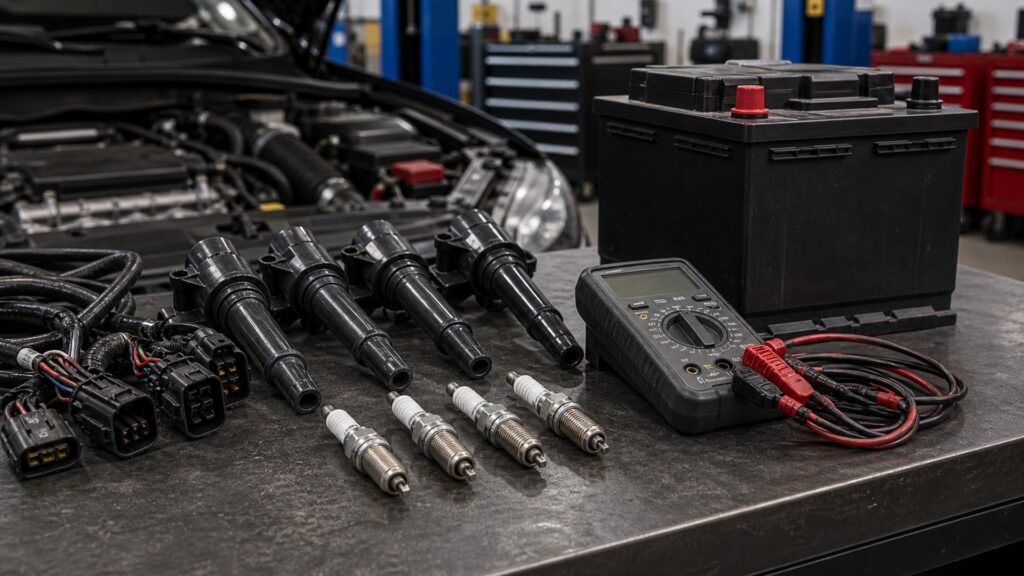
The battery establishes available low-voltage supply; ignition components transform, time, insulate, and discharge energy for one cylinder event at a time.
Tip: Perform battery tests before repeated cranking erases the original state of charge or heat and catalyst risk change the ignition symptom.
These terms distinguish energy availability from the ignition event that consumes a controlled share of it.
An estimate of chemical energy presently available within a rechargeable battery's managed operating range.
Battery-terminal voltage while the starter and vehicle electronics draw current to rotate and start the engine.
Opposition within the battery that causes voltage loss and heat as load current increases.
The low-voltage winding, switching device, supply, ground, and connections used to build ignition magnetic energy.
The high-voltage event induced after primary switching and delivered through coil insulation and the spark-plug path.
The difference in electrical potential across cables, terminals, switches, grounds, or connections while current flows.
Tip: Use simultaneous voltage and ignition data when possible; separating the tests in time can hide a supply sag that exists only during cranking.
During cranking, starter demand can be hundreds of times greater than one coil event. Battery condition and cable resistance determine whether modules remain awake and coils receive enough primary voltage while the engine turns.
The battery is a shared supply whose weakness can disturb many systems at once.
The controller charges individual or shared coils for milliseconds according to engine position and voltage compensation. Inductance and resistance shape current; switching releases energy into a high-voltage secondary circuit.
Ignition is a timed load and transformer, not an energy reservoir for the vehicle.
Battery weakness often appears during starting, accessory reserve, repeated resets, or charge recovery. Ignition faults may emerge after starting by cylinder, heat, moisture, engine load, gap demand, or dwell behavior.
The stage of operation that fails provides the first diagnostic boundary.
Low temperature can reduce battery delivery while thick oil increases starter load. Underhood heat accelerates battery degradation in some locations and increases coil winding and insulation stress during prolonged operation.
Shared temperature exposure does not make the components electrically interchangeable.
A good diagnosis records battery voltage, cable drops, cranking speed, module operation, coil current, synchronization, and misfire behavior together. This reveals whether ignition failure originates inside the coil path or upstream supply.
Interaction is real, but the repair still belongs to the component that failed its own test.
One stores and distributes low-voltage energy, while the other turns controlled primary-current pulses into cylinder-specific high-voltage discharge.
State of charge, load response, cranking voltage, internal resistance, reserve, temperature, terminal condition, cable voltage drop, starter context, and charging-system performance.
A shared low-voltage weakness that appears across starting or module behavior and remains present before ignition-specific conclusions are drawn.
Primary current and dwell, coil command, secondary insulation, plug gap and fitment, crank synchronization, cylinder-specific misfire, spark demand, timing, and stable combustion under representative load.
Neither category should be chosen solely from a no-start, warning lamp, age, visual corrosion, or code when starter, fuel, air, compression, wiring, grounds, modules, and mechanical condition remain untested.
Electrical proximity encourages shotgun replacement of a battery and coils whenever starting or misfire behavior feels inconsistent.
The battery supplies low-voltage primary energy. Coil inductance, winding ratio, and rapid switching produce the secondary pulse, while the plug gap sets breakdown demand. Battery condition influences margin without replacing the ignition mechanism.
The charging system may support operation after a marginal start, while the battery still lacks reserve or has elevated internal resistance. Test state, load response, connections, cranking behavior, and charging rather than relying on one start.
Ignition coils do not drive the starter motor. Diagnose battery delivery, cable drops, starter current, mechanical resistance, oil viscosity, and control authorization before replacing timed spark components for a low cranking-speed complaint.
Stable supply can resolve voltage-related faults, but plug wear, coil insulation, injector problems, vacuum leaks, compression, valve timing, fuel pressure, sensors, and catalyst issues can continue. Recheck cylinder data after electrical stabilization.
Tip: Test the shared supply first, then isolate timed ignition function so one weak connection does not masquerade as several component failures.
These answers address cranking, charging, voltage compensation, intermittent misfire, hybrids, and how to test interactions without replacing both systems.
Yes. Reduced primary supply can slow coil-current buildup while starter demand and module thresholds compete for voltage. Measure battery terminals, cable drops, cranking speed, coil current, and synchronization during the same event.
A shorted primary circuit or driver fault can draw abnormal current, but ordinary coil failure does not automatically create key-off drain. Measure parasitic current, circuit protection, command state, and coil behavior before connecting the symptoms.
Controllers may extend dwell when supply falls so primary current can reach the intended energy, then limit current to prevent overheating. Compensation has boundaries; weak batteries, connections, coils, or drivers can exceed them.
Many hybrids use a low-voltage battery for modules and contactor control, a high-voltage traction battery for propulsion, and ignition coils for the gasoline engine. Each energy path has distinct isolation, testing, and service rules.
Identify architecture, preserve codes, test battery state and loaded voltage, measure cable drops and cranking speed, verify coil power and dwell, examine cylinder misfire and spark evidence, then confirm fuel, compression, timing, and repair outcome.
Vehicle batteries store and supply low-voltage energy; ignition components meter that supply into timed magnetic charging and high-voltage spark events.
Test battery delivery and connection under load, then test coil charge, secondary containment, plug discharge, and timing during the same cranking or running event. Repair the component that fails its own evidence.
Related explainers connect the ignition mechanism, its operating margin, and whole-engine context so battery sag and cylinder misfire can be separated without parts-cannon diagnosis.
Trace how low-voltage primary supply becomes timed high-voltage discharge and combustion initiation.
Interpret dwell compensation, current saturation, firing demand, spark duration, and chamber effects under changing supply voltage.
Place battery, starter, charging, ignition, fuel, air, compression, and controls within the engine system.
Choose a retailer
Prices checked regularly. We may earn a commission at no cost to you.