
NVH Isolation
Measures used to reduce noise, vibration, and harshness reaching occupants.
- Acoustic glass and seals reduce airborne noise
- Bushings and mounts filter structure-borne vibration
- Tires can dominate remaining road noise
Luxury and non-luxury autos are not separated by one mechanism. The distinction usually comes from many small choices in noise isolation, materials, seat design, control calibration, feature integration, appearance, service, and brand positioning.
Because upper trims of mainstream vehicles can overlap entry luxury models, the badge is only a starting hypothesis. Compare the exact cabin, ride, controls, equipment, warranty terms, repair access, and price. A feature list says what exists; execution determines whether it feels coherent or merely numerous. The comparison becomes useful only when each claimed refinement is experienced on the same route and weighed against its option and ownership consequences.
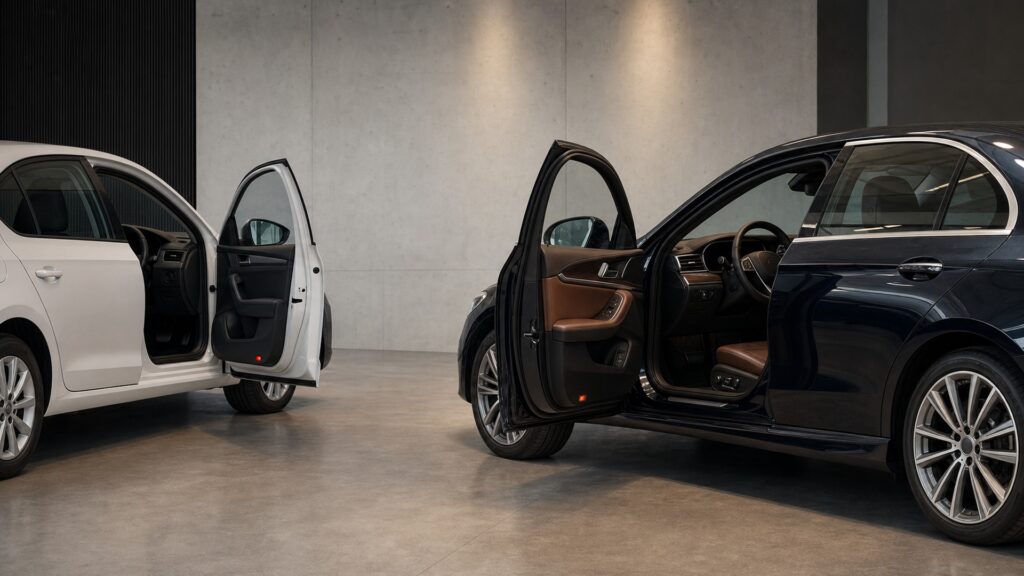
Look past the badge to execution across touch, sound, motion, controls, and support.
Tip: Use the same route and common tasks; familiarity reveals integration better than a showroom demonstration.
These terms identify the concrete experiences often compressed into the word luxury.
Measures used to reduce noise, vibration, and harshness reaching occupants.
A surface frequently seen, touched, or operated by occupants.
Software and hardware tuning shaping accelerator, transmission, steering, damping, and braking response.
How hardware, software, displays, controls, and alerts work together.
Geometry, support, adjustment, and space determining comfort for a particular occupant.
Warranty, service access, loaner policy, parts supply, and repair process surrounding the vehicle.
Tip: Name the exact improvement—quieter glass, better seat support, cleaner brake modulation, or faster controls—rather than calling the whole vehicle premium.
Quietness and ride polish emerge from body sealing, glass, mounts, bushings, damping, aerodynamics, and tires rather than one premium part.
Refinement is an accumulated system result.
A luxury design may integrate seats, climate, audio, lighting, displays, and driver assistance more deeply; poor menus or unstable software can erase the benefit.
Integration quality matters more than feature count.
Throttle mapping, shift strategy, steering effort, brake blending, and adaptive damping can make responses progressive and consistent.
Calibration is experienced through transitions.
Premium materials can improve touch, appearance, and isolation, but labels such as leather or wood say little about coverage, construction, aging, or repairability.
Material value depends on execution and endurance.
Mainstream upper trims may supply similar equipment, while entry luxury models may reserve features for options. Service experience, insurance, tires, depreciation, and repair complexity can widen the ownership difference.
The better fit depends on priorities, not category prestige.
Execution can differ meaningfully even when equipment lists overlap.
Isolation, calibration, seat design, materials, and integration can produce a consistently quieter and more polished experience.
Ownership support may add convenience when its terms and local delivery are strong.
Trim overlap means a mainstream vehicle can outperform an entry luxury model on a specific priority.
Prestige cannot guarantee fit, reliability, safety, durability, or value.
Luxury myths confuse price and prestige with measurable execution.
Brand position does not verify panel fit, software stability, material durability, or assembly consistency. Inspect the exact vehicle and use model-specific reliability and service evidence. Nvh isolation remains an important vehicle-specific boundary.
Feature count can add capability or friction. Clear controls, fast response, stable software, useful defaults, and low distraction determine whether technology feels integrated. Material touchpoint and Control Calibration remain important vehicle-specific boundaries in this case.
Upper mainstream trims may use effective insulation, supportive seats, and refined calibration. Compare on the same roads rather than inferring behavior from market category. Feature integration remains an important vehicle-specific boundary.
Purchase price, depreciation, insurance, tires, options, repairs, and service access vary. Prestige and retained value are not interchangeable across models or ownership periods. Trim overlap and panel fit remain important vehicle-specific boundaries in this case.
Tip: Replace “feels premium” with the specific sound, motion, surface, control, or service difference you can verify.
These questions separate market position from comfort, safety, technology, and ownership evidence.
No. Material type is one input. Coverage, grade, stitching, padding, seat geometry, cabin isolation, control behavior, and overall integration determine whether the experience is meaningfully different. Nvh isolation remains an important vehicle-specific boundary.
Hardware can share names while calibration, interface logic, sensor tuning, actuator quality, seat design, sealing, and acoustic treatment differ. The transitions between features often reveal the integration gap. That vehicle-specific boundary still matters.
Do not infer safety from price or badge. Compare model-year-specific NHTSA and IIHS results, standard equipment, tire condition, recalls, fit, visibility, and the exact configuration. Feature integration remains an important vehicle-specific boundary.
A larger wheel changes styling and tire geometry but can add mass, cost, and impact sensitivity. Ride and noise depend on the complete wheel, tire, suspension, and body system. That vehicle-specific boundary still matters.
Read warranty and maintenance terms, check local appointment access, loaner or pickup policies, parts availability, and exclusions. A national promise matters only if it is delivered where you live. That vehicle-specific boundary still matters.
Luxury autos differ most convincingly through the combined execution of isolation, calibration, materials, seating, feature integration, and ownership support—not through one badge or feature.
Compare exact trims on your roads and tasks, then price options, service, tires, insurance, and repair complexity; category prestige cannot substitute for fit.
Reliability, efficiency, and vehicle-system explainers help test whether added refinement aligns with long-term priorities.
Evaluate whether added complexity and equipment remain dependable rather than assuming a premium badge predicts reliability.
Measure the energy consequence of mass, tires, power, and accessories instead of treating luxury as an efficiency category.
Trace how suspension, powertrain, tires, structure, and control calibration create the responses often described as refined.
Choose a retailer
Prices checked regularly. We may earn a commission at no cost to you.