
Design Authority
The organization responsible for defining a component's requirements.
- The automaker controls the OEM service specification
- An independent maker controls its aftermarket design
- Both may rely on specialist factories
OEM and aftermarket parts differ first in who controls the service specification and sells the replacement, not in a universal good-versus-bad hierarchy. An OEM service part sits inside the vehicle maker's catalog, revision, procedure, and warranty system. An aftermarket part comes from an independent company that chooses how closely to reproduce or alter that function.
Those structures influence documentation, design freedom, availability, product variety, price, and recourse. They do not decide diagnosis or installation quality. A fair comparison identifies the exact manufacturer and line, checks the same vehicle application and functional ratings, includes required hardware and calibration, and prices the complete installed repair. Category labels become useful only after the function is defined.
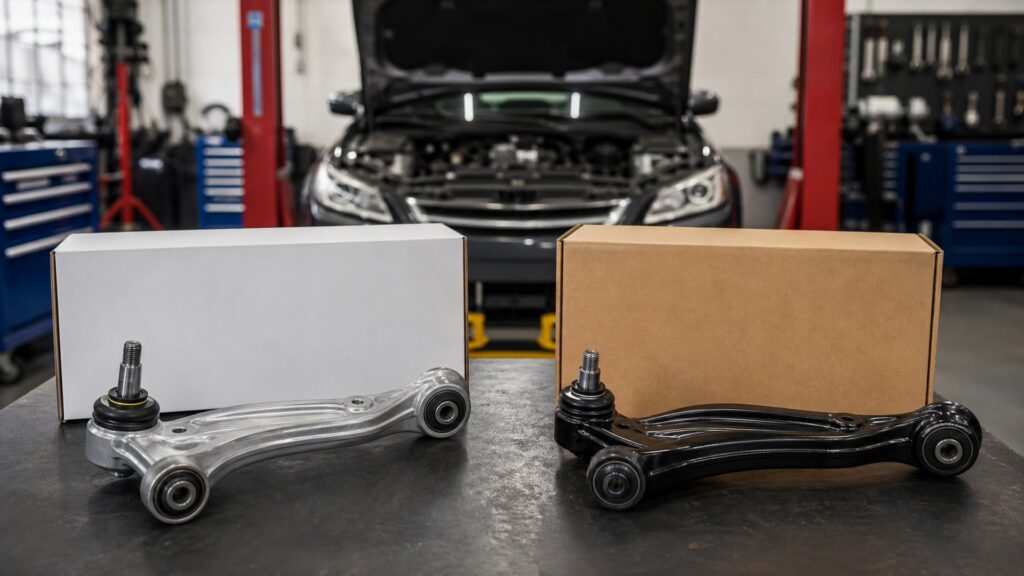
The practical difference lies in design authority, catalog control, product variation, distribution, and support—not in a blanket ranking of every component.
Tip: Put both candidates on one worksheet: maker, current number, application notes, materials, ratings, included hardware, procedure, warranty remedy, and total installed cost.
These six terms make the source comparison precise enough for an actual repair decision.
The organization responsible for defining a component's requirements.
Evidence that a part meets the needs of listed vehicle configurations.
An official replacement number succeeding an earlier service number.
A supplier's line targeting a cost, duty, or performance level.
Records showing maker, seller, part number, and transaction path.
What the seller or maker promises after a covered component failure.
Tip: Compare like functions before comparing prices; a bare component and a complete updated kit are not equivalent offers.
The vehicle maker can revise its service specification and map that revision through a VIN catalog. An aftermarket manufacturer interprets the required function, then chooses whether to reproduce, simplify, strengthen, or otherwise modify the design.
Different authority structures create different evidence questions, not automatic winners.
OEM catalogs typically present a current authorized service path. The aftermarket may offer economy, standard, severe-duty, repairable, lightweight, or performance lines for the same application, expanding choice while increasing the burden of matching grade to use.
More choice helps only when the decision criteria are explicit.
An OEM supersession follows the maker's controlled service-number chain. An aftermarket redesign follows an independent supplier's stated failure analysis and validation. Either may be valuable, but their evidence and installation notes come from different authorities.
A new-looking design deserves a mechanism and test story, regardless of source.
OEM parts move through authorized networks with defined catalog and claim systems. Aftermarket routes range from highly controlled distributors to anonymous marketplaces. Practical risk depends on traceability, seller competence, support, and the remedy's exclusions.
The supply path can matter as much as the brand printed on the component.
A less expensive part may require separate hardware, additional modification, uncertain calibration, or repeated labor. A costlier kit may include updates and support that reduce downtime. Total value appears only after the complete repair plan is priced.
The correct comparison is repair outcome per total cost and risk, not box price.
Both routes can restore function; their strongest differences concern control, variety, support, and evidence.
OEM sourcing can simplify revision-sensitive work by joining the current number, application notes, procedure, software, and claim route.
A documented aftermarket option can improve availability, price, serviceability, or duty-specific construction beyond the single OEM path.
Neither category proves the diagnosis, installer competence, calibration completion, or durability of the installed system.
Brand and price cannot replace checking the exact maker, product line, specification, vehicle split, seller, and warranty remedy.
Comparison myths usually replace a multidimensional choice with one source label.
OEM sourcing controls an authorized specification, but material choice varies by component and revision. A named aftermarket line may use similar, lower, or application-specific materials; compare measurable construction rather than assuming from channel.
Some alternatives reduce box price, while redesigned, severe-duty, or low-volume products can cost more. Hardware, shipping, programming, alignment, labor repetition, downtime, and warranty remedy determine the total installed difference in practice.
A supplier may build both products yet use different drawings, plants, materials, quality plans, or included hardware for separate customers. Confirm the exact product specification instead of inferring identity from corporate name.
FTC guidance says aftermarket or recycled parts do not automatically cancel warranty coverage. Damage caused by a defective part or installation can affect related claims, while free warranty remedies may specify the provider or part.
Tip: Ask which exact difference—specification, availability, construction, support, or total cost—matters to the repair.
These questions resolve common choices involving safety-critical parts, supplier identity, older vehicles, and mixed-source repairs.
Prioritize exact application, rated capacity, material and test evidence, traceable distribution, current procedure, installer competence, and usable recourse. An authorized OEM path can reduce ambiguity, but a documented independent supplier may also be appropriate.
Use manufacturer drawings or specifications, dimensions, weight, materials, coatings, connector and signal data, included hardware, catalog notes, country and plant markings, warranty issuer, and test documentation. Appearance alone proves little.
Trace supersessions, check authorized remanufactured or service-kit options, then evaluate documented aftermarket or used sources. Confirm fitment and procedure before disassembly, because scarce-part returns and vehicle downtime can dominate the decision.
Often, but each interface must remain compatible. Matched friction pairs, dampers on an axle, software-linked modules, fastener kits, seals, and calibrated sensors may have pairing requirements that outweigh source preference.
That depends on written parts, labor, shop, and vehicle warranties. Identify the seller, manufacturer, installer, claim procedure, exclusions, and causation evidence before purchase so responsibility does not become a surprise afterward.
OEM parts and aftermarket parts come from different specification, catalog, distribution, and support systems; either route can produce a suitable repair when its evidence matches the function.
Compare exact products and complete installed outcomes, then document diagnosis and verification. Source is a decision variable, not a substitute for engineering fit or workmanship.
The related explainers examine what OEM control contributes, what independent supply contributes, and how remanufacturing changes a separate new-versus-restored decision.
Examine the VIN, supersession, procedure, software, and traceability advantages of the OEM service channel.
See how independent suppliers add availability, competition, grades, and documented design alternatives.
Compare a restored core with a newly manufactured component, a distinction that cuts across supplier categories.
Choose a retailer
Prices checked regularly. We may earn a commission at no cost to you.