
OEM Service Part
A component distributed through the vehicle maker's authorized replacement channel.
- Matched through the maker's application catalog
- May differ from the assembly-line supplier package
- Carries source-specific warranty terms
An OEM replacement part matters when the repair depends on more than physical dimensions. The vehicle-maker service channel ties a current part number to a VIN application, engineering changes, installation instructions, software prerequisites, and a defined warranty process. That coordination can reduce ambiguity on complex or configuration-sensitive repairs.
The label still does not prove that diagnosis is correct, that every OEM-boxed component is unchanged from factory assembly, or that dealer sourcing is always the best value. Its practical advantage is controlled provenance and documentation. Buyers should compare that advantage with availability, price, supersession notes, and the consequences of choosing incorrectly.
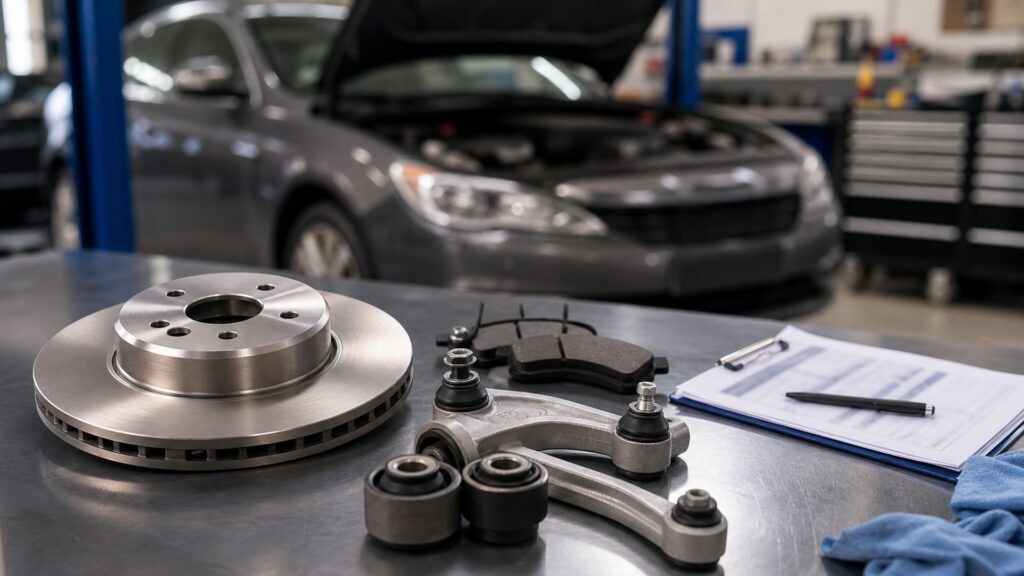
OEM value appears in the connection between vehicle identity, current specification, documented procedure, and accountable supply—not merely the logo on a carton.
Tip: Ask for the current part number and its supersession notes; an old number photographed on the failed component may no longer describe the complete repair.
These terms explain the information chain that can make an OEM source valuable on exacting repairs.
A component distributed through the vehicle maker's authorized replacement channel.
A catalog match using the vehicle identification number and encoded configuration.
A current service number that replaces an earlier number.
A revision to material, geometry, firmware, or production specification.
Software, coding, aiming, or relearn required for the installed part to function correctly.
Records connecting a component to its source, number, batch, and transaction.
Tip: Treat the catalog note, required procedure, and calibration instruction as part of the component; hardware alone may be incomplete.
The service catalog maps VIN, model year, engine, drivetrain, option codes, and production splits to a current number. Footnotes can add seals, fasteners, harnesses, or programming steps that a simple year-make-model lookup misses.
The useful product is the documented application, not just the object in the box.
A newer service number may consolidate suppliers, revise materials, or bundle hardware needed by an updated procedure. The change can be benign or consequential, so the correct response is to follow the catalog chain rather than guess from appearance.
A supersession is an instruction trail, not proof that every earlier part was defective.
Configuration-sensitive components may depend on a published sequence, single-use fasteners, fluid specification, module setup, security access, or sensor aiming. OEM documentation can align those requirements with the exact service number and vehicle revision.
Correct hardware can still fail when its installation context is omitted.
Authorized distribution creates a documented seller, transaction, part number, and claim route. That structure helps with suspected defects or wrong cataloging, but coverage remains governed by written terms, labor allowances, exclusions, and proof of installation.
Traceability improves recourse; it does not guarantee a trouble-free component.
OEM sourcing becomes more valuable as fitment ambiguity, software dependence, safety consequence, labor repetition, and downtime cost rise. For a simple standardized wear item, a well-documented alternative may offer equal suitability at lower cost.
Choose the information and risk control the repair requires, not the most prestigious label.
The channel can tighten application and documentation control without proving diagnosis or universal superiority.
Current catalog mapping, service instructions, software access, and accountable distribution reduce uncertainty on revision-sensitive work.
A documented claim path can matter when labor, calibration, or vehicle downtime makes a repeat repair expensive.
OEM packaging cannot identify the root cause, prevent installation errors, or guarantee that a component never fails.
Price and source alone do not establish value; actual specifications, availability, support, and repair risk remain part of the decision.
OEM myths often confuse controlled sourcing with perfect quality or mandatory dealer-only service.
A service part may come from a different approved supplier, carry revised materials, or arrive as an updated kit. The meaningful check is the current catalog application and specification, not visual similarity to the removed component.
An independent repairer can install an OEM service part when it has the correct information, equipment, and competence. Warranty terms may govern free remedies, but the box itself does not reserve installation to one business.
Counterfeit risk follows the supply chain, not the printed logo. Verify the seller, packaging, labels, part number, and invoice, especially when a safety-critical component is offered far below normal market pricing.
The catalog can identify a compatible component, but it cannot prove that component caused the symptom. Circuit tests, mechanical measurements, service information, and condition reproduction must establish the failed function first.
Tip: Separate warranty law, written coverage, and vehicle-specific procedure before accepting a blanket claim.
These answers address price, supplier identity, warranty implications, and cases where controlled service information is especially valuable.
Price may include controlled distribution, catalog support, engineering revisions, packaging, warranty administration, and lower sales volume. Those factors can reduce uncertainty, but buyers should still compare the actual specification and total installed cost.
No. Automakers commonly purchase components from specialized suppliers and distribute service versions under their channel. The OEM designation describes the authorized service relationship and specification control, not necessarily ownership of the factory that produced it.
FTC guidance says aftermarket or recycled parts do not automatically cancel vehicle warranty coverage. Damage caused by a defective part or improper installation can affect a claim for that damage, so records and causation matter.
It is often valuable for modules, immobilizer-linked hardware, advanced-driver-assistance sensors, emissions components, revised assemblies, and parts with complex VIN splits. Confirm the exact procedure because not every component in those groups requires dealer programming.
Keep the invoice, seller identity, part and serial numbers, packaging labels, mileage, diagnostic findings, calibration results, and final verification. Those records connect the installed component to the vehicle and support any later claim.
OEM replacement parts matter most when controlled application data, revisions, procedures, software, and recourse reduce a repair's uncertainty.
Start with diagnosis, trace the VIN to the current service number, follow every installation requirement, and verify the restored function; the branded box cannot complete those steps by itself.
These explainers distinguish OEM and aftermarket supply, then return the decision to diagnosis, fitment, installation, and verified function.
Compare the OEM channel with aftermarket specification, catalog, pricing, and warranty structures.
Examine how aftermarket suppliers can broaden design, availability, and price choices without one universal quality level.
Return to the complete diagnosis-to-verification workflow that every source category must satisfy.
Choose a retailer
Prices checked regularly. We may earn a commission at no cost to you.