
Core
A used component collected as the starting unit for remanufacture.
- Its housing or major structure may be reusable
- Damage can make it unacceptable
- Return systems preserve core supply
A new automotive part is manufactured from new production inputs into a component that has not served in another vehicle. A remanufactured part begins with a used core, is disassembled, cleaned and inspected, has specified wear items replaced or surfaces restored, and is reassembled and tested under the remanufacturer's process.
That process distinction matters more than appearance. A strong reman program defines which cores are rejected, what dimensions are measured, what always gets replaced, how critical surfaces are restored, and what the final test proves. A weak listing may use rebuilt, remanufactured, and refurbished interchangeably. Buyers should compare process scope, test coverage, warranty, supplier traceability, downtime, and core-return obligations with the new option.
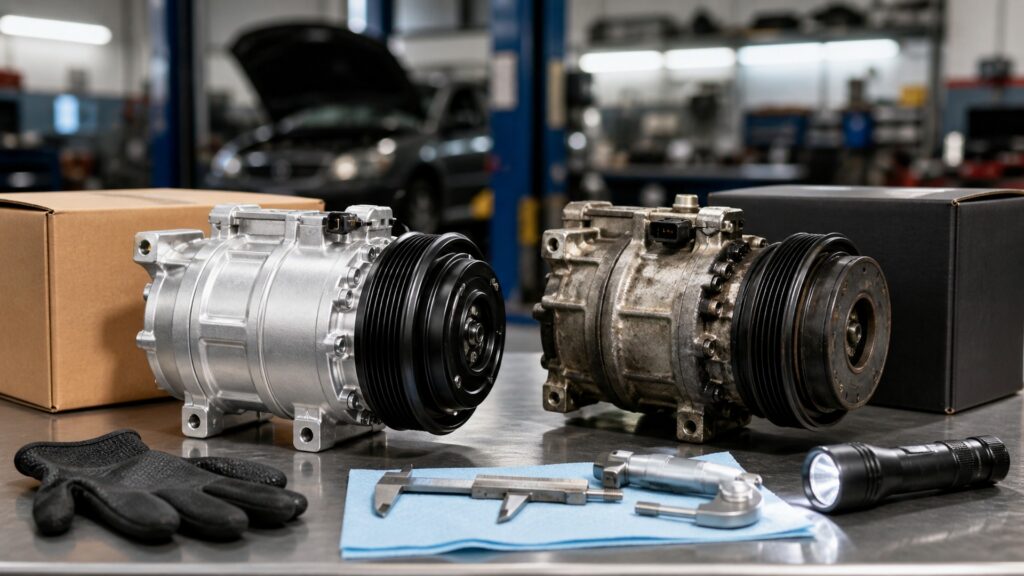
The decision turns on controlled restoration and test evidence versus new production—not on whether both parts look clean when removed from their boxes.
Tip: Ask for a process description that names replacement items, measured limits, and end-of-line tests; a fresh coating is not evidence of internal restoration.
These definitions separate remanufacturing from resale, light repair, and new production.
A used component collected as the starting unit for remanufacture.
A refundable deposit encouraging return of a rebuildable old unit.
A controlled restoration involving disassembly, cleaning, inspection, renewal, assembly, and testing.
A used component repaired by replacing failed or worn elements.
A component removed from another vehicle and resold without a complete restoration process.
A final check of assembled function under defined conditions.
Tip: The word remanufactured has value only when the supplier states its process and acceptance criteria.
A credible program identifies the core, checks castings or housings for cracks and distortion, measures reusable features, and rejects units outside recoverable limits. Core selection determines how much sound original structure remains available.
Remanufacturing begins with exclusion, not with cleaning every returned unit.
Complete access allows contamination removal and measurement of internal elements. The program then replaces mandatory wear items and any measured failures while restoring reusable surfaces through approved machining, plating, winding, or other processes.
Process discipline—not the percentage of reused material—determines whether function is restored.
New manufacture controls raw material, casting or forging, machining, treatment, assembly, and test without a prior service history. It avoids core variability but can still have supplier variation, production defects, supersessions, and application errors.
New eliminates prior use; it does not eliminate the need for quality control or fitment.
Electrical, hydraulic, pneumatic, rotational, leakage, or load tests can show that the assembled unit meets defined outputs. They cannot reproduce every temperature cycle, vehicle interface, software state, or installation condition.
A bench pass is strong process evidence but not the final vehicle verdict.
Reman value can disappear if a core is rejected, return shipping is difficult, the warranty excludes labor, or replacement stock is slow. New parts can avoid core logistics yet cost more or remain unavailable for older applications.
The practical choice includes the reverse logistics after installation.
A strong reman program can deliver verified function while reusing major structures, but the word alone says little.
A mature process can preserve scarce castings or housings, replace predictable wear elements, restore critical geometry, and test complete assemblies at useful cost.
Core exchange can keep older or expensive units serviceable when new production is limited or uneconomic.
Unknown process scope, weak core screening, limited testing, poor traceability, or costly repeat labor can outweigh a lower reman price.
New manufacture may be preferable when every life-limited element, latest engineering revision, or uncontaminated structure is critical and documented.
Reman myths blur process quality with cosmetic condition, age, or the number of reused pieces.
A used part is generally resold from a donor vehicle. A genuine remanufactured unit goes through a defined disassembly, cleaning, inspection, renewal, reassembly, and test process, although the rigor varies by supplier.
Programs usually reuse components that meet stated limits and replace defined wear or failed items. Claims such as all new internals need a written parts list; reuse is not inherently defective when measured and controlled.
New manufacture avoids prior service exposure but still depends on materials, processes, assembly, application accuracy, and installation. Production defects and supplier differences exist, so new is a history description rather than a durability guarantee.
Blasting, paint, and new connectors can improve appearance without revealing internal measurements or replacements. Process documentation, component lists, machining limits, leak or load tests, and warranty support provide more meaningful evidence.
Tip: Demand measured restoration and test evidence instead of accepting vocabulary as a quality certificate.
These answers clarify terminology, core acceptance, appropriate applications, contamination, and what documentation to request.
Usage and applicable rules can vary by product and jurisdiction, so do not rely on the label alone. Ask the seller to define disassembly depth, mandatory replacements, measured limits, test scope, warranty, and actual remanufacturer.
Starters, alternators, steering units, brake calipers, transmissions, engines, turbochargers, injectors, compressors, and electronic modules may be remanufactured. Suitability depends on recoverable cores, process capability, application support, and economics in practice.
Cracked housings, missing major pieces, wrong application, fire or water damage, broken mounting ears, disassembly, corrosion, or late return may reduce credit. Read the supplier's acceptance and shipping rules before removing the unit.
It depends on the material, exposure, and supplier process. Flood water, metal debris, overheated fluid, or chemical attack can damage structures and electronics beyond reliable recovery, so the remanufacturer must define rejection criteria.
Look for the actual remanufacturer, core-screening rules, replacement list, machining or electrical limits, cleanliness controls, end-of-line functions, serialization, warranty remedy, and application catalog. Then verify performance after installation with records.
Remanufactured parts differ from new parts because they restore a screened used core through controlled renewal and testing, while new parts begin with unused production inputs.
Compare process evidence, latest specification, installed verification, warranty, downtime, and core logistics. Neither a polished reman case nor an unused new part makes the outcome automatic.
Use the OEM-aftermarket comparison and full repair workflow to separate manufacturing history from catalog source, then apply the distinction to major engine work.
Separate the remanufactured-versus-new process decision from the OEM-versus-aftermarket supply decision.
Apply exact fitment, installation, calibration, and vehicle-level verification to either production history.
See how compression, oil control, cooling, timing, and measurement define the scope of engine-component restoration.
Choose a retailer
Prices checked regularly. We may earn a commission at no cost to you.