
Polymer Sealant
A synthetic paint protectant that deposits an organic or hybrid polymer film after spreading and removal.
- Often wipe-on and wipe-off
- May need haze or cure time
- Formula matters more than the name
Paint sealants and ceramic sprays occupy an overlapping middle ground between traditional waxes and professionally applied coatings. A sealant generally emphasizes a deposited synthetic polymer film, while a ceramic spray uses convenient application with silicon-based or hybrid chemistry to create water behavior and temporary protection.
Those descriptions are not regulated performance grades, and modern formulas blur them deliberately. Some wipe-on sealants contain SiO2; some ceramic sprays behave mainly as maintenance boosters; application may be wipe-on, spray-and-wipe, or spray-and-rinse. The useful comparison therefore starts with instructions, preparation, cure, compatibility, and verified durability—not with the largest chemistry word on the bottle.
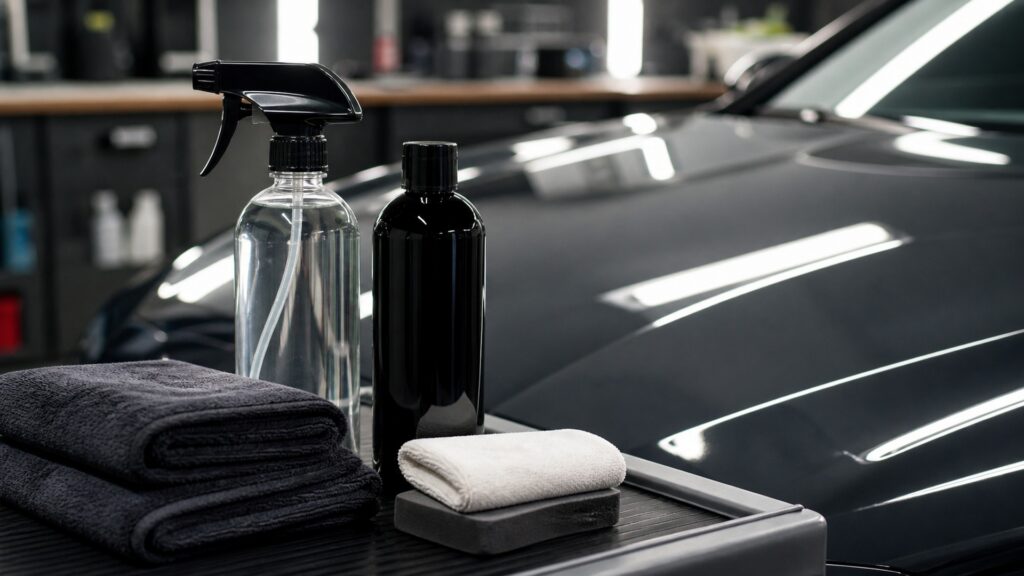
Compare the actual delivery, bonding, cure, and maintenance role because sealant and ceramic-spray categories increasingly share ingredients and claimed benefits.
Tip: Photograph the exact instructions and record the application date; maintenance products are easier to evaluate when the base layer and wash history are known.
These terms turn marketing categories into observable application and service variables.
A synthetic paint protectant that deposits an organic or hybrid polymer film after spreading and removal.
A low-viscosity spray protectant marketed around silicon-based or hybrid surface chemistry.
Water, solvent, or emulsion that distributes active ingredients before evaporation, wiping, or rinsing.
A formulation combining silicon-containing chemistry with other polymers or protection ingredients.
A product intended to refresh slickness or repellency over an existing protection layer.
The stated time and environmental limits before exposure to water, detergent, or abrasion.
Tip: Treat SiO2 as an ingredient family, not a certificate of coating thickness, crosslink density, or duration.
Sealant historically distinguishes synthetic protection from wax, while ceramic spray signals convenient silicon-based or hybrid behavior. Current products cross those boundaries, so neither term supplies a standard composition or test result.
A category label narrows the shelf; it does not finish the engineering comparison.
A wipe-on product gives direct control of a thin film but can streak if overloaded. A spray-and-rinse formula relies on water and panel coverage; a drying-aid format spreads while residual water is removed.
Convenience is part of performance because uneven application can erase a formula's theoretical advantage.
Both categories perform best on clean paint free of road film and incompatible residue. Some formulas mainly deposit; others develop stronger interaction during a stated cure, but consumer labels rarely quantify the resulting network comparably.
Preparation and cure create the real interface; the bottle name cannot compensate for a contaminated surface.
A fresh product may feel slick and bead tightly, yet those traits can change at different rates under detergents, minerals, heat, and abrasion. Cleaning can restore masked behavior without proving the entire film has regenerated.
One dramatic behavior is not a complete measurement of protection.
Choose a sealant when deliberate panel application and a stand-alone interval suit the routine. Choose a ceramic spray when fast renewal, drying-aid use, or coating-compatible boosting matters more than maximum persistence.
The useful winner is the system the owner can apply uniformly and renew before protection is exhausted.
Modern sealants and ceramic sprays can share ingredients while differing more clearly in delivery, role, and renewal burden.
Wipe-on sealants can provide deliberate coverage and a stand-alone protection cycle with familiar residue inspection.
Ceramic sprays can make frequent maintenance practical through spray-and-wipe, rinse-activated, or drying-aid workflows.
Neither name guarantees silicon content, crosslink density, chemical resistance, or a specific number of months in service.
Thin liquid protection does not replace paint repair, correction, impact film, careful washing, or prompt removal of damaging contamination.
These myths mistake an ingredient, application shortcut, or fresh water pattern for a standardized performance class.
Some sprays use related silicon chemistry, but ease of application, solids, bonding, cure, and intended service can differ substantially from a coating installation. Manufacturer positioning and instructions should define the product's actual role.
Modern hybrid sealants may incorporate SiO2 or other silicon-containing ingredients while retaining a wipe-on sealant format. The overlap is why application, cure, compatibility, and measured behavior matter more than category purity.
Bead shape reflects current surface wetting and can be influenced by fresh product, residue, contamination, or a topper. It does not independently establish film continuity, chemical resistance, adhesion, or remaining durability.
They can work uniformly when panel temperature, water coverage, product amount, dwell, pressure rinse, and drying follow instructions. Uneven technique creates spots, but wipe-on products also streak when overloaded or poorly removed.
Tip: Compare complete instructions and maintained results on the same surface rather than ranking fashionable labels.
These answers address preparation, stacking, durability, coated vehicles, and choosing a format for time-limited maintenance.
No. Both need clean, compatible paint, while polishing is reserved for defects worth removing. A transparent protectant preserves the visible starting surface, so inspection should decide correction rather than the product category.
Possibly, when the formulas are compatible, but the top layer can change water behavior without improving underlying adhesion. Following one documented system makes failure, renewal, and product interaction easier to interpret.
There is no dependable category-wide answer because formulas, preparation, cure, weather, washing, mileage, and abrasion vary. Compare product-specific instructions or controlled evidence, then plan renewal before appearance alone becomes the only signal.
Many are designed for that role, but compatibility and timing are system-specific. A booster can refresh repellency and slickness while making it harder to judge the exposed coating's own condition.
A spray format often reduces labor, especially as a drying aid or rinse application. A wipe-on sealant may justify extra time when predictable panel coverage and a longer stand-alone interval fit the owner.
Paint sealants differ from ceramic sprays less by a universal chemistry boundary than by how the formula is delivered, cured, maintained, and renewed.
Read the full system: intended role, clean-surface requirement, application path, water restrictions, compatibility, and realistic interval. Choose repeatable technique over a prestige word on the label.
Compare durable coatings, temporary wax, and damage-specific protection before assigning one bottle more work than its film can perform.
Compare a cured coating with renewable wax before placing hybrid sprays and sealants between those endpoints.
Understand what genuine coating preparation, leveling, and cure demand before calling a spray equivalent.
Select protection by stone impact, chemicals, weathering, washing, and maintenance rather than one product category.
Choose a retailer
Prices checked regularly. We may earn a commission at no cost to you.