
Self-Contained Source
Battery and switching hardware carried inside a portable jump pack.
- No donor vehicle is required
- Stored charge declines over time
- Output is bounded by the pack's cells and controls
A portable jump starter and jumper cables solve the same immediate problem through different electrical architectures. The pack brings its own battery and electronically controlled output. Cables contain no energy; they connect the disabled vehicle in parallel with a donor battery and, depending on the procedure, the donor vehicle's charging system.
That difference controls the roadside decision. A pack works without another vehicle and can limit some connection errors, but it must be charged, temperature-ready, and large enough. Cables can wait in storage for years and access a larger source, but require safe vehicle positioning, compatible systems, adequate conductor size, correct connection order, and a willing donor. Neither method diagnoses the failure.
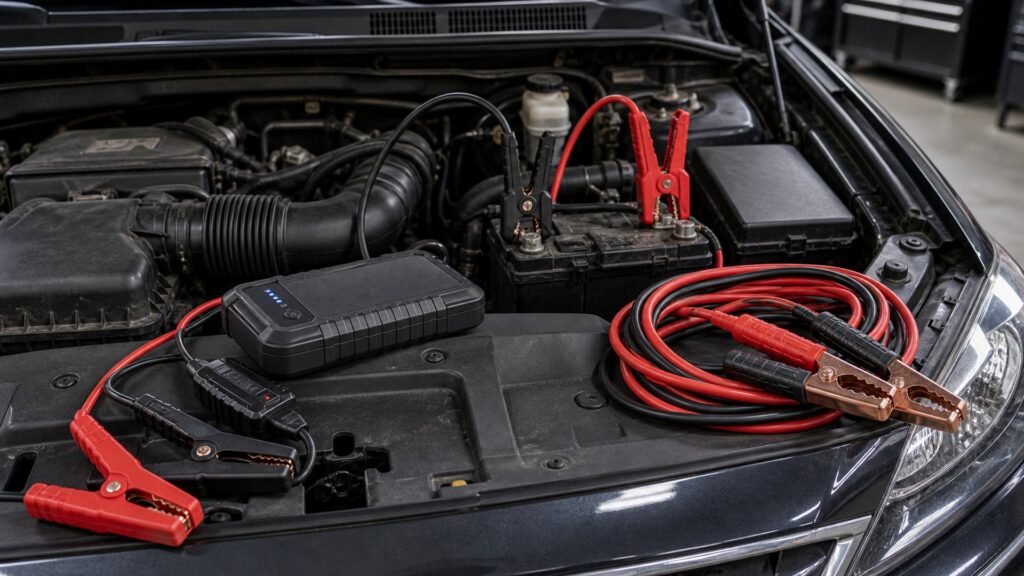
The useful contrast follows where energy comes from, how it crosses the clamps, what can go wrong during connection, and what must be maintained before the no-start occurs.
Tip: Open both vehicles' manuals before connecting anything. Approved jump points, grounding locations, hybrid or high-voltage restrictions, and connection sequences can differ even when both vehicles use nominal 12-volt starting systems.
These terms locate the electrical distinctions that matter at the roadside.
Battery and switching hardware carried inside a portable jump pack.
Temporary connection from another battery or approved source to the disabled vehicle.
Positive-to-positive and negative return arrangement that preserves nominal system voltage while sharing current capacity.
Loss of voltage across conductors, clamps, and contacts while starter current flows.
Specified order for attaching and removing conductors to control polarity, sparks, and live loose ends.
Ability of the pack or donor battery to hold voltage through the intended crank.
Tip: Jumper-cable procedures vary by vehicle; the source and disabled vehicle must share a compatible nominal voltage and use only the designated connection points.
The pack combines cells, switching, short leads, and protection in one case. Jumper cables are passive conductors whose performance depends on the remote donor battery, its terminal condition, and the placement of two vehicles.
The central choice is energy independence versus access to a larger external source.
A compact pack may have short conductors but limited cell capacity; jumper cables may reach farther but lose voltage through length, small gauge, weak clamps, or low-conductivity material. Current ratings without test duration and voltage reveal little.
Both methods fail when resistance consumes the voltage the starter and modules require.
Many packs detect reverse polarity, high temperature, or low voltage before enabling output. Conventional cables are live as soon as the circuit closes, so polarity verification, connection order, secure clamps, and separation of loose ends are the safety system.
Protection features reduce selected risks; they never make a damaged battery safe to energize.
A pack requires scheduled charging, temperature-conscious storage, and battery-health monitoring. Cables need no stored energy, but insulation, conductor, clamp spring, corrosion, gauge, length, and vehicle fit can deteriorate or prove inadequate after years unused.
The tool that needs less attention is not always the one that will work in the expected environment.
Cables require another vehicle near the disabled one, sometimes placing people and machines in traffic or tight spaces. A pack avoids that geometry. Conversely, an adequately rated donor circuit may support a difficult cold start that exceeds a small pack.
The best method is the safe compatible source available at that location—not a permanent winner.
A pack can arrive discharged; cables can arrive undersized, corroded, or attached to an unsuitable donor.
A maintained pack is strongest for solo travel, limited positioning space, and controlled self-assistance on a supported vehicle.
Quality cables suit situations with a compatible healthy donor, safe side-by-side access, correct jump points, and conductors sized for the actual starting demand.
Do not connect to a frozen, leaking, swollen, cracked, smoking, wrong-voltage, or unidentified battery system, or where the manual prohibits the method.
Abnormal mechanical resistance, severe sparking, hot conductors, repeated failure, or uncertain polarity calls for professional help rather than a second power source.
These misconceptions compare only convenience or advertised amperage.
A capable donor through short heavy copper cables can supply substantial current, but thin or long leads and weak clamps can waste it. A correctly sized pack may outperform a poor cable circuit on the same vehicle.
Protection electronics can block certain errors, yet manual override, damaged cells, wrong voltage, hot storage, poor clamp placement, and incompatible vehicles remain hazardous. Safety still depends on both manuals and a sound battery system.
Procedures differ because charging-system interaction and transient risk vary by vehicle. Follow both manufacturers' instructions instead of applying one universal rule, especially with modern electronics, hybrids, remote posts, or unusual battery locations.
Insulation can crack, conductors corrode, clamps weaken, and contact surfaces oxidize. Their gauge and reach may also be wrong for a newer vehicle, so periodic inspection and a controlled fit check remain necessary.
Tip: The real difference appears across the energy source, high-current path, roadside geometry, error control, and maintenance burden.
These answers address cold weather, hybrids, cable selection, donor risk, and why the engine may not start with either method.
A charged, correctly sized jump pack usually removes the need to find and position a donor. Carrying quality cables adds redundancy, but neither tool replaces roadside communication, diagnosis, or a plan for a battery that fails again.
A healthy donor battery may offer more energy than a compact pack, while both sources lose performance in cold conditions. Cable resistance, donor condition, oil viscosity, pack temperature, and diesel preheat demand determine the actual outcome.
Only as the vehicle manual permits. Many hybrids have a low-voltage jump point for control-system startup, but high-voltage components and donor limitations require model-specific procedures. Never improvise at orange cables or the traction battery.
Look for conductor material, cross-sectional size, insulation flexibility, clamp contact area, secure strain relief, adequate reach, and a stated application matching the vehicle. A large gauge number actually indicates a smaller conductor.
Open or resistive terminals, failed starter control, security or interlock faults, seized mechanical parts, wrong connection points, damaged batteries, or insufficient source voltage can all prevent cranking despite properly attached assistance equipment.
Portable jump starters differ by carrying and controlling their own energy; jumper cables create a passive high-current path to a separate compatible source.
Choose between independence and donor capacity only after accounting for conductor loss, vehicle position, protection method, temperature, upkeep, and the manufacturer's jump procedure.
The related articles explain the portable source in depth and place either starting method inside a broader stopped-vehicle response.
Examine cell state, starter inrush, voltage sag, temperature, protection modes, attempt limits, and post-start diagnosis inside a portable pack.
Sequence warning, communication, assessment, and exposure control before opening an engine bay beside traffic.
Decide whether route isolation, climate, storage temperatures, and vehicle type justify carrying one method or both.
Choose a retailer
Prices checked regularly. We may earn a commission at no cost to you.