
Radar Receiver
A radio receiver tuned to detect energy in bands used by compatible radar sources.
- It listens rather than measures vehicle speed
- Sensitivity affects detection distance
- Filtering affects nuisance alerts
Radar detectors and dash cams occupy the same windshield but solve different information problems. A detector listens for radio-frequency energy associated with speed-measurement equipment and warns before or during exposure. A dash cam converts light into encoded video and preserves a record of events the lens could see.
One device is predictive but probabilistic; the other is evidentiary but retrospective. Detector value depends on signal propagation, filtering, terrain, traffic, and local law. Camera value depends on exposure, lens coverage, storage, power continuity, and file retention. Neither identifies every hazard, proves a driver was faultless, or replaces lawful, attentive driving.
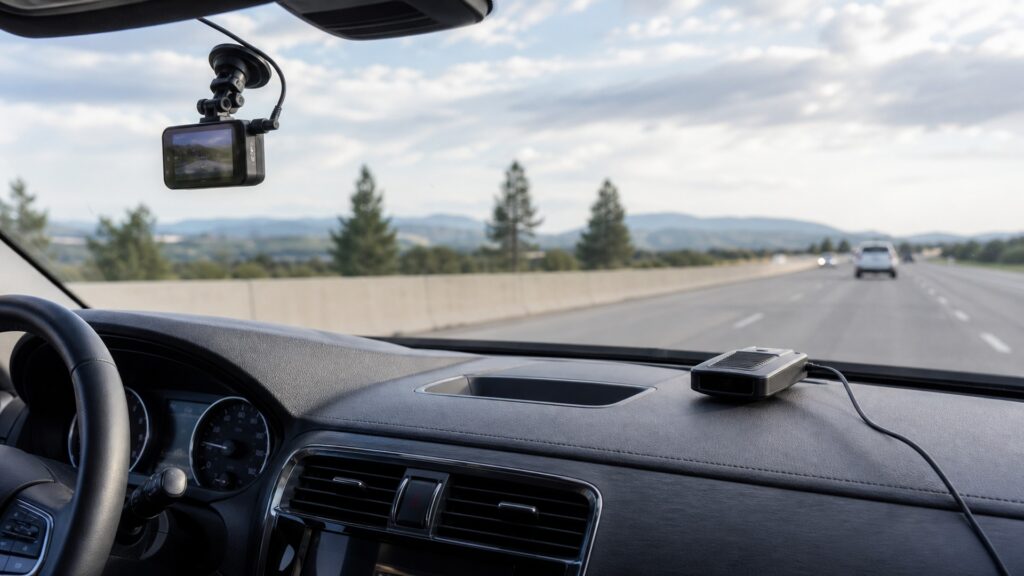
The useful comparison follows what enters each device, how it is interpreted, when it becomes available, and what remains afterward.
Tip: Before combining both devices near the mirror, map the driver's sight lines, airbag zones, wiper sweep, power cables, and each sensor's unobstructed view.
These terms distinguish a warning receiver from a rolling video recorder.
A radio receiver tuned to detect energy in bands used by compatible radar sources.
A frequency range the detector identifies and reports, often with a band label.
A detector warning caused by a non-enforcement source or an irrelevant signal.
Continuous video storage that overwrites the oldest ordinary files when space is needed.
A manual or automatic instruction that protects selected footage from routine overwriting.
The angular scene a camera lens projects onto its image sensor.
Tip: Judge a detector by useful alert context and a camera by recoverable footage, not by the quantity of sounds, icons, or advertised resolution alone.
An antenna gathers energy across supported bands, receiver stages separate weak signals, and software evaluates strength, frequency, duration, and patterns. The alert reports a candidate source; it does not identify an officer, measure legal risk, or guarantee advance notice.
A detector infers relevance from radio behavior before the driver knows the source.
Radio waves can travel beyond direct sight, reflect from vehicles, or be blocked by grades and structures. Continuous sources may be detected early; a short transmission aimed at the car can leave little useful lead time.
Advance warning is created by propagation opportunity, not by the detector's price alone.
A lens forms an image, the sensor samples it, a processor compresses frames, and storage receives timed files. Exposure, motion blur, dynamic range, windshield reflections, and compression determine whether a plate, signal, or vehicle path is actually legible.
A camera's real output is usable retained evidence, not a resolution number on the box.
A detector can suppress a relevant weak signal or alert repeatedly to harmless emitters. A camera can stop recording because of heat, a failing card, loose power, corrupted files, or protected storage that has filled unnoticed.
Both products need maintenance, but one fails as bad interpretation while the other often fails as missing history.
FCC receiver rules do not settle every jurisdiction's restrictions, and windshield mounting or recording rules can differ. Audio, passengers, and location data also create privacy questions. Controls and alerts should remain secondary to the road.
A technically functional device can still be badly placed, unlawfully used, or distracting.
A detector estimates possible activity now; a dash cam preserves a view of what already happened.
A detector can provide situational warning when a compatible signal reaches it early enough to be interpreted.
A dash cam can retain a time-ordered visual record for memory, reporting, insurance, or incident review.
A warning cannot certify that enforcement is present, absent, lawful, or aimed at a particular vehicle.
Video may omit speed, intent, off-camera events, audio context, or physical evidence and does not automatically determine fault.
These myths confuse reception with certainty and recording with complete proof.
It reports radio energy that resembles enabled bands and patterns. The source may be a door sensor, another vehicle, roadside equipment, or enforcement, and the alert may not reveal direction or exact location.
No receiver creates a signal that was never transmitted. Terrain, shielding, traffic, aiming, instant-on use, disabled bands, and filtering can reduce or eliminate useful lead time regardless of purchase price.
Pixel count is only one constraint. Distance, angle, motion, shutter time, glare, darkness, lens quality, bitrate, compression, windshield condition, and exposure control all affect whether characters survive in the recording.
Video shows a bounded viewpoint and may omit speed, signals, road conditions, or events outside the frame. Investigators and insurers can combine it with statements, damage, laws, and other available evidence.
Tip: Ask what signal was available, what the device retained, and which conclusion the evidence can actually support.
These answers cover legality, combined installation, laser alerts, storage checks, and how to choose between the devices.
No universal answer is safe. FCC rules generally do not prohibit the receiver itself, but states, localities, federal property, commercial-vehicle rules, and mounting restrictions can differ. Check current law for the trip.
Usually, if the vehicle permits it and both retain clear sensing paths. Plan power capacity, cable routing, heat, windshield visibility, mirror clearance, airbag zones, and interference testing before fixing their positions.
Laser is narrow and typically aimed at a specific vehicle area. A detector may alert only after that vehicle is illuminated, so the warning can describe exposure rather than provide meaningful advance notice.
Review representative files after installation, firmware changes, storage replacement, and periodically thereafter. Confirm focus, time, audio choice, front and rear channels, event locking, card health, and playback outside the camera.
Choose the information gap. Use a camera when preserving incident context matters most; consider a lawful detector when compatible radio warnings are useful. Budget separately for installation, storage, maintenance, and driver distraction.
Radar detectors and dash cams differ at the input, output, and moment of value: one interprets radio energy for a possible warning, while the other stores visible events for later review.
Install either device around its real sensing path, verify its failure modes, follow current law, and keep the driver's attention on the road.
Continue with the recording and electronics explainers to understand evidence retention, power integrity, signal flow, and installation limits.
Examine how a dash cam captures, buffers, locks, stores, and exports incident footage.
Trace how accessory power, data links, modules, displays, and installation choices interact inside a vehicle.
See how vehicle radar and cameras support collision warnings and intervention rather than enforcement detection or evidence recording.
Choose a retailer
Prices checked regularly. We may earn a commission at no cost to you.