
Driver Assistance
A feature that warns, intervenes briefly, or continuously supports a defined part of driving.
- Capability is feature-specific
- The driver retains responsibilities
- Availability can change during a trip
Driver assistance technology matters because a correctly functioning system can monitor selected hazards continuously, warn when attention or action is needed, and in some cases brake, steer, or adjust speed. Those seconds and small control inputs can help avoid a crash or reduce its severity when the system recognizes the situation in time.
The benefit is conditional, not autonomous. Cameras, radar, ultrasonic sensors, maps, wheel-speed signals, and software each see a limited version of the road. Weather, markings, geometry, occlusion, contamination, calibration, and driver behavior change performance. NHTSA distinguishes warning, intervention, and combined steering-and-speed assistance, while keeping the human responsible for supervising current consumer systems.
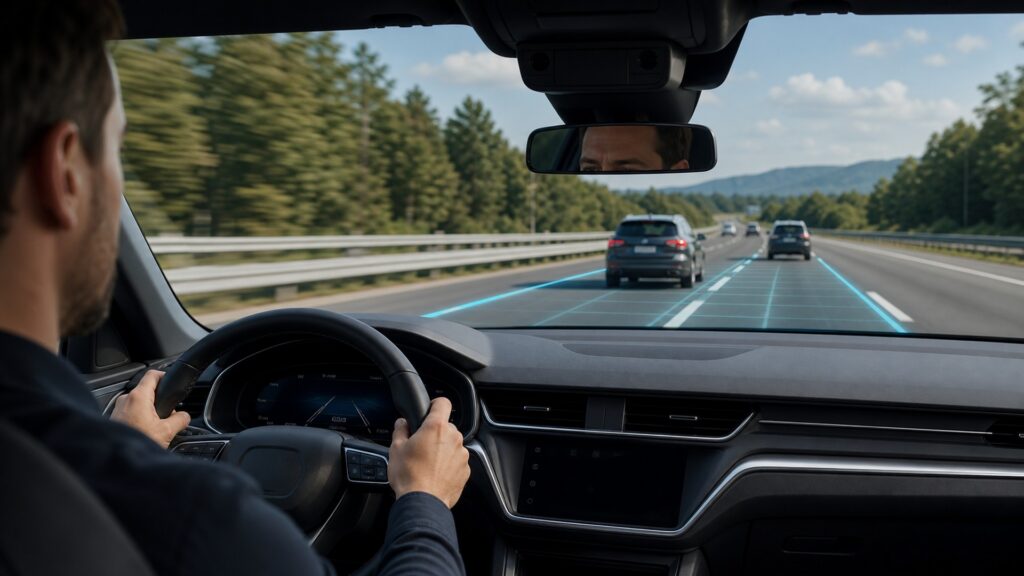
Assistance works through perception, estimation, threshold selection, human communication, limited intervention, and verification that the driver remains responsible.
Tip: After windshield, bumper, suspension, alignment, tire, or collision work, verify whether affected assistance sensors require inspection, aiming, programming, or calibration before trusting the feature.
These terms separate sensing and limited support from automated driving.
A feature that warns, intervenes briefly, or continuously supports a defined part of driving.
Software combination of observations from multiple sensors or vehicle signals.
An alert that a frontal collision risk has crossed the system's warning criteria.
A feature that applies or supplements braking when a qualifying collision is judged imminent.
Continuous steering support intended to help maintain a position within a detected lane.
A procedure that aligns a sensor's measurements with vehicle geometry and software expectations.
Tip: Learn the exact feature name and behavior in the owner's manual; marketing labels vary and do not reliably describe authority or supervision duties.
Cameras classify markings, lights, and object appearance; radar estimates range and relative motion; wheel, steering, brake, and yaw signals describe the host vehicle. Software combines available evidence, but occluded or unclassified objects can remain outside its usable scene.
Assistance begins with limited measurements, not a human-level understanding of the road.
The system predicts paths and closing rates, then compares estimated risk with calibrated thresholds. Early thresholds can create nuisance alerts; late thresholds reduce time. Driver inputs, turn signals, selected settings, and feature state can alter the decision.
Timing is a risk tradeoff encoded in software, not proof that the system knows the driver's intent.
Some features only communicate through sound, light, or vibration. Others request braking, steering torque, or speed changes through vehicle controllers. Authority is constrained by design, traction, speed range, sensor confidence, and driver override.
A feature can act quickly while still lacking enough authority or grip to prevent the event.
A camera or radar measures angles and distances relative to its mounting position. Windshield replacement, bumper work, collision repair, alignment, suspension changes, tire size, or disturbed brackets can change that relationship and require specified procedures.
Calibration restores a measurement reference; it does not repair damaged hardware or guarantee performance in every scene.
NHTSA describes Level 0 through Level 2 consumer features as systems in which the driver drives and monitors. Supervision means watching the road, knowing feature state, anticipating limits, and taking control before a missed detection becomes a crash.
The driver must manage both the roadway and the possibility that assistance will stop, hesitate, or act unexpectedly.
Assistance can add perception and reaction support while remaining bounded by sensors, traction, software, and the driver's supervision.
Warnings can draw attention to selected collision or lane risks, and intervention can reduce speed or correct trajectory in qualifying situations.
Continuous support can reduce workload during suitable conditions when the driver understands state, limits, and handoff responsibilities.
No feature sees every object, reads every road, has unlimited braking or steering authority, or performs consistently across all weather and geometry.
A feature name, active icon, or absence of faults cannot establish that calibration, sensing, traction, or driver supervision is adequate.
These myths turn assistance into either infallible automation or a useless nuisance.
NHTSA classifies continuous steering assistance without simultaneous speed control as Level 1, and combined steering plus speed assistance as Level 2. In both cases, the driver remains engaged, attentive, and responsible.
Radar can retain advantages in darkness and some visibility conditions, but heavy precipitation, ice, contamination, mounting changes, target geometry, multipath reflections, and software confidence can still reduce or alter system performance.
A sensor can remain mounted slightly outside its intended geometry without producing an obvious warning in every case. Follow repair information after relevant work and confirm calibration status with the specified procedure and equipment.
AEB is designed for defined targets, speeds, trajectories, and system states. Detection timing, road friction, driver input, vehicle load, curvature, weather, and available distance can prevent avoidance even when braking occurs.
Tip: The responsible middle ground is to understand the feature's sensing, authority, operating conditions, and required human response.
These answers address feature names, bad weather, repairs, false alerts, and what supervision means in everyday driving.
Brand names package functions differently and may combine warning, braking, steering, or convenience behaviors. Use NHTSA's functional descriptions and the exact owner's manual to determine what the feature senses and controls.
Only within the conditions permitted by the manual and with conservative judgment. Reduced visibility, covered sensors, poor markings, standing water, and lower tire grip can affect both perception and the vehicle's ability to respond.
Yes. A windshield-mounted camera can be disturbed or view through different glass geometry, and the service procedure may require calibration. Confirm requirements for the exact vehicle, camera, glass, and completed repair.
Clean specified sensor areas, confirm tires and vehicle condition, document locations and weather, review settings, and seek qualified diagnosis. Do not disable a safety feature permanently without understanding the fault and available repair.
Watch the roadway, know whether assistance is available and engaged, maintain a safe following distance, keep hands and feet ready, avoid unrelated tasks, and intervene early when the scene or system behavior becomes uncertain.
Driver assistance matters because extra sensing, warning, and limited control can add valuable time or reduce crash severity in situations the feature recognizes.
Its benefit depends on clean and calibrated sensors, suitable conditions, adequate traction, correct feature understanding, and a driver who remains ready to control the vehicle.
These explainers place assistance features inside their signal architecture and show how performance evidence differs from dashboard status.
Trace the sensors, networks, modules, software, displays, and actuators behind a modern assistance feature.
See how crash-test and safety-rating evidence differs from the presence or branding of individual driver-assistance features.
Learn how time-series data can expose intermittent sensor, network, and actuator behavior without proving performance by itself.
Choose a retailer
Prices checked regularly. We may earn a commission at no cost to you.