
Traction Board
Rigid textured panel placed under a tire to support and engage the tread.
- It reduces surface deformation
- Teeth need tread contact
- Wheelspin can eject it
Recovery boards and recovery straps solve immobilization through different mechanisms. Boards are placed beneath driven tires to create a firmer, textured path across sand, snow, mud, or a small void. Straps connect vehicles so a second vehicle transfers a steady or kinetic pulling force into the stuck vehicle.
Boards usually reduce the need for external force and keep the recovery local to the tire-ground interface. Straps introduce a high-load system spanning both vehicles, their recovery points, connectors, drivers, and the space between them. The correct choice depends on why the vehicle is stuck, whether it can drive, available room and assistance, attachment ratings, terrain damage, and the team's ability to control stored energy.
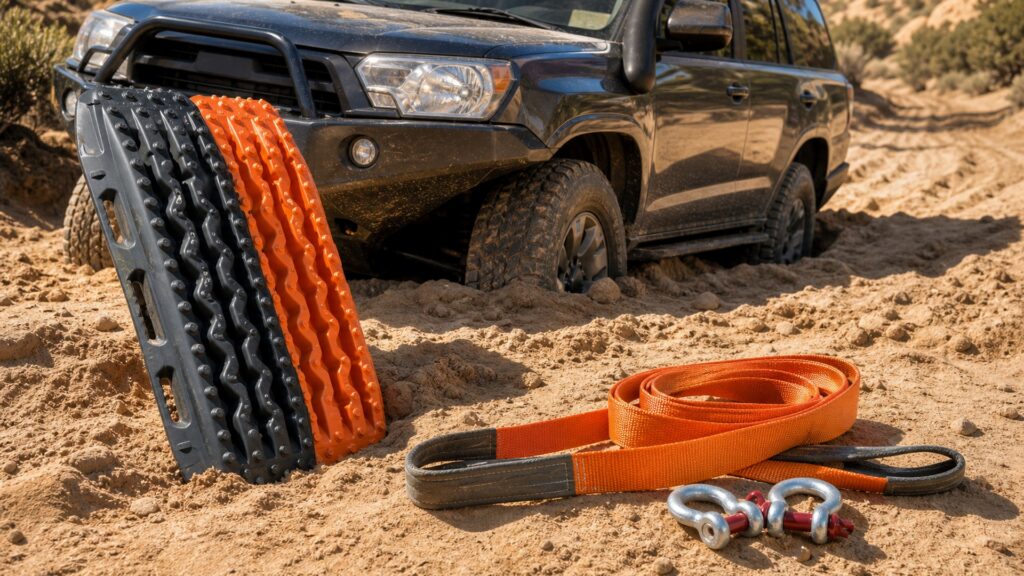
Diagnose the immobilization, dig and clear resistance, then select boards for a recoverable tire path or a strap only when a rated two-vehicle pull is justified.
Tip: Practice board placement and a low-load strap connection separately; treating them as one generic recovery exercise hides the different hand, wheelspin, attachment, communication, and recoil hazards.
These terms distinguish traction creation from force transfer.
Rigid textured panel placed under a tire to support and engage the tread.
Rated textile connector used to transfer pull between suitable vehicle recovery points.
Elastic recovery device designed to stretch and release energy during a bounded moving pull.
Use of a rigid support to span a small soft patch, rut, or void.
Percentage a recovery device lengthens under load and returns as force.
Removal of digging, suction, high-centering, or abrupt obstacles before pulling.
Tip: Never attach recovery straps to tow balls, suspension parts, unknown loops, or unrated hardware; follow vehicle and equipment instructions and seek trained help when points or loads are uncertain.
After excavation, a board supplies a textured load-spreading surface beneath the driven tire. Gentle torque pulls the board under the contact patch and lets the tire climb onto material that does not shear as readily as loose soil.
The board helps only if the tire can reach it and the chassis is not still carrying the vehicle's weight.
A strap transfers tension from the recovery vehicle through its rated point, connectors, textile body, the stuck vehicle's rated point, and chassis. A kinetic product also stores energy through controlled stretch.
The strap never acts alone; the weakest interface on either vehicle controls the safe system.
Boards suit loose surfaces and small steps where tires can drive out, often with one vehicle and little run-up. Strap recovery needs a second suitable vehicle, an aligned path, traction for it, and a clear span and stopping area.
A strap can move a vehicle farther, but it expands the hazard and environmental footprint.
Boards can spin, crack, or eject near tires; straps and connectors can recoil across a much larger zone after attachment or textile failure. Kinetic methods add vehicle momentum and elastic energy.
Lower apparent speed does not eliminate stored energy, and higher energy is not a substitute for excavation.
Boards and digging can first reduce resistance; a gentle rated pull may then assist if tire torque remains insufficient. The board still supports the tire while the strap transfers external force, so both hazard systems remain active.
Combining tools should lower required load, not justify a more aggressive attempt.
The tools differ in mechanism, required vehicle interfaces, stored energy, space, and likely failure paths.
Driven tires can reach a prepared exit path, the problem is loose material or a small void, and gentle wheel torque can move the vehicle without external pulling.
A solo, local, low-energy method preserves control and the boards' load, temperature, and terrain limits are understood.
A second suitable vehicle, rated points, compatible connectors, aligned space, communication, training, and an appropriate steady or kinetic product are available.
Neither tool is suitable for unstable slopes, deep water, major mechanical damage, unknown points, unsafe traffic exposure, or forces beyond ratings and competence.
These myths blur the large energy difference between rebuilding traction and pulling through vehicle structures.
Buried tires, packed material ahead of the tread, mud suction, and high-centering can prevent board engagement. Excavation creates space, reduces resistance, and lets the board support a gradual exit instead of becoming a projectile.
Tow straps, tree protectors, winch extensions, and kinetic ropes have different stretch, construction, and intended use. Substituting them changes peak force and failure behavior; use only products rated and instructed for the chosen method.
Even a steady pull tensions textile, connectors, recovery points, and vehicle structure. Movement, slope, abrasion, attachment failure, and rolling vehicles still require aligned rigging, clear exclusion zones, communication, and controlled stopping.
Excess wheelspin can melt board teeth, cut tires, dig deeper holes, eject boards, and reduce directional control. Apply the minimum smooth torque, stop if engagement fails, reposition, and extend or rebuild the path.
Tip: Choose the mechanism that removes the actual cause of immobilization with the smallest controlled load.
These answers cover solo use, strap type, board count, combined methods, and damaged equipment.
Yes, when terrain and vehicle condition permit self-recovery. Secure the vehicle, assess surroundings, dig thoroughly, position boards without placing hands near moving tires, use gentle throttle, and retrieve equipment without entering an unstable area.
A tow strap generally supports a more controlled steady pull, while a kinetic rope is designed for substantial elastic stretch during a bounded moving recovery. Product instructions, ratings, points, space, and training determine use.
Two can support a driven axle, while additional boards may extend a path or support more tires. The correct number depends on drivetrain, surface, board rating, obstacles, direction, and whether the vehicle is high-centered.
They can when each has a defined role: boards reduce tire resistance while a suitable vehicle applies a controlled rated assist. Manage both the tire-ejection zone and the entire tensioned-line corridor simultaneously.
Follow manufacturer criteria for cracks, melted or missing teeth, severe warping, cuts, pulled stitching, chemical contamination, ultraviolet degradation, damaged eyes, illegible labels, heat exposure, or any overload or event requiring professional inspection.
Recovery boards create a temporary drivable surface beneath tires, while recovery straps transfer pulling force between vehicles through rated attachments and may store significant elastic energy.
Use boards after excavation for local low-energy traction problems; use straps only with suitable vehicles, verified points, compatible gear, clear space, communication, and training; combine methods only to reduce required force.
These explainers place board-versus-strap selection inside the broader system of assessment, excavation, tire pressure, winching, communication, inspection, and exit planning.
Review how recovery tools, ratings, connectors, load paths, recoil zones, and trained communication form one controlled equipment system.
Design a route-specific recovery kit that covers assessment, excavation, traction, inflation, pulling, connection, communication, and post-event inspection.
See why accurate deflation and reliable reinflation can restore the tire-ground interface before or after board use.
Choose a retailer
Prices checked regularly. We may earn a commission at no cost to you.