
Self-Recovery
Method completed by the immobilized vehicle and its occupants without another pulling vehicle.
- Boards and winches may qualify
- Solo work increases communication limits
- Anchors may still be external
Vehicle recovery gear matters because being stuck is not one problem. A tire may lack pressure, tread may shear loose material, the chassis may rest on terrain, mud may hold the underbody, a wheel may hang without load, the starter may fail, or damaged steering and suspension may make movement unsafe.
A useful kit provides diagnostic and low-energy options before pulling force: lighting, gloves, shovel, gauge, repair and inflation, traction aids, communication, and vehicle-specific attachment knowledge. Rated straps, winch equipment, connectors, and anchors extend capability only when the team understands load paths and stored energy. Readiness means choosing the correct method, reaching the gear, protecting people, and stopping when conditions require professional help.
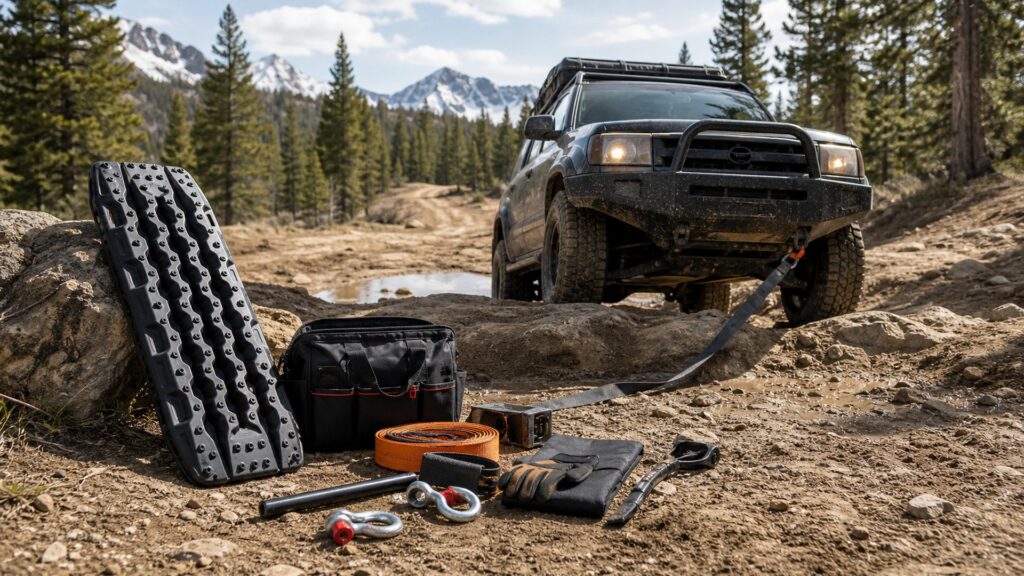
Organize recovery from assessment through resistance reduction, tire mobility, traction, controlled pulling, communication, inspection, and a clear threshold for abandoning self-recovery.
Tip: Run tabletop scenarios for a flat tire, sand burial, high-center, dead battery, blocked route, and damaged steering; name the first tool, safe zone, required helper, and point at which the attempt stops.
These terms organize recovery gear by function rather than by product count.
Method completed by the immobilized vehicle and its occupants without another pulling vehicle.
Method using another vehicle, trained team, or professional equipment to restore movement.
Device or material improving the tire-ground interface or bridging a limited surface defect.
Rated connector, rope, strap, block, extension, protector, or anchor element in a recovery load path.
Arrangement that trades additional rope travel and components for reduced line tension at the pulling device.
Structured check for damage caused by immobilization, extraction, heat, abrasion, impact, or overload.
Tip: Recovery can expose people to tension, moving vehicles, unstable terrain, traffic, weather, fire, water, and medical risk; obtain hands-on instruction and comply with route and land-management rules.
Secure the vehicle, identify hazards, inspect occupants and mechanical condition, determine what carries the weight, map the desired exit, check weather and traffic, and decide whether movement could worsen rollover, water entry, fire, or damage.
Assessment preserves options; an immediate pull can convert a simple immobilization into structural damage or injury.
Many recoveries are pressure or resistance problems. A repairable puncture can be stabilized, soft material cleared, high-center contact removed, pressure adjusted within limits, and a drivable surface built before external force is applied.
Low-energy mobility tools often reduce both required force and the size of the hazard zone.
Steady straps, kinetic devices, winches, blocks, bridles, protectors, and connectors serve distinct methods. Their ratings must align with vehicle points, anchors, directions, terrain, and dynamic behavior; incompatible gear creates unpredictable weak links.
The kit is a system whose safe capacity is governed by its least suitable loaded interface.
Night, wind, engines, distance, and stress disrupt communication. One director, agreed hand or radio signals, visible controls, protective equipment, and enforced zones keep drivers, spotters, and bystanders away from tires, fairleads, tensioned lines, and moving vehicles.
Human coordination controls energy more reliably than an additional accessory in the bag.
Once stable, inspect tires, wheels, steering, suspension, underbody, fluids, points, ropes, straps, connectors, mounts, and electrical equipment. Clean and dry gear, record overloads, replace damaged items, and restore accessible storage before the next exposure.
A successful extraction is incomplete until the vehicle and recovery system are known ready—or explicitly taken out of service.
The kit should solve common causes early, control force when necessary, and preserve an exit to professional assistance.
Assessment, lighting, protection, communication, excavation, tire measurement and repair, inflation, traction, rated connections, controlled pulling, inspection, and escalation are all covered.
Tools match the exact vehicle and route, remain accessible under load, carry legible ratings, receive condition checks, and have been practiced before a remote failure.
Unstable vehicles, rising water, fire, traffic, structural or steering damage, medical emergencies, unsafe anchors, prohibited access, or loads beyond training require emergency or professional response.
Carrying gear does not create land access, eliminate environmental responsibility, guarantee a communications link, or make a lone high-energy recovery prudent.
These myths confuse kit size, vehicle capability, and hardware ratings with a controlled recovery plan.
Gear must match vehicle mass, identified points, tire and wheel configuration, electrical supply, terrain, climate, occupants, route rules, and operator skill. Generic quantity cannot replace compatible interfaces, ratings, access, and scenario planning.
Winches are powerful but depend on battery, mounting, rope, anchor, rigging, access, and training. Shovels, pressure control, tire repair, boards, communication, and route decisions often solve the problem with less energy and damage.
Immobilization may occur on a slope, in water, at night, or with a door blocked. First-use items must remain reachable without unloading unsecured cargo into traffic or entering the vehicle's downhill or unstable side.
Textile fibers, internal rope, connectors, points, mounts, and batteries can suffer hidden heat, shock, contamination, or overload damage. Inspection criteria, event history, cleaning, drying, and manufacturer retirement rules determine continued service.
Tip: A useful kit reduces uncertainty and energy before it increases pulling force.
These answers cover kit design, winches, tire repair, storage, and professional-recovery thresholds.
List plausible immobilizations for the route, then cover assessment, personal protection, communication, excavation, tire measurement and repair, inflation, traction, vehicle-specific rated connections, appropriate pulling methods, visibility, inspection, and professional escalation.
No. Route, solo travel, vehicle mass, available anchors, terrain, mounting, electrical capacity, training, and recovery alternatives determine value. A winch without suitable points, rigging, maintenance, and safe operating space is incomplete capability.
Only damage and repair locations permitted by the tire, vehicle, and repair-system instructions. Sidewall cuts, bulges, exposed cords, bead damage, wheel damage, large or irregular punctures, or uncertain structure require replacement or professional service.
Keep first-use items reachable, restrained against crash forces, dry, ventilated, and separated from sharp or chemical contamination. Heavy gear belongs low when practical, while recovery access should not require standing in traffic or unstable terrain.
Use professionals when vehicle stability, water, fire, traffic, injury, mechanical damage, anchor uncertainty, required force, environmental risk, equipment condition, communication, or operator competence falls outside a clearly controlled and rated plan.
Vehicle recovery gear matters because immobilization has multiple causes, and a route-specific system lets travelers assess them, reduce resistance, restore tire mobility, create traction, and apply controlled force through rated paths.
Build capability from low-energy tools upward, protect starting and communication, keep equipment accessible, train with exact interfaces, control people and stored energy, inspect afterward, and escalate whenever the recovery boundary is uncertain.
These explainers deepen the rated force system and the board-versus-strap decision while preserving one home for overall readiness.
Understand how recovery equipment manages resistance, rated points, connectors, rigging geometry, stored energy, safe zones, and inspection.
Choose between local surface-building boards and two-vehicle force-transfer straps based on terrain, energy, space, interfaces, and skill.
See how a compressor, accurate gauge, appropriate repair, electrical supply, and cold-pressure check restore tire mobility.
Choose a retailer
Prices checked regularly. We may earn a commission at no cost to you.