What Makes Resistance Bands Different from Suspension Trainers

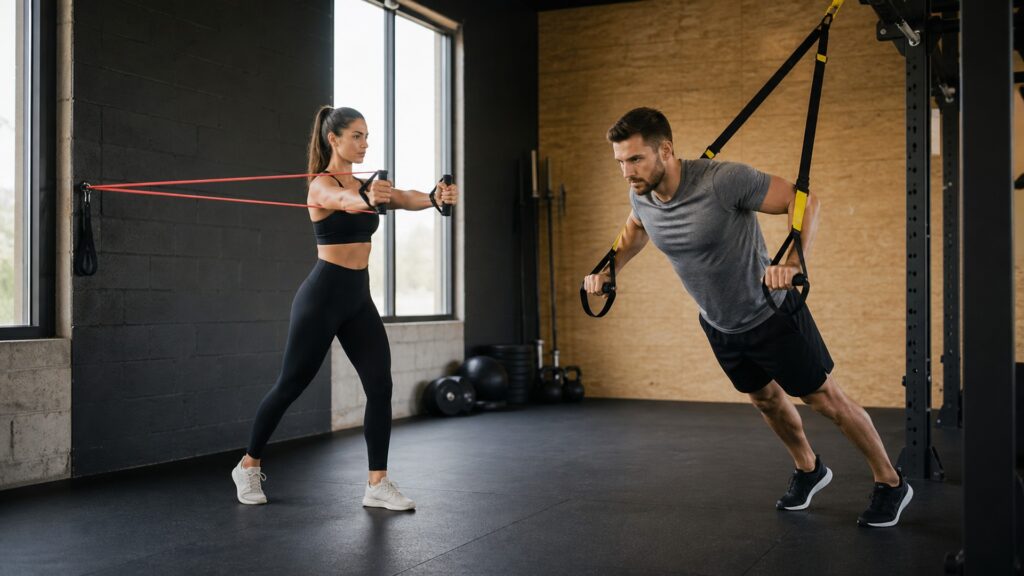
Resistance bands and suspension trainers are often grouped together because both are portable gym accessories. Mechanically, they are different tools. A resistance band creates elastic tension as it stretches, while a suspension trainer uses straps, handles, an anchor point, and body angle to load movement with bodyweight.

That difference changes the resistance curve, setup, stability demand, exercise selection, and how difficulty is adjusted. Bands can assist or resist movement through stretch. Suspension trainers make position and balance central to the exercise. The useful comparison begins with where the resistance comes from.

By: Review Streets Research Lab
Updated: August 31, 2026
Explainer · 8-12 min read
resistance bands explainer hero image for Review Streets
What You'll Learn

How Elastic Tension Differs from Body-Angle Suspension Training

The two tools may share portability, but they load exercises through different mechanics and require different setup judgment.

  • Why bands become harder as they stretch
  • How suspension trainers use body angle and gravity
  • Why anchor direction changes both tools differently
  • How stability and balance demands differ
  • Where bands can assist movements that straps cannot
  • Why setup safety and range control matter for portable training

Tip: For resistance bands vs suspension trainers, the useful first question is what condition the tool or metric changes.

Definitions

Key Concepts That Define Resistance Bands vs Suspension Trainers

These terms separate elastic loading from suspended bodyweight loading so the two portable tools do not blur together.

Resistance band

A resistance band is elastic material that pulls back as it stretches.

  • Tension usually rises through the range of motion.
  • It can assist or resist a movement depending on setup.
  • Wear, anchor direction, and stretch distance all affect safety and feel.

Suspension trainer

A suspension trainer uses straps, handles, and an anchor so bodyweight becomes the load.

  • Difficulty changes as the user changes body angle.
  • The handles demand alignment and stability control.
  • The anchor must support the intended force.

Elastic resistance

Elastic resistance is force created by stretching a band.

  • It can feel easier at the start and harder near the end range.
  • Pre-stretch changes the resistance curve.
  • It behaves differently from a fixed weight or bodyweight lean.

Anchor point

An anchor point is the fixed location that holds a band or suspension trainer.

  • Height and direction change the line of pull.
  • A poor anchor can make either tool unsafe or ineffective.
  • Suspension setups usually place more bodyweight demand on the anchor.

Body angle

Body angle is the lean or position that changes load on a suspension trainer.

  • Stepping closer or farther from the anchor changes difficulty.
  • Foot stance can also alter stability.
  • This is the main adjustment system for many strap exercises.

Resistance curve

A resistance curve describes where an exercise feels easier or harder across the range.

  • Bands often get harder as they lengthen.
  • Suspension load changes with leverage and body position.
  • The curve should match the movement's purpose.

Tip: Look for the source of resistance first: stretched material or the user's body angle under an anchor.

Resistance Source

Bands Load Stretch; Suspension Trainers Load Body Position

A resistance band resists because elastic material pulls back as it lengthens. A suspension trainer resists because the user's body hangs or leans against gravity through straps connected to an anchor.

  • Band tension changes across the range of motion.
  • Suspension-trainer load changes as body angle changes.
  • Bands can pull from many directions if anchored safely.
  • Suspension trainers require an anchor that supports bodyweight forces.
  • The source of resistance shapes every exercise choice.

Elastic pull and suspended bodyweight are separate training mechanics.

Adjustment

Difficulty Changes Through Different Controls

With bands, the user changes difficulty by choosing band thickness, starting stretch, grip length, or anchor distance. With suspension trainers, the user changes difficulty by stepping closer or farther from the anchor, changing foot position, or altering body angle.

  • A thicker band usually creates more tension.
  • Pre-stretching a band changes where the exercise feels hardest.
  • A lower body angle can make suspension rows harder.
  • Foot stance can add or reduce stability demand.
  • Small setup changes can change the exercise dramatically.

Both tools adjust quickly, but the adjustment language is different.

Movement Pattern

Bands Can Assist; Suspension Trainers Mostly Redirect Bodyweight

Bands can make an exercise harder by pulling against the movement or easier by assisting part of the movement. Suspension trainers usually make the user control bodyweight, leverage, and stability through handles or foot cradles.

  • Bands can assist pull-ups, mobility work, or speed work.
  • Bands can add lateral or rotational pull to common movements.
  • Suspension trainers excel at rows, presses, lunges, planks, and supported single-leg work.
  • Straps demand more control of body alignment.
  • The same movement name can feel very different across the tools.

The movement pattern should decide the tool, not the shared portable label.

Limits

Portable Does Not Mean Setup-Proof

Both tools depend on setup. A band can snap, slip, or pull from a poor angle. A suspension trainer can fail if the anchor, door, strap length, or floor position is unreliable.

  • Inspect bands for cracks, thinning, or damage.
  • Keep the band path away from the face when tension is high.
  • Use an anchor that matches the force direction.
  • Confirm a suspension anchor can handle the intended load.
  • Leave enough space to control the full range of motion.

The main limit of portable gear is not portability; it is whether the setup stays stable.

Decision Boundary

Choose by Resistance Curve and Body Control

Bands fit users who need elastic resistance, assistance, compact loading, or varied pull directions. Suspension trainers fit users who want bodyweight leverage, handle-based control, and stability challenges from a single anchor.

  • Choose bands for assisted movements, warmups, and variable elastic tension.
  • Choose suspension trainers for rows, presses, lunges, and bodyweight control.
  • Avoid bands when stretch direction cannot be controlled safely.
  • Avoid straps when the anchor or body position is uncertain.
  • Use both only when each tool has a distinct job in the session.

The difference comes down to elastic tension versus suspended leverage.

Quick Reality Check

Where Resistance Bands vs Suspension Trainers Helps and Where the Explanation Needs Limits

A balanced view of what resistance bands vs suspension trainers clarifies, plus what the concept should not be stretched to prove.

What Resistance Bands vs Suspension Trainers Clarifies

Resistance Bands vs Suspension Trainers helps readers connect the category name to actual mechanisms, setup choices, and use conditions.

It also makes comparison more honest by separating the main job from marketing claims or vague performance language.

Where the Shortcut Breaks Down

The explanation cannot prove that one product, score, or accessory is best for every body, routine, or training goal.

It also cannot replace qualified guidance for pain, symptoms, health concerns, or individualized programming.

Common Myths

Misconceptions About Resistance Bands vs Suspension Trainers

Common shortcuts and misunderstandings can make the topic seem simpler than it is.

Resistance Bands vs Suspension Trainers is only about preference

Preference matters, but the category also has real mechanics. Sensor placement, bracing, elastic tension, pressure method, or setup can change how the tool behaves.

More advanced always means more useful

A feature-rich device or accessory can still be a poor match if it does not solve the actual tracking, support, resistance, or recovery problem.

One metric or feature tells the whole story

A single score, material, attachment, or device format needs context from fit, setup, exercise type, routine, and the user's reason for using it.

If it feels helpful once, it is always the right choice

A useful first session does not prove the tool fits every workout. Conditions, fatigue, exercise selection, and setup quality can change the result.

Fitness gear can replace professional guidance

Consumer fitness tools can support training decisions, but health concerns, persistent pain, unusual symptoms, or complex programming questions need qualified human judgment.

Tip: The shared portability can hide the real difference: bands load stretch, while suspension trainers load body angle.

FAQ

Frequently Asked Questions About Resistance Bands vs Suspension Trainers

Concise answers to common questions readers may have after the main explanation.

What is the simplest way to understand resistance bands vs suspension trainers?

Start by identifying the main job: what signal, load, support, pressure, or decision the tool changes. Then judge the category by that job.

Is resistance bands vs suspension trainers always important?

No. Its importance depends on the activity, training goal, user tolerance, setup quality, and whether the issue it addresses is actually limiting the session.

Can the same tool work for beginners and advanced users?

Often yes, but the reason may differ. A beginner may need structure or simplicity, while an advanced user may need precision around a specific bottleneck.

What is the biggest mistake when comparing options?

The biggest mistake is treating the category label as the explanation. The better comparison follows mechanism, fit, adjustment, limits, and use context.

Can this prevent injury or guarantee better results?

No. Fitness products and metrics can support decisions, but they should not be presented as guarantees of safety, recovery, performance, or health outcomes.

Bottom Line

Resistance bands and suspension trainers differ because one loads stretch while the other loads body position against an anchor.

That distinction changes exercise choice, adjustment, stability, and setup risk. Portability is the shared trait; resistance source is the real divider.

Next Steps

Go Deeper or Compare Your Options

Use these Gym Accessories explainers to connect portable resistance with bracing, straps, and recovery-tool decisions.

Why Lifting Belts Matter

Use this next when the support question turns from general gym accessories to bracing under loaded lifts.

Quick Summary

Resistance Bands vs Suspension Trainers Explained

  • Bands create elastic resistance as they stretch.
  • Suspension trainers load bodyweight through straps and body angle.
  • Bands can assist movements as well as resist them.
  • Suspension exercises demand anchor stability and body alignment.
  • Setup safety matters more than the portable label.