
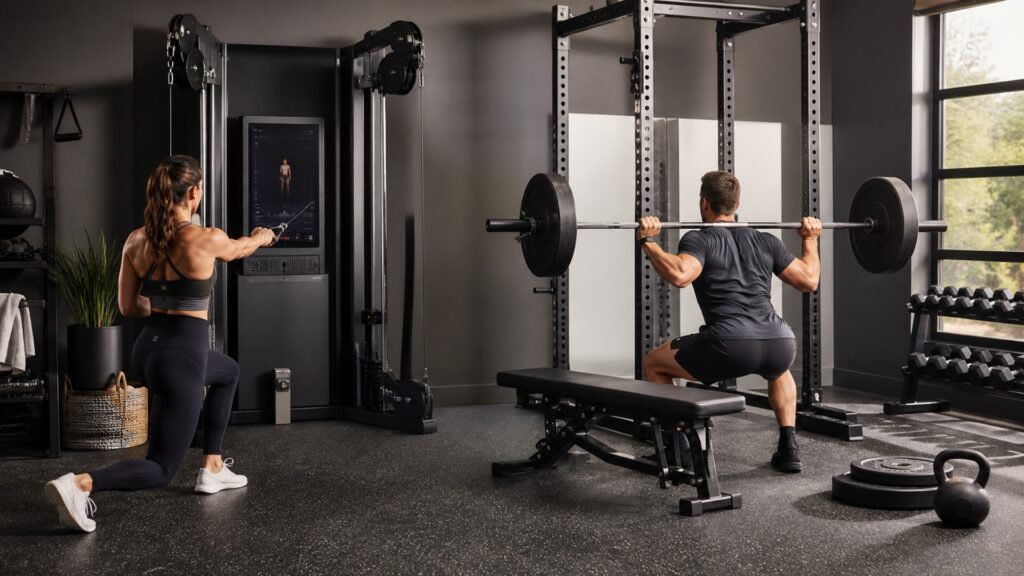
What Makes Smart Home Gyms Different from Traditional Home Gyms

Smart home gyms and traditional home gyms differ in where the training experience lives. A smart system blends hardware with software, screens, sensors, digital resistance, and guided programming. A traditional home gym relies more on physical equipment such as racks, benches, dumbbells, plates, bands, cables, and cardio machines.

That changes ownership, progression, space, coaching, repair, and daily routine. Smart systems can reduce planning and adjustment friction, but they may depend on subscriptions and software support. Traditional gyms can be more flexible and durable, but they ask more from the user.

By: Review Streets Research Lab
Updated: August 31, 2026
Explainer · 8-12 min read
smart home gyms explainer hero image for Review Streets
What You'll Learn

How Connected Resistance Differs from Conventional Equipment

The comparison turns on software dependency, resistance source, coaching, tracking, space, and long-term ownership.

  • Why smart gyms combine hardware and software into one experience
  • How traditional setups separate equipment from programming
  • Why digital resistance feels different from plates, stacks, or dumbbells
  • How subscriptions and app support affect ownership risk
  • Where data feedback can help progression and where it can mislead
  • Why space-saving designs trade off against repairability and exercise freedom

Tip: Why smart gyms combine hardware and software into one experience before comparing products or routines.

Definitions

Key Concepts That Define Smart Home Gyms vs Traditional Home Gyms

A smart home gym uses connected hardware, software, screens, sensors, or digital resistance to guide and track workouts. The cards below clarify the terms that most often change real setup decisions.

Smart home gym

A smart home gym uses connected hardware, software, screens, sensors, or digital resistance to guide and track workouts.

  • It may replace plates or stacks with motors or electromagnetic resistance.
  • Its experience depends on software as much as hardware.
  • Subscriptions and updates can affect long-term value.

Traditional home gym

A traditional home gym uses conventional equipment such as dumbbells, benches, racks, plates, bands, cables, and cardio machines.

  • The resistance is usually physical and visible.
  • It can work without an app or subscription.
  • It needs more user planning and often more storage.

Digital resistance

Digital resistance uses motors, magnets, or electronically controlled systems instead of loose plates or fixed stacks.

  • It can change load quickly and track output.
  • It may feel different from free weights or cables.
  • Repairability and software support matter.

Connected coaching

Connected coaching is the guided workout layer delivered through screens, apps, classes, or automated prompts.

  • It can reduce planning friction.
  • It can also narrow the user into the platform's programming style.
  • The coaching layer should be judged separately from the resistance hardware.

Hardware independence

Hardware independence is the ability to keep using equipment without software access, subscriptions, or cloud features.

  • Traditional gear is usually stronger here.
  • Smart systems may lose value if services change.
  • This matters for ownership risk.

Data feedback

Data feedback is the tracking of reps, load, range, tempo, or workout completion through the system.

  • It can make progression easier to see.
  • It may not capture technique or effort perfectly.
  • Useful feedback needs clear interpretation.

Tip: A traditional home gym uses conventional equipment such as dumbbells, benches, racks, plates, bands, cables, and cardio machines.

System Design

Smart Gyms Package Training Into a Platform

A smart home gym works as a connected system. Hardware, display, software, classes, tracking, and resistance control are tied together. A traditional gym separates those pieces, leaving more decisions to the user.

  • Smart systems may guide exercise order and load changes.
  • Traditional setups let the user choose programming independently.
  • A screen can reduce planning friction.
  • Platform design can limit exercise style.
  • The experience depends on both machine quality and software quality.

Smart versus traditional is partly hardware and partly control.

Resistance Source

Digital Resistance Changes Adjustment and Feel

Many smart gyms use controlled resistance rather than plates, dumbbells, or weight stacks. That can make load changes fast and compact, but the feel may differ from conventional free-weight or cable resistance.

  • Digital systems can adjust load in small steps.
  • Some can change resistance during the rep.
  • Traditional weights make loading visible and mechanically simple.
  • Free weights demand more stabilization and setup skill.
  • The best source depends on the movement and user expectation.

Resistance method shapes the workout before coaching begins.

Data and Coaching

Feedback Can Reduce Guesswork and Add Dependency

Smart gyms often track reps, load, tempo, range, or workout completion while offering guided sessions. That can help users who want structure, but it also makes the platform a major part of the product.

  • Data can show progression without a separate log.
  • Guided sessions can help users start quickly.
  • Automated feedback may not see every technique issue.
  • Subscriptions can change cost and access.
  • Software updates can improve or disrupt the experience.

The coaching layer is valuable only if the user wants that relationship with the platform.

Ownership

Traditional Equipment Is Usually Easier to Keep Independent

A rack, bench, dumbbell, or plate set keeps working without a login. A smart gym may depend on electronics, service terms, parts, apps, or ongoing content.

  • Traditional gear can be repaired or replaced piece by piece.
  • Smart systems may save space by combining functions.
  • Closed platforms can create long-term uncertainty.
  • Resale value may depend on account transfer rules.
  • Electrical and internet needs matter in the room.

Ownership risk is part of the comparison, not fine print.

Decision Boundary

Choose by Whether You Want a Platform or a Toolset

A smart gym fits users who value guidance, fast changes, tracking, and compactness. A traditional gym fits users who prefer independence, visible loading, modular upgrades, and broader exercise freedom.

  • Choose smart when coaching and data reduce friction you actually feel.
  • Choose traditional when durable tools and flexible programming matter more.
  • Check whether the subscription is optional or central.
  • Compare maximum resistance and movement variety honestly.
  • Avoid treating connected features as automatic training quality.

The difference is platform-managed training versus user-managed equipment.

Quick Reality Check

Where Smart Home Gyms vs Traditional Home Gyms Helps and Where It Needs Context

A practical balance between the useful explanation and the limits that keep the article honest.

What This Clarifies

It explains how smart home gyms vs traditional home gyms changes movement setup, training flow, or equipment decisions.

It helps readers compare real mechanisms instead of relying on vague performance or convenience claims.

What It Cannot Prove

It cannot prove that one product or method fits every body, room, routine, or goal.

It cannot replace qualified guidance for pain, medical concerns, rehabilitation, or individualized programming.

Common Myths

Misconceptions About Smart Home Gyms vs Traditional Home Gyms

Common shortcuts and misunderstandings can make the topic seem simpler than it is.

Smart Home Gyms vs Traditional Home Gyms is automatically useful for everyone

Usefulness depends on the exercise, setup, body position, space, and the exact problem the tool or concept is meant to solve.

The more advanced option is always better

Advanced features can help, but they can also add friction, cost, dependency, or setup demands that make the simpler option more practical.

One specification tells the whole story

A headline spec needs context from fit, stability, movement path, adjustment, and the user's actual training routine.

Feeling different means it is working better

A different sensation can be useful feedback, but it is not proof of better results, safer training, or faster recovery.

Fitness equipment can replace coaching or medical judgment

Equipment and metrics can support decisions, but symptoms, pain, technique problems, and health concerns need qualified human guidance.

Tip: For smart home gyms vs traditional home gyms, a claim is only useful when it names the mechanism and the conditions around it.

FAQ

Frequently Asked Questions About Smart Home Gyms vs Traditional Home Gyms

Concise answers to common questions readers may have after the main explanation.

What is the main thing to understand about smart home gyms vs traditional home gyms?

Look at the mechanism first: how it changes resistance, position, tracking, support, space, or routine flow in the specific fitness setting.

Is it necessary for every home gym or workout?

No. It matters only when it solves a real limitation or supports movements the user will repeat consistently.

How should beginners think about it?

Beginners should prioritize clear setup, repeatable movements, manageable resistance, and enough room to learn before chasing complicated features.

What is the biggest comparison mistake?

The biggest mistake is judging by category label alone instead of checking movement path, fit, adjustment, stability, and use conditions.

Can it prevent injury or guarantee results?

No. It can support better setup or clearer training decisions, but it should not be presented as a safety, rehabilitation, or performance guarantee.

Bottom Line

Smart Home Gyms vs Traditional Home Gyms matters when its mechanism changes a real training decision rather than merely adding another product label.

The practical takeaway is to match the tool, metric, or setup to the movement, room, routine, and limits that actually shape use.

Next Steps

Go Deeper or Compare Your Options

Use these related explainers to place smart home gyms vs traditional home gyms inside adjacent Fitness equipment and accessory decisions.

Why Home Gym Equipment Matters

See why equipment choices change training consistency, space planning, exercise selection, and routine friction at home.

Quick Summary

Smart Home Gyms vs Traditional Home Gyms Explained

  • Why smart gyms combine hardware and software into one experience
  • How traditional setups separate equipment from programming
  • Why digital resistance feels different from plates, stacks, or dumbbells
  • How subscriptions and app support affect ownership risk
  • Practical value depends on setup, repeated use, and honest limits.