What Makes Turbochargers Different from Superchargers

Turbochargers and superchargers both drive a compressor that raises intake pressure, increasing air mass available for combustion. Their decisive difference is the energy source: a turbo turbine extracts energy from hot exhaust flow, while a supercharger takes mechanical power from the crankshaft through a belt, gears, or another drive.

That split changes response, heat paths, exhaust restriction, packaging, lubrication, control, and efficiency. Turbo behavior depends on turbine matching, exhaust energy, rotating inertia, and wastegate control. Supercharger behavior depends on drive ratio, compressor type, bypass operation, and parasitic demand. Either system still needs suitable fuel, intercooling, calibration, engine margin, and drivetrain capacity.

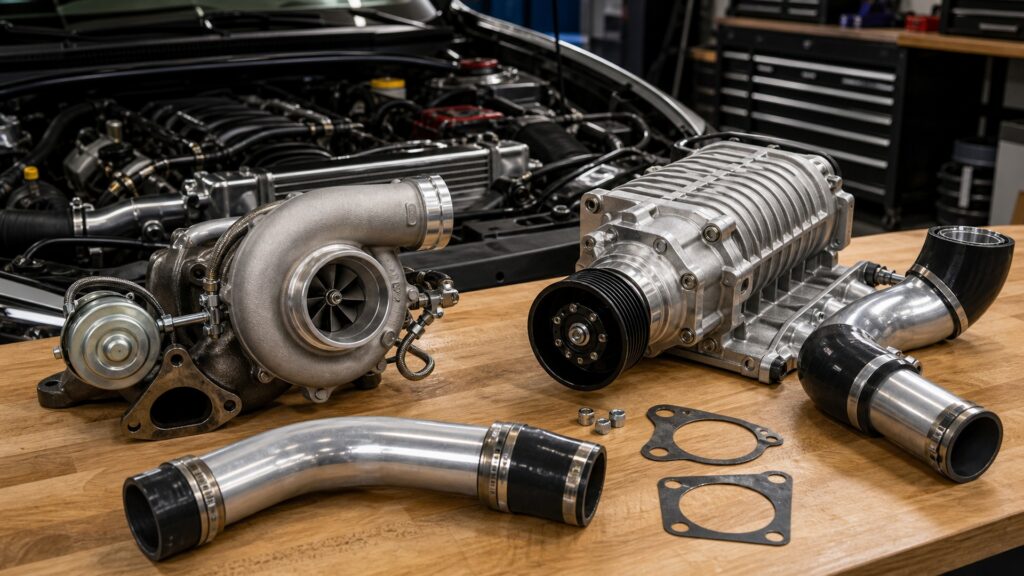
By: Review Streets Research Lab
Updated: August 31, 2026
Explainer · 8-12 min read
turbochargers different from superchargers explainer hero image for Review Streets
What You'll Learn

Trace the Operating Chain behind Turbochargers and Superchargers

For Turbochargers and Superchargers, follow physical inputs, control decisions, limiting conditions, and verification evidence to determine whether the claimed result is useful.

  • Where Each Compressor Gets Its Shaft Power
  • Why Boost Arrives Differently with Speed and Load
  • How Compression Efficiency Changes Charge Temperature
  • How Wastegates, Bypasses, and Throttles Regulate Output
  • Which Supporting Systems Receive the New Load
  • Where turbochargers and superchargers measurement separates improvement from impression

Tip: Record the turbochargers and superchargers configuration and a repeatable baseline before changing it; uncontrolled comparisons cannot identify which mechanism caused the result.

Definitions

Key Concepts That Define Turbochargers and Superchargers

These six terms locate the controlling variables inside turbochargers and superchargers.

Pressure Ratio

Absolute compressor outlet pressure divided by absolute inlet pressure.

  • Pressure Ratio has a configuration-specific meaning within turbochargers and superchargers
  • Gauge boost alone omits inlet and altitude effects
  • Verify pressure ratio directly on the vehicle before deciding

Compressor Map

Chart relating corrected flow, pressure ratio, efficiency, and operating limits.

  • Compressor Map has a configuration-specific meaning within turbochargers and superchargers
  • The full duty path matters
  • Verify compressor map directly on the vehicle before deciding

Wastegate

Valve diverting exhaust around a turbo turbine to regulate speed and boost.

  • Wastegate has a configuration-specific meaning within turbochargers and superchargers
  • Control authority depends on flow capacity
  • Verify wastegate directly on the vehicle before deciding

Bypass Valve

Valve routing air around a compressor during low demand or throttle closure.

  • Bypass Valve has a configuration-specific meaning within turbochargers and superchargers
  • Its purpose differs by layout
  • Verify bypass valve directly on the vehicle before deciding

Positive Displacement

Supercharger type moving approximately fixed volume each revolution.

  • Positive Displacement has a configuration-specific meaning within turbochargers and superchargers
  • Internal leakage and heating change real output
  • Verify positive displacement directly on the vehicle before deciding

Parasitic Loss

Crankshaft power consumed to drive a mechanical compressor and accessories.

  • Parasitic Loss has a configuration-specific meaning within turbochargers and superchargers
  • Demand rises with flow and pressure
  • Verify parasitic loss directly on the vehicle before deciding

Tip: Apply turbochargers and superchargers concepts with exact service data, calibrated instruments, and a recorded complete configuration.

Drive Energy

Where Each Compressor Gets Its Shaft Power

A turbine converts exhaust enthalpy into turbo shaft work; a supercharger drive removes work directly from the crankshaft. Neither source is free, because turbine pressure affects pumping work and mechanical drive creates parasitic demand.

  • Measure turbine inlet pressure
  • Estimate drive power
  • Compare complete engine output
  • Include accessory and pumping loss

Energy source—not the presence of boost—defines the fundamental architecture.

Response Shape

Why Boost Arrives Differently with Speed and Load

Turbo speed builds as exhaust energy accelerates the rotating group, creating transient delay influenced by sizing and controls. Positive-displacement superchargers respond closely with crank speed; centrifugal units generally build pressure more strongly at higher speed.

  • Compare transient torque curves
  • Separate throttle delay from spool
  • Review compressor type
  • Test each gear and altitude

The word supercharger does not describe one universal torque curve.

Heat and Pressure

How Compression Efficiency Changes Charge Temperature

Compressing air raises temperature. Compressor efficiency, pressure ratio, intercooler loss, recirculation, engine-bay heat, and repeated operation determine charge density and knock resistance for either architecture.

  • Plot the operating line
  • Measure intercooler approach
  • Watch heat-soak recovery
  • Protect against surge and overspeed

Boost pressure without temperature and flow cannot describe usable oxygen mass.

Control Hardware

How Wastegates, Bypasses, and Throttles Regulate Output

Turbo systems regulate turbine power using wastegates and sometimes variable geometry. Superchargers use drive ratio plus bypass or clutch strategies; both coordinate throttle, recirculation, torque requests, and pressure relief.

  • Verify actuator range
  • Pressure-test control plumbing
  • Retain surge protection
  • Log requested versus measured boost

Control authority must cover transients as well as steady-state pressure.

Installation Burden

Which Supporting Systems Receive the New Load

Turbos add hot exhaust plumbing, turbine backpressure, oil or coolant connections, and severe thermal packaging. Superchargers add belt load, brackets, pulley alignment, and crank-driven demand; both challenge fuel, cooling, calibration, engine, transmission, and traction.

  • Audit fuel-system margin
  • Shield heat-sensitive parts
  • Inspect oil and drive service
  • Validate legal emissions configuration

The better system is the one whose entire load path fits the vehicle and use case.

Quick Reality Check

What Turbochargers and Superchargers Can Change—and What It Cannot Prove

For Turbochargers and Superchargers, isolate the operative mechanism from conclusions still requiring complete-vehicle testing.

Evidence of a Coherent Result

Turbochargers differ by extracting exhaust energy through a turbine, whereas superchargers draw mechanical drive from the crankshaft; that choice reshapes response, heat, control, and installation.

A credible turbochargers and superchargers result repeats after temperature stabilization while its connected safeguards remain functional.

Claims Requiring More Evidence

Neither architecture independently guarantees power, reliability, efficiency, emissions compliance, or engine safety without compatible compressor operation and supporting systems.

Within turbochargers and superchargers, sound, sensation, a peak number, or a product label cannot establish durability, legality, or improvement throughout the operating range.

Common Myths

Misconceptions About Turbochargers and Superchargers

Common turbochargers and superchargers myths confuse a visible feature with complete-vehicle behavior.

Turbochargers make free power from wasted exhaust

A turbine recovers exhaust energy, but it also raises exhaust-side pressure and temperature and requires pumping work, lubrication, cooling, and control. Net efficiency can be excellent without making the compressor's shaft power mechanically free.

Every supercharger has instant full boost

Positive-displacement designs usually respond quickly, yet delivered pressure still depends on throttle, bypass position, leakage, speed, drive ratio, and control. Centrifugal superchargers characteristically build more pressure as impeller speed rises.

Equal boost pressure means equal power

Pressure gauges omit temperature, compressor efficiency, airflow, restriction, valve timing, residual gas, fuel, ignition, and engine pumping loss. Two systems at identical gauge pressure can trap different oxygen mass and produce different torque.

Turbo lag always means the turbo is too large

Sizing influences spool, but turbine housing, exhaust leaks, cam timing, gearing, throttle strategy, boost control, altitude, rotating inertia, and engine displacement also shape response. Diagnosis requires logs rather than one size label.

Tip: Test each turbochargers and superchargers claim under controlled conditions; then inspect the heat, force, flow, and control demands created specifically by turbochargers and superchargers.

FAQ

Frequently Asked Questions About Turbochargers and Superchargers

The following answers resolve practical decisions specific to turbochargers and superchargers.

Which system usually feels more responsive?

A positive-displacement supercharger typically gives immediate low-speed pressure, while a turbo may need exhaust energy to accelerate. Modern controls, electric assistance, gearing, displacement, and component sizing can narrow or reverse the perceived difference.

Are turbochargers more efficient than superchargers?

Turbos can recover exhaust energy instead of drawing all compressor power from the crank, often improving full-system efficiency. Turbine backpressure, heat, compressor operation, pumping loss, and duty cycle prevent a universal efficiency verdict.

Do both systems need an intercooler?

An intercooler is beneficial when compression heating materially reduces density or knock margin, but layout, pressure ratio, duty, fuel, packaging, and manufacturer design determine necessity. Some low-pressure applications use other thermal strategies.

Which forced-induction system is easier to install?

It depends on platform support. Supercharger kits may avoid custom exhaust plumbing but require precise brackets and belt drive; turbos need hot-side packaging and oil management. Both require fuel, calibration, cooling, and validation.

Can a stock engine safely accept either system?

Only within verified cylinder-pressure, temperature, fuel, knock, lubrication, and speed limits. Compression ratio, ring lands, rods, head sealing, calibration, fuel quality, duty cycle, and existing condition matter more than the architecture's name.

Bottom Line

Turbochargers differ by extracting exhaust energy through a turbine, whereas superchargers draw mechanical drive from the crankshaft; that choice reshapes response, heat, control, and installation.

Neither architecture independently guarantees power, reliability, efficiency, emissions compliance, or engine safety without compatible compressor operation and supporting systems.

Next Steps

Continue from Turbochargers and Superchargers to Its Dependent Systems

Use these adjacent mechanisms to plan, validate, and troubleshoot the complete turbochargers and superchargers decision.

Why ECU Tuning Matters

See how software coordinates boost, fueling, ignition, torque, protection, and diagnostics.