Why Forced Induction Matters

Forced induction matters because a compressor raises intake pressure so an engine can trap more air mass than atmospheric filling alone permits. More oxygen allows more fuel and torque from the same displacement, while altitude compensation and downsizing can broaden the engineering value beyond peak horsepower. Compression also raises charge temperature.

The added cylinder pressure, heat, exhaust mass, fuel demand, torque, and control complexity propagate through pistons, head sealing, lubrication, cooling, catalysts, transmission, tires, and emissions systems. Turbochargers and superchargers supply compressor power differently, but both require appropriate compressor operation, charge cooling, boost control, calibrated combustion, mechanical margin, and repeated validation.

By: Review Streets Research Lab
Updated: August 31, 2026
Explainer · 8-12 min read
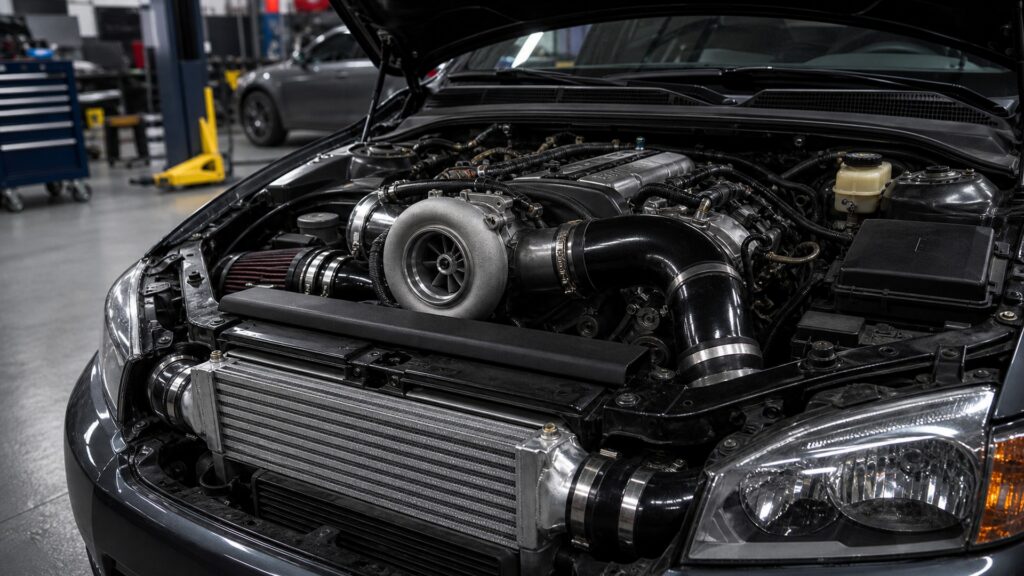
forced induction explainer hero image for Review Streets
What You'll Learn

Trace the Operating Chain behind Forced Induction

For Forced Induction, follow physical inputs, control decisions, limiting conditions, and verification evidence to determine whether the claimed result is useful. Establish compressor speed, turbine-pressure, injector, pump, crankcase-pressure, charge-cooler, and knock-response limits before pursuing a target. Examine boost entry and throttle closure because actuator preload, recirculation, gear selection, ambient pressure, and exhaust energy can create transient overshoot or unstable operation that never appears in a stabilized pressure reading. Track the route through corrected flow and pressure ratio as engine speed climbs, then compare it with surge, choke, efficiency islands, and shaft-speed boundaries. Include filter loss and intercooler pressure drop rather than plotting manifold boost against ideal atmosphere. This identifies whether a hotter charge or falling mass delivery comes from compressor selection, control authority, or another restriction. Pressure-test the assembled tract at a controlled low value and listen for leaks around couplers, bypass valves, manifold joints, and reference hoses before loading the engine. Inspect drain routing, oil aeration, belt dust, turbine housing clearance, wastegate linkage, and heat-shield air gaps after repeated cycles. When evaluating fuel delivery, compare commanded rail pressure with measured pressure while accounting for manifold reference and electrical voltage. Review spark plugs, crankcase ventilation, coolant loss, and filter debris between sessions. These physical checks can expose compressor-system faults that electronic logs misclassify as calibration noise, fuel inconsistency, or ordinary adaptation.

  • How Compression Raises Potential Cylinder Torque
  • Why More Oxygen Demands Calibrated Energy and Knock Control
  • Where Compression and Power Send Thermal Load
  • How Cylinder Pressure Reaches the Drivetrain and Tires
  • Why Software and Hardware Must Govern the Same Envelope
  • Where forced induction measurement separates improvement from impression

Tip: Record the forced induction configuration and a repeatable baseline before changing it; uncontrolled comparisons cannot identify which mechanism caused the result.

Definitions

Key Concepts That Define Forced Induction

These six terms locate the controlling variables inside forced induction.

Boost Pressure

Intake pressure above the chosen atmospheric reference.

  • Boost Pressure has a configuration-specific meaning within forced induction
  • Gauge value does not describe mass or temperature
  • Verify boost pressure directly on the vehicle before deciding

Pressure Ratio

Absolute compressor outlet pressure divided by absolute inlet pressure.

  • Pressure Ratio has a configuration-specific meaning within forced induction
  • Inlet restriction and altitude affect it
  • Verify pressure ratio directly on the vehicle before deciding

Compressor Map

Chart of corrected flow, pressure ratio, efficiency, surge, and speed limits.

  • Compressor Map has a configuration-specific meaning within forced induction
  • Operation traces a path rather than one point
  • Verify compressor map directly on the vehicle before deciding

Charge Density

Air mass contained in a given intake volume after compression and cooling.

  • Charge Density has a configuration-specific meaning within forced induction
  • Heat and pressure loss alter it
  • Verify charge density directly on the vehicle before deciding

Knock Margin

Distance between current combustion conditions and damaging autoignition.

  • Knock Margin has a configuration-specific meaning within forced induction
  • Fuel, heat, pressure, and timing change it
  • Verify knock margin directly on the vehicle before deciding

Fuel-System Headroom

Unused pump, injector, line, and pressure-control capacity at maximum demand.

  • Fuel-System Headroom has a configuration-specific meaning within forced induction
  • Transient and hot conditions must be included
  • Verify fuel-system headroom directly on the vehicle before deciding

Tip: Apply forced induction concepts with exact service data, calibrated instruments, and a recorded complete configuration.

Air-Mass Increase

How Compression Raises Potential Cylinder Torque

A compressor increases absolute pressure, but usable oxygen depends on flow, temperature, intercooler loss, throttle, valves, residual gas, and engine speed. Pressure ratio and corrected flow locate the operating point.

  • Plot the compressor operating path
  • Measure manifold temperature
  • Include inlet restriction
  • Avoid surge and speed limits

Boost pressure is one coordinate, not a complete measure of trapped charge.

Combustion and Fuel

Why More Oxygen Demands Calibrated Energy and Knock Control

Additional air requires proportional fuel delivery and ignition appropriate for higher cylinder pressure. Fuel quality, mixture, charge temperature, compression ratio, deposits, and chamber design establish knock and exhaust-temperature margin.

  • Verify rail pressure under load
  • Monitor knock by cylinder
  • Retain conservative thermal protection
  • Test the worst intended fuel

Lean capacity assumptions or excessive timing can convert added air into destructive pressure.

Heat Rejection

Where Compression and Power Send Thermal Load

Compressor inefficiency heats the charge, while extra combustion raises coolant, oil, exhaust, catalyst, turbine, and underhood temperature. Intercoolers transfer heat but add volume and pressure loss.

  • Measure heat-soaked charge temperature
  • Review oil and coolant recovery
  • Shield nearby components
  • Repeat the full duty cycle

One cool dyno pull cannot establish thermal durability.

Mechanical Load Path

How Cylinder Pressure Reaches the Drivetrain and Tires

Pistons, rings, rods, bearings, head fasteners, clutch, converter, gearbox, shafts, differentials, mounts, and tires receive higher force or heat. Torque spikes and low-speed cylinder pressure can be more consequential than peak horsepower.

  • Estimate torque by gear
  • Inspect engine condition first
  • Validate crankcase ventilation
  • Check transmission and traction limits

A compressor kit does not increase the capacity of every downstream component.

Boost Control and Compliance

Why Software and Hardware Must Govern the Same Envelope

Wastegates, bypass valves, throttles, recirculation, torque requests, knock control, and failsafes regulate pressure and speed. Exhaust aftertreatment, diagnostics, noise, and anti-tampering rules remain part of a road-vehicle installation.

  • Log requested and measured pressure
  • Test actuator authority
  • Retain onboard monitoring
  • Use application-specific legal documentation

A controlled, diagnosable system is more valuable than an uncontrolled peak boost number.

Quick Reality Check

What Forced Induction Can Change—and What It Cannot Prove

For Forced Induction, isolate the operative mechanism from conclusions still requiring complete-vehicle testing.

Evidence of a Coherent Result

Forced induction matters because compressed intake air can increase trapped oxygen and torque, but it simultaneously raises thermal, combustion, mechanical, control, fuel, and compliance demands.

A credible forced induction result repeats after temperature stabilization while its connected safeguards remain functional.

Claims Requiring More Evidence

Boost pressure alone cannot establish charge density, safe cylinder pressure, compressor efficiency, fuel capacity, durability, emissions legality, or drivetrain survival.

Within forced induction, sound, sensation, a peak number, or a product label cannot establish durability, legality, or improvement throughout the operating range.

Common Myths

Misconceptions About Forced Induction

Common forced induction myths confuse a visible feature with complete-vehicle behavior.

More boost always means proportionally more power

Pressure can rise while charge temperature, restriction, turbine backpressure, ignition retard, fuel shortage, compressor inefficiency, or throttle closure reduce oxygen and torque. Power follows safely burned air mass and effective cylinder pressure, not gauge boost alone.

An intercooler eliminates forced-induction heat problems

A cooler reduces charge temperature within its effectiveness and flow capacity, but engine coolant, oil, exhaust, catalysts, turbine, transmission, and underhood parts still absorb additional heat. Repeated duty and recovery require separate validation.

A conservative tune makes any stock engine safe

Calibration can manage fuel, timing, torque, and protections only inside the engine's mechanical, thermal, lubrication, sealing, and fuel-quality limits. Existing wear, weak components, or excessive pressure cannot be repaired through software.

Turbo and supercharger kits need only bolt-on installation

Mechanical fit is one stage. Fuel supply, calibration, oil and coolant routing, crankcase ventilation, belt or exhaust integrity, heat shielding, sensors, diagnostics, drivetrain capacity, emissions legality, and repeated testing complete the system.

Tip: Test each forced induction claim under controlled conditions; then inspect the heat, force, flow, and control demands created specifically by forced induction.

FAQ

Frequently Asked Questions About Forced Induction

The following answers resolve practical decisions specific to forced induction.

How much boost can a stock engine handle?

There is no universal pressure value. Engine condition, compression, chamber design, fuel, temperature, compressor efficiency, torque target, speed, calibration, duty cycle, and component variation determine the safe cylinder-pressure and thermal envelope.

Why does an intercooler improve performance?

Cooling compressed air raises density and knock margin, potentially allowing more oxygen or safer timing. Core effectiveness, pressure drop, airflow, heat soak, water condensation, plumbing volume, and ambient temperature determine the actual benefit.

What causes turbocharger compressor surge?

Surge occurs when compressor operation crosses into unstable low-flow behavior at a given pressure ratio, often during throttle closure or poor matching. Bypass control, plumbing, throttle transients, map position, and system volume influence severity.

Does forced induction require premium fuel?

Use the fuel specified by the validated calibration. Higher octane can increase knock resistance but does not fix inadequate delivery, excessive charge temperature, wrong mixture, poor fuel quality, or a tune designed for another ethanol content.

What should be monitored after adding boost?

Log pressure ratio, airflow, charge temperature, fuel pressure, mixture, ignition, knock, wastegate or bypass command, coolant and oil temperature, torque intervention, misfires, diagnostics, and compressor limits during repeated realistic operation.

Bottom Line

Forced induction matters because compressed intake air can increase trapped oxygen and torque, but it simultaneously raises thermal, combustion, mechanical, control, fuel, and compliance demands.

Boost pressure alone cannot establish charge density, safe cylinder pressure, compressor efficiency, fuel capacity, durability, emissions legality, or drivetrain survival.

Next Steps

Continue from Forced Induction to Its Dependent Systems

Use these adjacent mechanisms to plan, validate, and troubleshoot the complete forced induction decision.

Why ECU Tuning Matters

Follow how sensors, fuel, spark, boost, torque, safeguards, and diagnostics are coordinated.