
Chemical Energy
Potential retained in battery materials that can be converted into terminal voltage and external electrical current.
- Chemistry sets safe boundaries
- Charge restores reactive state
- Damage can release heat
Vehicle batteries hold chemical energy and supply direct current to starting, control, accessory, or propulsion circuits. Their failures appear through voltage sag, reduced capacity, abnormal resistance, charging faults, imbalance, isolation warnings, heat, or connection problems. Battery tests ask whether stored energy can be delivered and replenished safely.
Brake components manage motion. Hydraulic or electromechanical force presses friction materials together so kinetic energy becomes heat; electrified vehicles may first recover part of that energy through the motor before friction brakes complete or stabilize the stop. Brake tests ask whether commanded deceleration is predictable at every wheel. Regeneration links the systems, but it does not make a battery a brake or friction hardware an energy store.
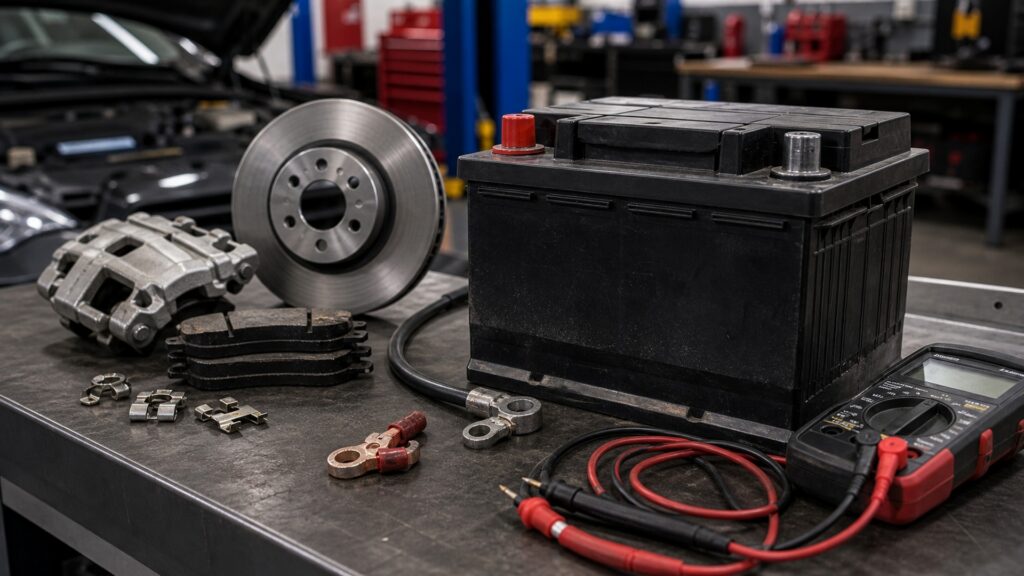
The comparison depends on where energy begins, where it travels, what converts it, and which failure threatens electrical availability or vehicle control.
Tip: Any soft pedal, fluid leak, smoke, grinding with reduced control, or severe pull takes priority over battery testing because the vehicle may be unable to stop predictably.
These terms distinguish an electrical reservoir from a motion-control system, including their limited connection during regenerative braking.
Potential retained in battery materials that can be converted into terminal voltage and external electrical current.
High low-voltage current supplied to a starter motor while an internal-combustion engine is being rotated for startup.
Fluid pressure generated or controlled within a brake circuit to transmit force toward calipers or wheel cylinders.
A condition-dependent relationship between contacting materials that helps determine braking force for a given clamp or normal load.
Energy associated with vehicle mass and speed that must be reduced when the driver or control system commands deceleration.
Controlled use of an electric drive motor as a generator to slow the vehicle and return eligible energy toward the traction battery.
Tip: Draw the energy direction: batteries discharge into electrical loads; brakes remove vehicle motion, with regeneration returning only controlled energy through the drive system.
A battery supports low-voltage networks or propulsion by maintaining potential across its terminals. Its usable output depends on charge, resistance, temperature, connections, chemistry, and protective control.
The battery supplies power; it does not directly create wheel-friction force.
A pedal or automated command becomes hydraulic pressure or electromechanical action, clamp force, and friction torque. Tires then transmit that force to the road while stability controls distribute it.
Brake effectiveness is proved by controlled deceleration, not by electrical state of charge.
Large current through internal resistance warms a battery and connections. Braking concentrates kinetic energy in rotors, drums, pads, and surrounding air. Location and timing distinguish the heat source.
A hot terminal and a hot rotor require different isolation, tools, and repair logic.
During eligible deceleration, the motor generates electrical power and the pack accepts a controlled portion. At low speed, high charge, limited temperature, hard stops, or faults, friction brakes supply more of the demand.
A full battery can change regenerative feel without making friction hardware optional.
Battery work requires safe connection, correct fitment, load performance, charging, communication, and isolation checks. Brake work requires leak-free hydraulics, correct assembly, free rotation, bedding where specified, and predictable stops.
Passing one energy test cannot certify the other system.
Batteries govern electrical availability, while brake components govern deceleration and heat. Regeneration routes energy between them only under controlled conditions.
State of charge, voltage under load, capacity, internal resistance, terminal and cable condition, charging behavior, temperature, cell balance, communications, and high-voltage isolation.
Starting difficulty, electrical resets, reduced range, charge faults, or pack warnings justify battery-path tests while starter, converter, alternator, wiring, loads, and controls remain in scope.
Pedal travel, hydraulic pressure, fluid integrity, pad or shoe thickness, rotor or drum condition, wheel drag, friction temperature, stability data, stopping response, and regenerative blending.
Reduced regeneration does not prove failed friction components, and a worn pad does not prove battery weakness. Diagnose each path and control any stopping hazard before pursuing convenience or range complaints.
Regenerative braking makes the two systems cooperate, which can invite the mistaken belief that they share parts, measurements, or maintenance logic.
Regeneration can reduce friction use in some conditions, but friction brakes still stop at low speeds, supplement hard stops, stabilize the vehicle, and operate when recovery is limited. Corrosion, sticking, and wear still require inspection.
Battery or electrical faults may affect powered assistance or warnings on some vehicles, but excessive hydraulic travel demands immediate brake-system diagnosis. Check fluid, leaks, air, adjustment, hardware, and manufacturer procedures rather than assuming low charge.
Correcting drag may reduce wasted energy, but pads do not restore battery capacity, cell balance, charge acceptance, or power electronics. Measure wheel drag and the electrical energy system separately before attributing range loss.
High state of charge can limit regenerative energy acceptance, increasing reliance on friction braking while controls preserve requested deceleration. Properly functioning brakes should remain predictable; the battery display alone does not certify stopping performance.
Tip: Treat regeneration as an energy-transfer bridge while retaining separate battery and friction-brake evidence, hazards, and release standards.
These answers address regenerative blending, shared warning systems, heat, maintenance, and why electrical and stopping tests must remain independent.
Some vehicles use electrically powered brake assist or integrated controls, so low-voltage faults can affect warnings or assistance. Follow the vehicle's emergency guidance, read all modules, and test both supply and brake operation safely.
The pack may accept less regenerative energy near its charge or temperature limits. Controls compensate with friction braking, but the transition can feel different. Persistent, severe, or warning-accompanied changes require qualified inspection.
Yes. Unwanted friction increases propulsion energy demand, reducing fuel economy or electric range. That does not prove the battery is defective; compare wheel temperatures and drag while also evaluating charge, resistance, and energy-use data.
Control the immediate hazard. Unreliable stopping, fluid leakage, smoke, severe pulling, or grinding outranks a starting or range complaint. Battery overheating, arcing, damage, or high-voltage warnings also require isolation and qualified response.
Keep battery load, charge, temperature, isolation, and replacement data apart from pad thickness, rotor measurements, fluid work, wheel temperatures, pedal observations, bedding, and stopping verification. Event-specific records prevent false associations later.
Vehicle batteries store chemical energy and supply electrical current; brake components remove kinetic energy through controlled friction and, in electrified vehicles, coordinated regenerative recovery.
Follow energy direction and test the correct reserve: electrical delivery and recharge for batteries, predictable hydraulic, friction, and blended deceleration for brakes. Treat regeneration as a bridge, not evidence that the systems are interchangeable.
Related explainers show the battery's internal conversion, the brake system's wheel-end conversion, and the fitment constraints that keep stored energy safely retained.
Trace chemical potential, ion movement, external current, cell stacking, and controlled recharging.
Follow pedal command, hydraulic force, friction contact, wheel torque, heat, and stability control.
Match battery voltage, chemistry, case, terminals, retention, venting, sensing, and controls.
Choose a retailer
Prices checked regularly. We may earn a commission at no cost to you.