
Shared Low-Voltage Bus
The common electrical network through which a battery, charging source, grounds, modules, actuators, and accessories exchange power.
- Many loads reveal source faults
- Ground paths complete circuits
- Converters may support the bus
A vehicle battery is a source and buffer. It converts chemical potential into direct current for the starter, modules, accessories, and—in an electrified powertrain—may also form the high-voltage propulsion reservoir. Its condition influences many loads through available charge, resistance, temperature, connections, and charging support.
Ignition components are event-makers in gasoline engines. The controller begins coil dwell at a calculated crank position, primary current builds a magnetic field, switching collapses that field, and a secondary pulse breaks down the plug gap so combustion can begin at the commanded time. The battery can limit this process during cranking, but it does not choose the cylinder or create the final spark geometry. Supply faults and event faults need different evidence.
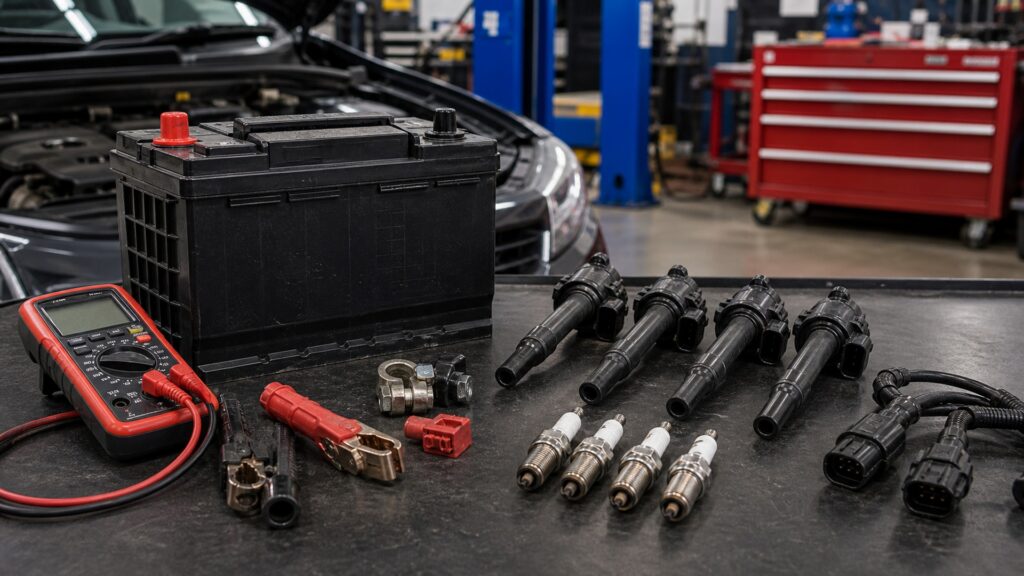
The battery establishes electrical opportunity; ignition components transform and schedule a small portion of it into a combustion trigger.
Tip: Stabilize battery supply before interpreting marginal ignition waveforms, but do not let a successful charge erase a repeatable cylinder-specific fault.
These terms define the boundary between vehicle-wide electrical availability and the timed energy conversion at a gasoline cylinder.
The common electrical network through which a battery, charging source, grounds, modules, actuators, and accessories exchange power.
The battery's practical margin for sustaining starter and control-system demand during repeated or difficult starting conditions.
The commanded interval during which primary current builds magnetic energy before the ignition switch opens for a spark event.
The rise of current through a coil's low-voltage winding as inductance, resistance, supply, dwell, and driver behavior interact.
The high potential induced in the coil's secondary winding and applied across insulation, terminals, and the spark-plug gap.
The measured rotational angle and speed reference used by engine controls to schedule ignition and interpret cylinder contribution.
Tip: Capture battery voltage, starter current, cranking speed, coil current, and cylinder data on the same timeline whenever the systems appear to interact.
During cranking, the battery may feed a starter drawing far more current than ignition while keeping engine computers, pumps, injectors, and coils above operating thresholds. A source problem can disturb several functions together.
Broad electrical instability points upstream toward supply or distribution.
The controller schedules dwell, monitors primary current, and releases coil energy for a selected cylinder. The plug gap then ionizes inside a specific chamber whose pressure and mixture determine voltage demand.
A repeated single-cylinder pattern points downstream of the shared bus unless supply evidence says otherwise.
Coil windings and rapid switching trade current and time for the voltage needed to cross the plug gap. The battery remains on the primary side; insulation and plug geometry govern the secondary side.
A normal battery test cannot certify coil insulation or plug discharge.
Battery location, charge, and ambient temperature shape capacity and resistance. Coils and boots endure rapid underhood cycling, plug-well heat, and localized electrical stress that may create hot-soak misfires.
Temperature can affect both while preserving distinct failure patterns.
Graphing battery-post voltage, cable drop, starter current, coil current, dwell, synchronization, and misfire evidence reveals whether the event failed because supply collapsed or the timed converter malfunctioned.
Interaction is measured, not assumed from electrical proximity.
One component family stores and distributes energy across the vehicle; the other meters, transforms, insulates, and discharges energy for a particular gasoline-cylinder event.
State of charge, loaded voltage, capacity, resistance, cable drop, cranking current, temperature, connections, charging support, low-voltage stability, traction-pack data, and isolation belong to the source path.
Weak starting, multiple module resets, dimming, lost reserve, charge faults, or system-wide low voltage justify upstream testing before individual ignition parts are condemned.
Coil command, dwell, primary current, secondary leakage, plug fitment and gap, firing demand, crank synchronization, cylinder misfire, combustion timing, and load or hot-soak sensitivity belong to the event path.
A no-start alone proves neither category. Starter condition, charging, fuel, injection, air, compression, mechanical timing, sensors, controls, wiring, grounds, and authorization can interrupt the same starting sequence.
Because the battery supplies the coil primary circuit, an electrical interaction is often simplified into the false idea that either part can explain every starting or misfire complaint.
The battery supplies low-voltage primary current. Coil inductance, winding ratio, and rapid switching create the secondary pulse, while plug gap and chamber conditions determine breakdown demand. Battery supply affects margin but not the complete mechanism.
A shared supply issue usually affects more than one event, but wiring layout, dwell compensation, compression, and load can expose one cylinder first. Test battery voltage and distribution while diagnosing the cylinder-specific path.
Restored voltage can improve cranking and coil charging, but it cannot reverse electrode erosion, correct gap, remove conductive tracks, repair a cracked insulator, or change wrong plug geometry. Re-evaluate ignition evidence after supply stabilization.
Coils do not turn the crankshaft. Low cranking speed requires battery, cable, starter, control, oil-viscosity, and mechanical-load testing. New coils may mask nothing and can introduce connector, boot, or fitment problems.
Tip: Distinguish shared effects from cylinder effects, then observe both systems during the same event before assigning cause.
These answers address shared voltage, cylinder-specific faults, dwell compensation, high-voltage traction batteries, and an efficient testing order.
Yes. Supply sag can slow coil-current buildup, disrupt injectors or modules, and alter cranking speed. Record battery posts, cable drops, current, synchronization, and cylinder counts together before deciding whether the misfire remains ignition-specific.
Coil current builds at a rate shaped by supply voltage, resistance, and inductance. The controller can alter dwell to reach intended energy without overheating the coil or driver, but compensation cannot overcome unlimited voltage loss.
Battery-electric vehicles have no gasoline combustion and therefore no spark-ignition coils or plugs. Hybrids may combine a traction battery, a low-voltage battery, and ignition components for an internal-combustion engine within separate energy paths.
Check architecture, battery state, terminal voltage under cranking, cable drops, starter current, and module stability first. Once supply and rotation are adequate, evaluate synchronization, coil command, spark, fuel, compression, and mechanical timing.
Stable battery-post voltage and acceptable distribution coexist with repeatable abnormal coil current, command, insulation, plug, timing, or cylinder evidence under the complaint condition, and correcting that specific ignition fault restores combustion without artificial supply support.
Vehicle batteries maintain shared electrical supply from stored chemical energy; ignition components take a timed portion of low-voltage current and transform it into a cylinder-specific high-voltage discharge.
Use vehicle-wide voltage, current, charge, connection, and charging evidence for batteries. Use dwell, current ramp, secondary containment, plug geometry, synchronization, and cylinder contribution for ignition—and compare both on one timeline when they interact.
Related explainers deepen the battery's electrochemical source, the ignition conversion sequence, and the operating data that reveal whether voltage sag or spark-path failure occurs first.
Trace electrochemical conversion, current flow, cell stacking, resistance, and charging on the source side.
Follow dwell, magnetic field collapse, secondary voltage, plug ionization, and combustion timing.
Measure charge, resistance, loaded voltage, power, temperature, and protective limits in context.
Choose a retailer
Prices checked regularly. We may earn a commission at no cost to you.