
Access Control
The rules and credentials governing legitimate entry, disarm, starting, and recovery for a vehicle.
- Identity changes permissions
- Revocation limits exposure
- Fallback remains authorized
Vehicle security systems manage protected state. They interpret credentials, openings, movement, impact, tilt, and timing to decide whether to alarm, notify, restrict starting, or permit authorized recovery. Their central question is whether a configured access or intrusion condition requires a response now.
Dash cameras preserve a bounded view of light, motion, sound where enabled, and time. They may record while driving or parked and may flag impact, but a clip normally documents only what entered the lens and storage window. Cameras can support review after an event; they do not automatically authenticate a driver or control starting. The two systems can share power and triggers while retaining different jobs and evidentiary limits.
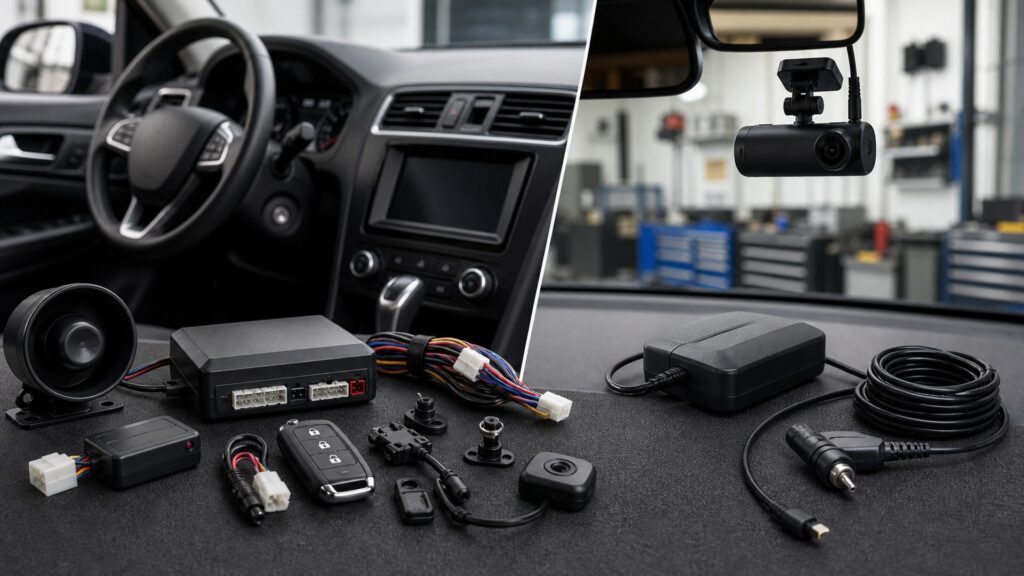
The comparison follows purpose, sensors, time, response, evidence, shared installation, and verification.
Tip: Ask whether the needed result is an immediate access decision or a later record of a limited scene.
These definitions separate security authority from visual documentation.
The rules and credentials governing legitimate entry, disarm, starting, and recovery for a vehicle.
A configured opening, motion, impact, tilt, or authorization condition evaluated while the security system is armed.
A sequence of images, and sometimes audio or metadata, captured within a camera's view and operating interval.
The time span a recording remains available before loop overwrite, deletion, corruption, or storage exhaustion removes it.
The local or remote route carrying an event message from a controller to a person or service.
The boundary on what an alarm record or video clip can reliably establish about cause, identity, sequence, location, or completeness.
Tip: Keep controller decisions, recorded pixels, timestamps, and retention as distinct evidence.
Security logic can arm zones, validate credentials, command alarms, or deny normal starting. A camera acquires images and writes files. Even when one triggers the other, control authority and documentation remain separate.
Prevention, response, and recording are related goals rather than interchangeable functions.
Door contacts, immobilizer messages, tilt, or interior motion describe security conditions. Image sensors capture light through a lens, bounded by framing, exposure, obstruction, darkness, weather, and reflections.
A sensor can only support claims about the physical phenomenon it measures.
A security event may exist only at a transition from closed to open or authorized to denied. A useful clip needs recording before, during, and after the event plus correct time and protection from overwrite.
A matching trigger does not guarantee a complete or synchronized record.
Both systems may run unattended, wake on impact, use cellular links, or compete for windshield and trim space. Combined current, heat, radio behavior, network sleep, and trigger polarity require testing.
A shared installation must preserve both observation and protection without draining the vehicle.
Security proof covers armed state, zone identity, response commands, notification, authorization, and recovery. Camera proof covers framing, focus, exposure, time, audio settings, file integrity, retention, export, and playback.
Two incomplete records do not become complete merely because their timestamps are close.
Security records may identify a zone and response without showing the actor, while video may show part of a scene without proving authorization, intent, or complete sequence.
A security trigger can protect a relevant clip when timing, polarity, and storage behavior are verified.
Aligned clocks can help reviewers compare controller history with recorded scene changes.
The camera cannot see outside its field or recover overwritten footage.
The security system cannot derive identity or complete visual context from a zone event alone.
These myths assign evidentiary powers to sensors that observe different phenomena.
Video can document a person or vehicle in view, but it does not normally validate keys, change immobilizer authorization, supervise entry zones, or deny starting. Those functions require vehicle and security control logic.
The camera may be asleep, facing elsewhere, blocked, overexposed, corrupted, late to wake, or out of storage. Verify pre-event recording, trigger input, file protection, framing, timestamps, and playback under parked conditions.
Clock agreement helps correlation but does not prove causation, identity, or completeness. Multiple events may occur close together, time zones can differ, and either device can drift or record only part of the sequence.
Coverage, account access, server delay, subscription status, bandwidth, file selection, retention policy, and power can interrupt upload. Keep local storage healthy, confirm delivery, protect credentials, and export important files through documented methods.
Tip: Describe exactly what each record contains and omits.
These answers clarify selection, synchronization, parked operation, privacy, and incident review.
Choose a supported vehicle-security solution because credential and immobilizer logic own start authorization. A dash camera can preserve visible activity near the vehicle but should not be treated as the controller for legitimate or denied starting.
Choose a camera with suitable field of view, low-light performance, parked mode, retention, file protection, export, and privacy controls. Security event logs can complement the clip but cannot supply missing pixels or audio.
Confirm supported voltage or data signaling, direction, pulse duration, isolation, wake delay, event labeling, repeated-trigger behavior, and fault effects. Then create controlled events and verify both security response and protected video independently.
Measure the vehicle's baseline sleep current, each system separately, and both together after networks settle. Repeat for weak coverage, repeated events, low-voltage cutoff, realistic storage duration, battery condition, and seasonal temperature.
Secure relevant video exports, original metadata, security event history, notification records, timestamps, account activity, and notes about observed conditions. Avoid editing originals, protect access, and follow applicable reporting, insurance, and privacy procedures.
Vehicle security systems differ from dash cameras because security controls protected state and immediate response, while cameras retain a limited visual history. Their sensors, time windows, and evidence answer different questions.
Combine them only with verified triggers, synchronized clocks, healthy storage, bounded parked power, and clear data permissions. Accept each system independently before using their records together.
These explainers deepen security state control, camera capture, and the risks of their shared parked installation.
Follow the security chain from arming and credentials through event decisions, responses, and recovery.
Follow optical capture, encoding, storage, retention, export, and playback through the dash-camera chain.
Control parked power, access, privacy, false alarms, data exposure, and authorized incident recovery.
Choose a retailer
Prices checked regularly. We may earn a commission at no cost to you.