
Fail-Safe Behavior
The predictable condition reached when power, communication, a sensor, or an integration path becomes unavailable.
- Safety remains primary
- Failure must be visible
- Recovery stays authorized
Vehicle security is safety-relevant whenever it changes access, starting, electrical loads, alarms, location data, or driver attention. A poorly integrated immobilizer can strand an authorized user, a loose wire can disturb another circuit, and an uncontrolled siren can create repeated nuisance events. Protection must not trade one hazard for another.
Safety also extends beyond installation. Shared credentials, weak account recovery, exposed location history, outdated software, and indefinite data retention can expand access rather than constrain it. A responsible system limits privileges, contains faults, preserves emergency procedures, and returns the vehicle to a known state after low voltage, connectivity loss, service, or an alarm.
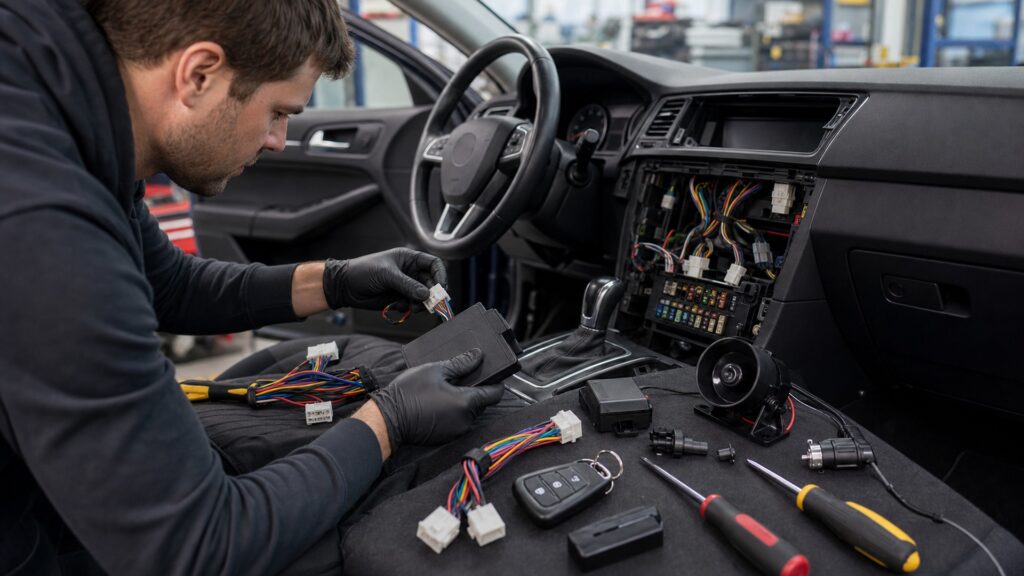
The review separates installation safety, authorized access, nuisance behavior, parked energy, data exposure, and recovery.
Tip: A protection layer is acceptable only when its failure leaves a predictable, documented, and recoverable vehicle state.
These terms identify the controls that keep anti-theft functions from creating new hazards.
The predictable condition reached when power, communication, a sensor, or an integration path becomes unavailable.
A documented legitimate method for entry, occupant assistance, or vehicle recovery when normal electronic access is unavailable.
The safety, social, battery, and attention cost created when normal conditions repeatedly produce security responses.
The usable parked energy remaining after factory and added loads, temperature effects, aging, and storage duration.
The explicit authority granted to users, apps, installers, services, or accounts to view events, location, credentials, or commands.
The defined set of vehicle circuits, software functions, credentials, and data an authorized installer may access or change.
Tip: Define both the protected asset and the safe authorized fallback.
Added wiring must respect circuit loading, fuse placement, insulation, routing, crash zones, heat, moisture, airbags, restraints, and multiplexed networks. Immobilization must follow supported design rather than arbitrary interruption of a convenient conductor.
A theft deterrent cannot justify an unsafe vehicle circuit.
Lost fobs, depleted batteries, injured occupants, towing, repairs, and handoff to another driver require controlled fallback. Procedures should identify who may act, what evidence is required, and what state follows recovery.
Strong access control includes a legitimate recovery path rather than secret improvisation.
Excess sensitivity, confusing tones, unexpected start denial, repeated phone alerts, or alarm activation during transport can distract people and erode trust. Configure while parked and distinguish urgent security events from maintenance notices.
A warning that is routinely ignored no longer supports the intended protective decision.
Always-on modules consume battery energy; weak coverage may increase radio activity; undersized conductors or loose joints can generate heat. Measure stabilized current and inspect thermal behavior under realistic parking conditions.
Electrical safety includes both immediate protection and days of unattended operation.
Use unique credentials, current supported software, explicit permissions, secure transfer when ownership changes, and logs for sensitive commands. After a suspected compromise, follow authorized revocation and recovery rather than experimenting with bypasses.
Security data and remote control deserve the same lifecycle discipline as physical keys.
Remote commands, immobilization, location history, and always-on connectivity add capability while increasing the importance of authentication, fault containment, privacy, and authorized recovery.
Supported interfaces keep safety circuits intact and expose degraded operation before protection disappears.
Credential, data, and recovery procedures limit access to legitimate users across the ownership lifecycle.
No security system prevents every theft method, vandalism event, credential compromise, or service mistake.
Alerts and tracking assist response but cannot guarantee intervention, recovery, or preservation of evidence.
These myths confuse aggressive restriction with safe, dependable protection.
Interrupting an arbitrary circuit can affect diagnostics, safety behavior, reliability, or emergency mobility. Use only supported vehicle-specific authorization designs, qualified installation, proper protection, and a documented recovery method rather than improvised hidden cuts.
Excess sensitivity can turn traffic, weather, animals, or normal handling into repeated alarms, draining energy and teaching people to ignore warnings. Tune with recorded events and preserve enough discrimination to identify meaningful changes.
Either credential can be lost, copied, shared, intercepted, or left active after ownership changes. Security depends on authentication strength, device protection, revocation, account recovery, audit history, and limited permissions rather than credential format alone.
Position reports may be delayed, unavailable, inaccurate, disabled, or unsafe to pursue personally. Preserve evidence, contact authorities and insurers, protect account access, and treat tracking as one recovery aid rather than a promise of retrieval.
Tip: Evaluate failure consequences for occupants, legitimate users, and the vehicle.
These answers address safe installation, nuisance control, parked power, digital access, and incident response.
Airbag, restraint, brake, steering, powertrain, high-voltage, safety-warning, and multiplexed network circuits require exact authorized information. Visual wire color or convenient voltage is not enough evidence for cutting, loading, grounding, or command injection.
Use event history to identify the initiating zone, inspect mounting and wiring, reproduce normal vibration or movement, adjust one documented setting at a time, and confirm that intended intrusion events still cross the response threshold.
Start with battery health, measure stabilized sleep current, verify radio and network sleep, bound notification retries, protect against low voltage, and test realistic storage duration and temperature rather than relying solely on a module specification.
Only named legitimate users and necessary services should keep the minimum permissions required. Remove installer sessions, shared temporary codes, former drivers, sold-vehicle accounts, and unused integrations while retaining secure ownership and recovery records.
Move to a safe location, preserve alerts and logs, contact appropriate authorities or providers, revoke exposed credentials through authorized channels, inspect the vehicle professionally, restore trusted software and settings, then retest every access and recovery state.
Vehicle-security safety factors matter because physical protection, electrical integrity, authorized access, human response, parked power, privacy, and cybersecurity share one vehicle. A weakness in any layer can undermine the rest.
Use supported interfaces, least privilege, bounded alerts, measured sleep behavior, and documented recovery. The safest system contains faults and protects legitimate mobility while making unauthorized events harder to complete or easier to report.
These explainers turn safety controls into installation requirements and recurring evidence checks.
Verify supported architecture, circuit interfaces, sensor placement, parked current, credentials, and emergency access.
Maintain wiring, sensors, battery reserve, software, accounts, permissions, event records, and recovery procedures.
Understand how arming, authentication, sensing, decisions, responses, and recovery interact.
Choose a retailer
Prices checked regularly. We may earn a commission at no cost to you.