
Optical Sightline
The path through glazing from the driver or camera toward roadway objects whose clarity and geometry support decisions.
- Curvature shapes projected images
- Residue scatters light
- Obstruction removes usable field
Windshield components shape what enters the driver's and camera's view. Glass optics, lamination, perimeter bonding, wipers, washers, defogging, heaters, and mounted sensors manage light, water, contamination, fracture, and enclosure at the forward body opening. Their failures appear as obstruction, distortion, leaks, missed sweep, noise, or feature unavailability.
Ignition components create an event inside a gasoline engine. The controller schedules coil dwell from crankshaft position, primary current stores magnetic energy, switching induces secondary voltage, and the plug gap discharges to initiate combustion. Their failures appear as no-start, cylinder misfire, load hesitation, or abnormal waveforms. Both can involve electricity and warnings, but a wiper motor does not time combustion and a coil cannot clear rain.
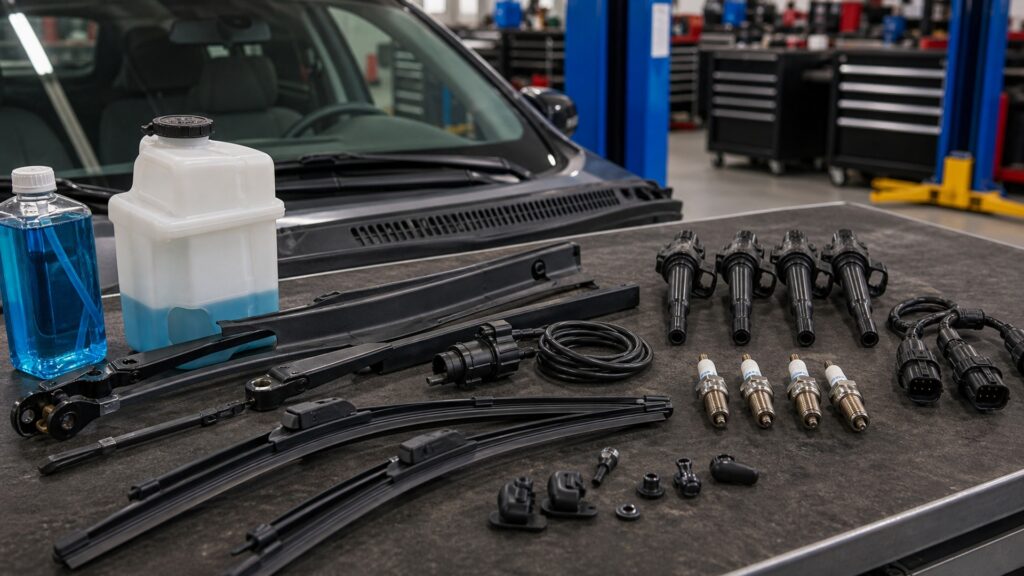
Windshield parts control the optical boundary outside the powertrain; ignition parts control a timed electrical discharge inside a combustion sequence.
Tip: A flashing severe-misfire warning and suddenly lost forward visibility are both stop conditions; control the immediate hazard before extending any diagnostic drive.
These terms distinguish optical clearing and bonded retention from magnetic energy storage and timed spark discharge.
The path through glazing from the driver or camera toward roadway objects whose clarity and geometry support decisions.
The cured adhesive joint locating and sealing the windshield within the prepared body opening.
The road scene reaching a forward camera through a defined glazing area and mounted optical axis.
The controlled interval during which current builds magnetic energy in an ignition coil before discharge.
High potential induced in the ignition coil's secondary winding and applied through insulation to the spark-plug gap.
The relationship between sensed crank and cam positions that lets the controller assign spark to the correct cylinder and angle.
Tip: Use physical location and event timing first: rain, glare, fog, and sweep belong at the glass; engine rpm, cylinder load, and crank angle belong at ignition.
Glazing transmits the road scene; wipers and fluid remove exterior obstruction; airflow controls interior moisture; sensors use specified windows. These functions can be evaluated with the engine off when power support is available.
Visibility is a perception path, not a combustion output.
Crank and cam data identify timing, the driver charges the coil primary, field collapse raises secondary voltage, and plug discharge creates the initial flame kernel in a compressed mixture.
Spark is a millisecond event that cannot repair optical obstruction.
Wipers follow a visible repeated path governed by motor, linkage, arm, and blade geometry. Misfire logic detects abnormal crank acceleration tied to cylinder events, engine speed, and load.
A rhythmic symptom must be assigned to its frequency source.
Cold stiffens blades and increases icing; heat changes glass stress, adhesive cure, and cabin moisture. Ignition heat affects coil resistance, insulation, boots, plugs, and chamber firing demand.
Shared temperature exposure does not create interchangeable parts.
A weak battery or ground can slow wipers, reset modules, and reduce ignition margin during cranking. Stabilize shared supply, then retain separate tests for surface clearing and timed combustion.
Upstream voltage interaction should be measured before downstream parts are blamed.
Windshield components preserve a visible, sealed, sensor-compatible opening; ignition components create synchronized high-voltage discharge for gasoline-cylinder combustion.
Cracks, haze, distortion, delamination, leaks, wiper contact and sweep, washer delivery, fog or frost clearing, heater circuits, rain sensors, camera sightlines, glass markings, bonding, and calibration.
The complaint follows weather, lighting, moisture, glass temperature, wipe cycles, road view, or attached visibility features rather than cylinder load and combustion timing.
Coil power and command, dwell, primary current, secondary containment, plug fitment and gap, firing demand, crank synchronization, cylinder contribution, load misfire, heat soak, and combustion timing.
A warning lamp, weak battery, or rhythmic noise alone proves neither category. Shared power, networks, motors, sensors, wiring, grounds, and unrelated mechanical faults require measurement.
Electrical motors and sensors on modern windshields can make the category sound powertrain-related, while rain-induced engine faults can appear during the same conditions as wiper use.
Wipers use their own motor, controls, fuse, wiring, linkage, and shared vehicle supply. Ignition coils create timed spark for gasoline combustion. Key state may authorize both, but authorization does not make ignition hardware the wiper source.
Wiper chatter follows blade sweep and can occur while the engine is off. Misfire counters interpret crankshaft acceleration during combustion. Observe frequency, operating state, and physical location before using either data source.
Glazing damage does not normally alter spark, fuel, compression, or timing. Shared crash damage, water intrusion, wiring faults, or low voltage might affect both areas, but each causal path requires separate evidence.
Plugs affect combustion only. A camera warning requires inspection of glass cleanliness, fog, ice, tint, damage, optical zone, bracket, camera seating, power, network data, software, and calibration according to vehicle procedures.
Tip: Keep the output and timeline explicit so one electrical connector does not turn two systems into one diagnosis.
These answers address shared voltage, rain-related faults, rhythmic symptoms, hybrid vehicles, warnings, and efficient diagnostic order.
Yes. It can slow a wiper motor, disrupt sensors or modules, and reduce coil-current buildup during cranking. Measure battery posts, distribution voltage, grounds, commands, and each load before replacing windshield or ignition parts.
Moisture can expose coil, boot, connector, harness, or intake faults, but wiper use does not establish causation. Preserve cylinder data, inspect leakage paths, and test the ignition and air systems independently under controlled conditions.
They have windshield systems but no gasoline spark-ignition coils or plugs. Hybrids may combine windshield electronics, low- and high-voltage batteries, and ignition components for an engine, with distinct controls and service boundaries.
Control visibility first if the driver cannot see. Once safe, stabilize electrical supply and separate wiper, washer, leak, camera, and glass evidence from cylinder misfire, spark, fuel, compression, and timing evidence.
The windshield fault follows a repeatable optical, water, or sweep measurement while ignition remains normal, or the cylinder fault follows command and combustion evidence while visibility functions remain normal after shared power is verified.
Windshield components manage the optical, bonded, weather-clearing, and sensor-compatible body opening. Ignition components meter low-voltage current into timed magnetic storage and high-voltage plug discharge for gasoline-cylinder combustion.
Separate them by output, location, and frequency. Test shared battery and network dependencies where relevant, then require independent visibility and combustion evidence before choosing parts or releasing the vehicle.
Related explainers trace the windshield path, ignition sequence, and diagnostic data practices needed when rain, voltage, or warnings make separate systems appear connected.
Trace glazing, bonding, wiping, washing, defogging, and camera sightlines through the forward opening.
Trace dwell, magnetic field collapse, secondary voltage, plug discharge, and combustion timing.
Preserve codes and synchronized live data without turning shared electrical symptoms into a parts verdict.
Choose a retailer
Prices checked regularly. We may earn a commission at no cost to you.