
Center Differential
A gear arrangement permitting front and rear axles to rotate at different average speeds while both receive torque.
- It supports turning on high-grip pavement
- Locking behavior varies by design
- Torque bias is not tire grip
All-wheel drive usually suits drivers who encounter changing rain, snow, gravel, or mixed pavement during normal travel. Its center differential, clutch, or motor controls can vary front-to-rear torque without asking the driver to manage a locked connection through every turn.
Four-wheel drive usually earns its extra hardware when loose surfaces, steep grades, deep ruts, rocks, sand, extraction, or very low-speed control require a selectable transfer case, locked driveline mode, low range, or truck-oriented durability. The names are not standards, however. Some systems cross the boundary. Use the owner's instructions, hardware, tires, clearances, recovery needs, and route—not the badge—to decide.
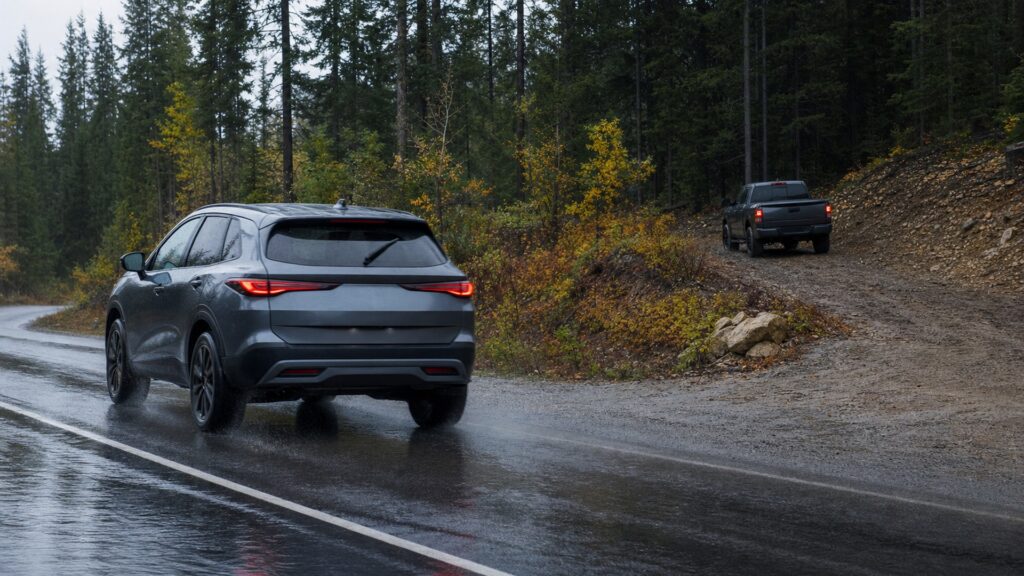
AWD favors transparent variable torque on ordinary roads; traditional part-time 4WD favors deliberate coupling and low-speed leverage where tire slip can release driveline stress.
Tip: If the manual warns against a selected mode on dry pavement, obey it. A locked front-to-rear driveline can store torsional stress during turns when tire slip cannot relieve the different axle travel distances.
These terms explain why four driven wheels can behave differently on pavement and loose terrain.
A gear arrangement permitting front and rear axles to rotate at different average speeds while both receive torque.
An electronically controlled friction coupling that progressively connects a secondary axle when commanded.
A gearbox dividing transmission output toward front and rear driveshafts in many four-wheel-drive vehicles.
A reduction ratio multiplying wheel torque and lowering road speed for a given engine or motor speed.
Stored torsional stress created when coupled axles need different average speeds but the surface prevents tire slip.
The commanded division of propulsion torque among axles or wheels before available tire friction is considered.
Tip: Equal tire circumference matters across both systems because persistent speed differences can heat couplings, disturb controls, or load the transfer hardware.
Front and rear tire paths differ during cornering. An open, geared, clutch-controlled, or motorized AWD center function accommodates that difference while distributing useful torque for ordinary-road acceleration.
Road-friendly coupling behavior is AWD's core daily advantage.
On dirt, mud, sand, snow, or rock, tire slip can release the rotational mismatch of a locked driveline. The direct connection can remain predictable under sustained low-speed load where a clutch-based system might heat.
A locked mode is a terrain tool, not a universal traction upgrade.
Low range can provide precise crawl speed, engine braking, launch control, and reduced clutch or transmission strain during steep, heavy, or technical maneuvers. It cannot fix insufficient ground clearance or weak tire grip.
The strongest case for 4WD is often controlled low-speed work rather than winter commuting.
AWD and 4WD can improve propulsion when some tires have grip. Braking and cornering still depend on tire compound, tread, temperature, road friction, load transfer, stability control, speed, and driver inputs.
Four powered wheels can help a vehicle start faster than it can stop.
Some 4WD systems include an automatic pavement mode, while some AWD systems offer locks or terrain reductions. Owner documentation identifies allowed surfaces, maximum speeds, towing procedures, neutral behavior, tire requirements, and warning responses.
A familiar label cannot replace the operating map for the installed system.
The better fit follows coupling behavior, low-range need, surface slip, route severity, tires, clearance, and the manufacturer's operating envelope.
Driving remains mainly on pavement but weather and surface friction change, automatic intervention is valuable, and no sustained locked coupling or low-range crawling task exists.
The exact system tolerates normal cornering, the owner maintains matched tires, and its efficiency, service, packaging, and thermal limits suit year-round daily use.
Repeated loose-surface travel, steep technical grades, deep ruts, controlled launching, recovery work, or low-speed heavy movement genuinely uses a selectable lock, low range, clearance, protection, and robust cooling.
Neither choice compensates for unsuitable tires, excessive speed, poor visibility, weak recovery points, overload, unsafe water depth, or untrained driving. Some modern systems blur the names, so exact documentation governs.
AWD-versus-4WD myths confuse propulsion capability with tire friction, braking, ground clearance, or unrestricted mode use.
Many systems vary torque by operating state and may drive one axle predominantly. Differentials, clutches, brakes, and motor controls alter wheel behavior. Equal percentages are neither universal nor proof that each tire has equal traction.
A traditional locked part-time mode can bind on firm high-grip surfaces because front and rear axles need different average speeds while turning. Use only modes the manufacturer approves for the surface.
Propulsion hardware can help acceleration, but braking uses tire-road friction at all wheels regardless of drive label. Winter tires, speed, following distance, ABS behavior, grade, and road condition control stopping margin.
Low range multiplies torque and improves speed control; it can also dig tires deeper or stress components. Clearance, approach geometry, tire grip, line choice, momentum, recovery equipment, water, and soil remain binding constraints.
Tip: Attach every benefit to a surface, mode, speed, tire, and operating limit rather than celebrating four powered wheels in the abstract.
These answers address pavement use, snow, low range, towing, tire matching, and why the names require model-specific interpretation.
It often is when roads alternate between dry, wet, slushy, and snowy surfaces because the system can manage axle connection automatically. Proper winter tires, slower speed, visibility, and stopping distance remain more important.
Use it on surfaces and at speeds permitted by the manual, typically loose or slippery ground where tire slip can relieve locked-driveline mismatch. Select high or low range according to terrain, load, and procedure.
Unequal rolling circumference can create persistent axle or wheel speed differences, heating clutches or loading differentials and transfer components. Follow tire-size, wear, inflation, rotation, and temporary-spare instructions for the exact vehicle.
An approved automatic or full-time mode may help launch traction, but locked part-time operation can be inappropriate on dry pavement. Towing capacity, stability, tires, brakes, cooling, hitch load, and manual instructions remain separate.
Read the owner's manual and build information for center differential or clutch behavior, selectable modes, low range, locks, speed limits, overheating responses, tire requirements, neutral procedures, and prohibited surfaces. Badges are insufficient.
AWD generally serves variable paved-road traction through a center differential, controlled clutch, or separate axle motor that accommodates turning; traditional 4WD serves loose-terrain work through selectable coupling and often low range.
Pick AWD for automatic daily adaptation and 4WD when the route truly uses lockable low-speed hardware. Verify the installed system, fit appropriate tires, obey surface restrictions, and remember that acceleration capability is not braking grip.
Related explainers connect drive-system behavior to AWD's broader consequences, whole-vehicle motion, and the body and equipment assumptions that often distort SUV decisions.
Examine how AWD changes launch traction, packaging, losses, tire requirements, and maintenance beyond the immediate mode choice.
Trace torque through drivetrain, tires, steering, braking, suspension, and electronic controls.
Separate SUV body packaging from actual AWD, clearance, towing, tires, and off-road equipment.
Choose a retailer
Prices checked regularly. We may earn a commission at no cost to you.