
Driven Axle
An axle receiving propulsion torque.
- AWD can drive front and rear axles
- Torque paths vary by design
- Axle load affects usable traction
All-wheel drive matters when available propulsion torque exceeds what one axle can transmit through its tires. By routing some torque to a second axle, the system can use contact patches that still have grip during launch, climbing, or changing surfaces.
That advantage is narrower than many safety claims imply. AWD does not create tire friction, shorten every stop, or authorize more cornering speed. Coupling design, control logic, differential behavior, tire condition, temperature, and rolling circumference determine whether the extra torque path helps and what maintenance it requires. The distinction matters most when the surface leaves useful propulsion grip at one axle after the other reaches its limit.
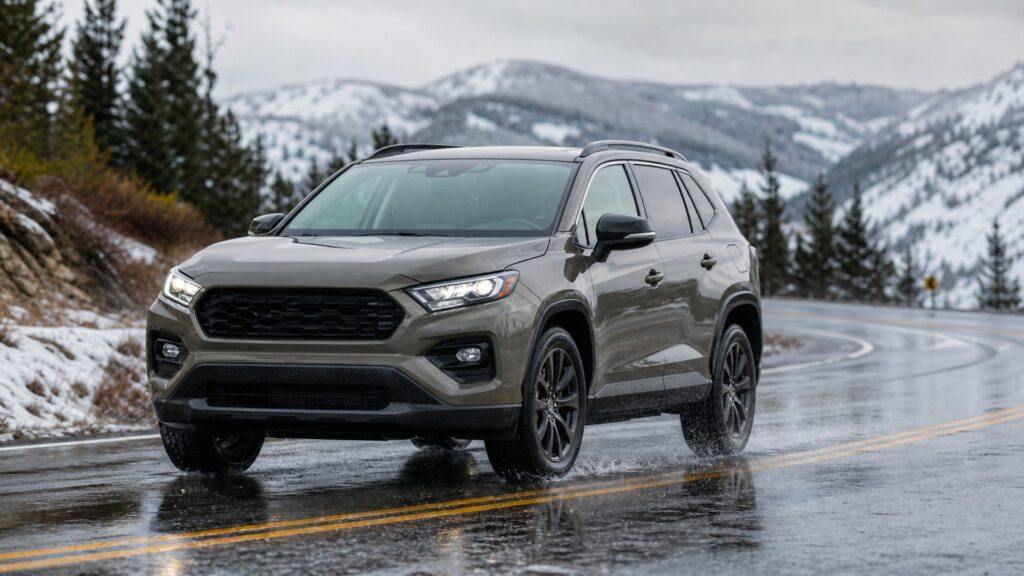
Follow the coupling, differentials, controls, and tires that decide whether a second driven axle adds useful force.
Tip: During an AWD comparison, inspect the tires first; the driveline can only distribute the grip each tire actually has.
These six terms separate the torque-routing hardware from the tire friction and control actions around it.
An axle receiving propulsion torque.
A differential or clutch managing speed and torque between axles.
Difference between tire rotation and vehicle travel.
Brake and torque intervention managing excessive wheel slip.
Force available at each contact patch.
Distance a tire covers per revolution.
Tip: Keep acceleration traction distinct from braking and cornering grip; all three use the tires, but AWD directly changes only the propulsion path.
AWD adds a path that can send propulsion torque to both axles, increasing the number of contact patches available to accept drive force.
It changes acceleration traction, not road friction.
Sensors and controls use wheel speed, throttle, steering, and motion to command clutches, motors, brakes, or torque reduction.
The AWD badge does not specify one control strategy.
When one axle reaches its propulsion-grip limit, a second axle may use remaining grip to deliver more total drive force.
The advantage appears only when another driven tire has usable grip.
Braking and cornering depend primarily on tire-road force, speed, mass, and chassis control. AWD can influence propulsion during a maneuver but does not add friction.
Acceleration confidence should not be mistaken for universal stopping or cornering capacity.
Couplings, differentials, lubricants, software, and tire circumference must remain within manufacturer limits.
AWD adds useful hardware and additional maintenance dependencies.
AWD myths usually turn a propulsion advantage into a claim about every vehicle motion.
A second driven axle can use remaining propulsion grip when one axle reaches its limit.
Active control can adapt torque routing as load and surface conditions change.
Available tire friction still governs braking, cornering, and total drive force.
Coupling heat or tire mismatch can reduce the expected benefit.
AWD myths usually turn a propulsion advantage into a claim about every vehicle motion.
Tires create friction with the road. AWD can distribute propulsion torque to more contact patches, helping use available grip, but it cannot manufacture traction on ice or unsuitable tires. That vehicle-specific boundary still matters.
Many systems vary torque by axle and wheel, and some disengage portions of the driveline. Equal distribution is neither universal nor always desirable during turning. Wheel slip remains an important vehicle-specific boundary.
Driven-wheel count mainly changes propulsion. Braking uses all four tires on most vehicles, so tire compound, speed, surface, ABS, and vehicle mass dominate the stop. Contact patch remains an important vehicle-specific boundary.
Construction, model, wear, pressure, and rolling circumference can affect handling and driveline load. Follow the vehicle maker's replacement and rotation requirements. Differential and thermal protection remain important vehicle-specific boundaries in this case.
Tip: When an AWD claim sounds broad, name the maneuver: launching, climbing, braking, or cornering.
These questions resolve common AWD, weather, tire, and thermal boundaries.
Terms overlap, but 4WD often describes driver-selectable or low-range systems for demanding surfaces, while AWD commonly manages road use automatically. Verify the exact hardware instead of relying on naming. That vehicle-specific boundary still matters.
It can help distribute propulsion torque when acceleration grip is uneven. Safe speed, tread depth, tire design, water depth, visibility, and braking distance remain the main boundaries. That vehicle-specific boundary still matters.
No. Worn or unsuitable tires reduce the friction every AWD command depends on. They can also create circumference differences or inconsistent handling that the driveline cannot repair. That vehicle-specific boundary still matters.
Some on-demand systems transfer torque through controlled clutches. Sustained slip or heavy demand can generate heat, prompting temporary protection. Behavior and warnings are model-specific. Differential remains an important vehicle-specific boundary.
Some EVs use separate motors for front and rear axles, allowing rapid electronic allocation without a mechanical center shaft. Tire grip and thermal limits still govern usable force. That vehicle-specific boundary still matters.
All-wheel drive matters because a second driven axle can use propulsion grip unavailable to the first, improving launch or climbing force in the conditions its coupling and controls support.
Tires still set acceleration, braking, and cornering limits; verify the exact AWD design, tire requirements, thermal behavior, and maintenance before extending its benefit.
SUV fit, crash-test evidence, and fuel use are separate questions that should be evaluated beside the AWD mechanism.
See when clearance, cargo, and capacity justify an SUV without treating AWD as the whole body-style decision.
Keep propulsion traction separate from crashworthiness, avoidance tests, and model-specific safety evidence.
Understand how extra mass, driveline losses, tires, and use pattern can affect the energy consequence of AWD.
Choose a retailer
Prices checked regularly. We may earn a commission at no cost to you.