
Cargo Aperture
The height and width of the opening through which cargo must pass.
- A liftgate often permits taller objects
- Wheel housings can narrow usable width
- Volume does not prove an object fits
Use an SUV instead of a sedan when the SUV's taller cargo opening, more flexible rear volume, seating access, ground clearance, or rated capacity solves a recurring need. The badge alone is not the reason; the measurable constraint is.
A sedan often answers a different set of priorities with a separate trunk, lower step-in height, smaller frontal area, and road manners shaped by a lower package. There is substantial overlap, so compare the exact vehicles, not stereotypes. Passenger fit, cargo dimensions, route, parking, tires, payload, and crash-test evidence define the real boundary.
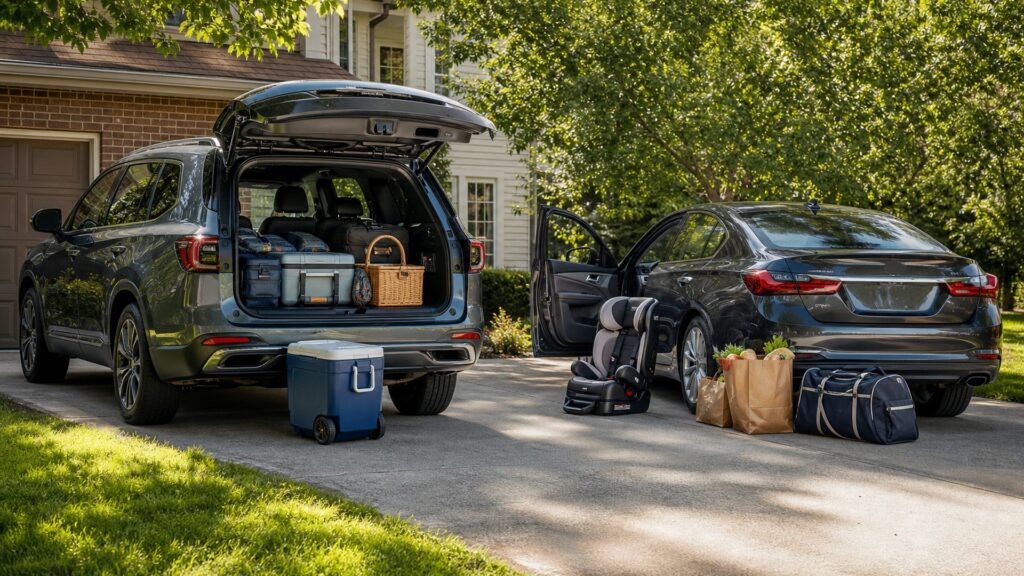
The useful choice emerges from object dimensions, passenger access, roads, capacity, and the tradeoffs created by the exact vehicle.
Tip: Bring the largest recurring cargo dimensions and passenger needs to the comparison; exterior size alone cannot prove usable fit.
These measurements turn an SUV-versus-sedan label into concrete space, access, road, and capacity decisions.
The height and width of the opening through which cargo must pass.
Whether luggage occupies a separate trunk or a cabin-connected rear area.
The seating height and movement required to enter or exit.
The vertical distance between the ground and the vehicle's relevant low point.
The effective height and location of vehicle mass influencing load transfer.
Manufacturer limits for carried load and trailer use in a defined configuration.
Tip: Measure the task, then verify the exact vehicle; body-style averages are screening clues, not specifications.
An SUV is useful when tall, bulky, dirty, or frequently changing cargo needs a large liftgate and a cabin-connected load floor. A sedan's trunk may be ample for bags yet reject an object whose shape cannot pass its opening.
Choose the opening and interior geometry that fit recurring objects.
A taller seat may reduce crouching for some passengers and can improve sightlines, but a high sill or floor can make entry harder for children or shorter adults. Door opening and seat contour matter more than the SUV label.
Use the actual cabin ergonomics, not a generic promise of easier access.
A lower body can reduce frontal area and mass, while lower mass placement can support less roll. These are tendencies, not guarantees; tires, suspension, aerodynamics, and powertrain can reverse an individual comparison.
If tall-space utility is unused, the sedan may avoid costs created by carrying it.
Clearance and protected underbody geometry can help on deep snow, rutted roads, steep driveways, or trail access. Tire type and depth, approach angles, and driver judgment remain separate constraints.
Choose extra clearance for a road obstacle you actually encounter.
Some SUV configurations provide payload, roof-load, or towing capacity unavailable in a compared sedan. The decision is valid only after adding passengers, cargo, accessories, tongue weight, and required equipment against exact ratings.
Capability comes from the rated configuration, not the silhouette.
SUV and sedan labels help screen options, but dimensions and ratings decide the actual fit.
Tall cargo, flexible rear volume, frequent passenger access, genuine clearance needs, or validated capacity can create a clear advantage.
A single vehicle can combine several of those needs efficiently.
If passengers and cargo fit easily and roads are paved, extra height or capacity may go unused.
A sedan can offer a smaller footprint or lower energy demand, but exact comparisons remain necessary.
Body-style myths turn broad market tendencies into claims about every vehicle's space, safety, or capability.
A tall exterior does not guarantee floor length, opening width, or seat-fold geometry. Some hatchbacks and large sedans can carry particular objects better than smaller SUVs. Cargo aperture remains an important vehicle-specific boundary.
Safety depends on crash scenario, structure, restraints, avoidance systems, size interaction, tires, and driver behavior. Use model-specific NHTSA and IIHS evidence instead of a body label. Trunk remains an important vehicle-specific boundary.
Clearance helps avoid contacting obstacles. AWD redistributes propulsion torque. Neither substitutes for suitable tires, braking grip, safe speed, or favorable approach geometry. Hip point and roof height remain important vehicle-specific boundaries in this case.
Many sedans provide effective rear seating, child-seat access, and secure trunks. The deciding evidence is passenger fit, door geometry, cargo opening, and the family's actual equipment. Center of gravity remains an important vehicle-specific boundary.
Tip: Replace “SUVs are better at” with a measurement: opening size, hip point, clearance, payload, tow rating, or tested consumption.
These answers address families, snow, towing, parking, and the difference between cargo volume and usable fit.
No. A moderate hip point can help some people, while a tall floor or sill can create a climb. Test entry, exit, grab points, door opening, and seat comfort directly.
Not automatically. Winter tires, ground clearance, stability control, visibility, and driving conditions all matter. AWD may help acceleration, but it does not create extra braking grip by itself. That vehicle-specific boundary still matters.
They help, but measurement methods and shapes differ. Check opening dimensions, floor length, seat-fold steps, wheel-house width, and whether the actual object can be loaded and secured. That vehicle-specific boundary still matters.
Use the exact tow, payload, axle, hitch, tire, and cooling ratings. Some SUVs tow; some do not support the intended trailer. The body style alone is not authorization. That vehicle-specific boundary still matters.
Compare length, width, turning circle, visibility, camera coverage, and local space. A compact SUV may be shorter than a large sedan, so height is not the deciding dimension. That vehicle-specific boundary still matters.
Use an SUV instead of a sedan when measurable cargo geometry, passenger access, clearance, or rated capacity solves a recurring constraint the sedan does not.
If those benefits remain unused, compare the sedan's packaging, efficiency, parking, and road behavior; exact dimensions, ratings, tires, and safety tests outrank the label.
Use efficiency, crash-test, and AWD explainers to keep separate questions from collapsing into one SUV stereotype.
See how mass, frontal area, tires, speed, and route influence the energy consequence of a body-style choice.
Use crash-test evidence correctly instead of treating SUV or sedan as a safety score.
Understand when all-wheel-drive traction supports an SUV use case and when tires, braking, or clearance remain the limit.
Choose a retailer
Prices checked regularly. We may earn a commission at no cost to you.