
Diagnostic Confidence
The strength of evidence connecting a verified fault to the proposed repair.
- Measurements should support the failed function
- Unresolved symptoms increase estimate risk
- Teardown can change confidence
Use replacement parts instead of replacing the vehicle when a diagnosed repair can restore safe, dependable function for less than the value of the transportation it preserves. That value is not limited to resale price: registration, insurance, financing, taxes, familiar maintenance history, and the cost of arranging another vehicle all belong in the comparison.
Replacement becomes more rational when damage is structural or widespread, diagnosis remains uncertain, failures recur across major systems, parts or qualified labor are unavailable, or the vehicle no longer fits essential needs. The decision should compare forward-looking costs and risks from today—not defend past spending or discard a sound vehicle because one repair bill looks large in isolation.
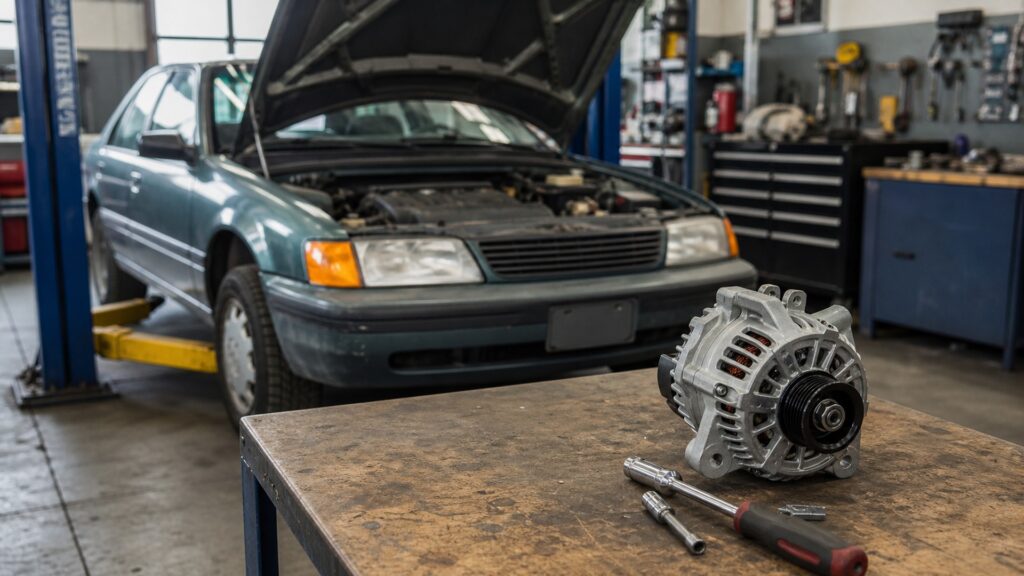
A useful keep-or-replace decision combines diagnostic confidence, safety, remaining life, downtime, ownership history, and the full cost of obtaining equivalent transportation.
Tip: Price the replacement vehicle you would actually buy—including taxes, fees, financing, and immediate maintenance—before calling a repair uneconomic.
These terms convert an emotional repair bill into a consistent comparison of future transportation paths.
The strength of evidence connecting a verified fault to the proposed repair.
The useful time or mileage reasonably expected after repair.
Repair cost divided by a chosen vehicle value benchmark.
The cash and financing required to obtain and prepare another suitable vehicle.
The financial and practical burden while transportation is unavailable.
Money already spent that cannot be recovered by today's choice.
Tip: Use ranges for uncertain costs and life; a decision that flips under a small estimate change needs more diagnosis or contingency planning.
A failed alternator, wheel bearing, sensor, or control arm can be a bounded event. Severe corrosion, flood contamination, collision distortion, widespread electrical faults, or simultaneous powertrain decline can make one estimate a fragment of a larger problem.
Component repair makes sense only when the repair scope is credibly bounded.
The alternative to a repair bill is not spending nothing. It is acquiring a vehicle that meets the same passenger, cargo, reliability, and safety needs, then paying transaction costs and accepting an unfamiliar maintenance history.
A large repair can still be cheaper than resetting the entire ownership cycle.
Review maintenance records, rust, fluid condition, tires, brakes, suspension, emissions equipment, battery health, and known model-specific patterns. The goal is a range of useful service after repair, not a promise based on odometer alone.
The repair buys future service, so the condition of everything left behind matters.
Compromised crash structure, advancing corrosion at load paths, uncorrectable safety faults, unavailable critical parts, or a repair no qualified facility will support can make continued use inappropriate even when arithmetic appears favorable.
Some boundaries are go-or-no-go conditions rather than negotiable costs.
A sound repair that requires months of unavailable parts may fail a daily transportation need. Likewise, a vehicle that no longer accommodates mobility, passengers, cargo, charging, towing, or commute conditions may not justify another major investment.
The right mechanical repair can still be the wrong transportation decision.
A bounded, well-diagnosed repair can be economically strong, while structural or system-wide deterioration changes the problem.
The fault is isolated, diagnosis is strong, the remaining vehicle is sound, parts and labor are available, and the repair restores a vehicle that still fits the owner's needs.
Known maintenance history and avoided transaction costs can make continued ownership more valuable than resale price alone suggests.
Structural damage, severe corrosion, contamination, repeated major failures, or unsupported electronics can make future risk too broad for one repair estimate.
Long downtime or a permanent mismatch with current passenger, cargo, accessibility, range, or work requirements can defeat otherwise favorable arithmetic.
Keep-or-replace myths often treat one percentage or one old payment as a universal rule.
Market value is one benchmark, not the replacement cost of equivalent transportation. A safe, bounded repair may preserve useful service for less than taxes, fees, financing, immediate maintenance, and uncertainty on another vehicle.
No loan payment does not erase structural corrosion, unsafe faults, repeated downtime, or widespread deterioration. The decision still depends on diagnosis, remaining systems, repair support, transportation needs, and forward cost.
Past spending is sunk and cannot be recovered by another repair. Use maintenance records to understand condition, but decide from today's repair, future risks, replacement alternative, and expected transportation value.
Newer vehicles can reduce some age-related exposure, yet purchase price, financing, depreciation, recalls, defects, collision history, and unknown used-car maintenance create different risks. Replacement changes the risk portfolio; it does not erase it.
Tip: Compare future scenarios from today and keep safety boundaries separate from negotiable cost.
These answers cover value ratios, engine or transmission estimates, collision damage, older high-mileage vehicles, and making the decision under uncertainty.
There is no universal cutoff. Use the ratio as a warning that deserves deeper analysis, then include replacement transaction cost, post-repair condition, remaining service, downtime, diagnostic confidence, and the owner's actual transportation requirements.
No. A verified major-unit repair can make sense when structure and other systems are sound and the replacement alternative is costly. It becomes weaker when diagnosis, warranty, parts support, or the surrounding vehicle is poor.
Require a qualified structural assessment, complete repair plan, restraint and sensor checks, calibration requirements, and realistic diminished-value or insurance consequences. Cosmetic appearance alone cannot establish that load paths and safety systems are restored.
Mileage is context, not a verdict. Maintenance, corrosion, operating duty, fluid condition, compression or battery health, prior repairs, and current inspection reveal more. High mileage mainly widens uncertainty and makes documentation more valuable.
Ask the shop for confirmed work, probable additions, authorization limits, and a stop-work threshold. Compare best, expected, and worst cases with the replacement option before disassembly makes the vehicle harder to sell.
Use replacement parts when a well-diagnosed, supportable repair restores a fundamentally sound vehicle that still meets its transportation job at a favorable forward cost.
Choose vehicle replacement when safety, structure, system-wide decline, uncertainty, downtime, or changed needs make that restored service unlikely; ignore sunk costs and compare realistic alternatives.
These related explainers help estimate recurring disruption and inspect the engine and suspension systems that often dominate keep-or-replace uncertainty.
Use failure frequency, severity, predictability, and recovery time to judge the likely post-repair ownership experience.
Understand which engine functions and measurements determine whether a major powertrain repair is bounded and verifiable.
Trace ride-height, alignment, joint, spring, and damper evidence when chassis deterioration influences the decision.
Choose a retailer
Prices checked regularly. We may earn a commission at no cost to you.