
Sprung Mass
Vehicle mass supported by the springs.
- Includes most body and powertrain mass
- Its motion influences ride and handling
- Payload changes the supported load
Suspension components matter because a tire can steer, brake, and accelerate only while its contact patch carries a controlled load and points in the intended direction. Springs support weight and store motion; dampers dissipate oscillation; arms, joints, bushings, and knuckles constrain the wheel's path. The body and subframe close those load paths.
A worn damper, collapsed spring, torn bushing, loose joint, bent arm, or shifted mount changes more than comfort. It can alter ride height, alignment, transient load, tire wear, steering response, and braking stability. Diagnosis therefore combines inspection, measured free play, ride-height and alignment data, tire evidence, and a road test. Parts should be matched across the axle where behavior depends on symmetry, then verified under load.
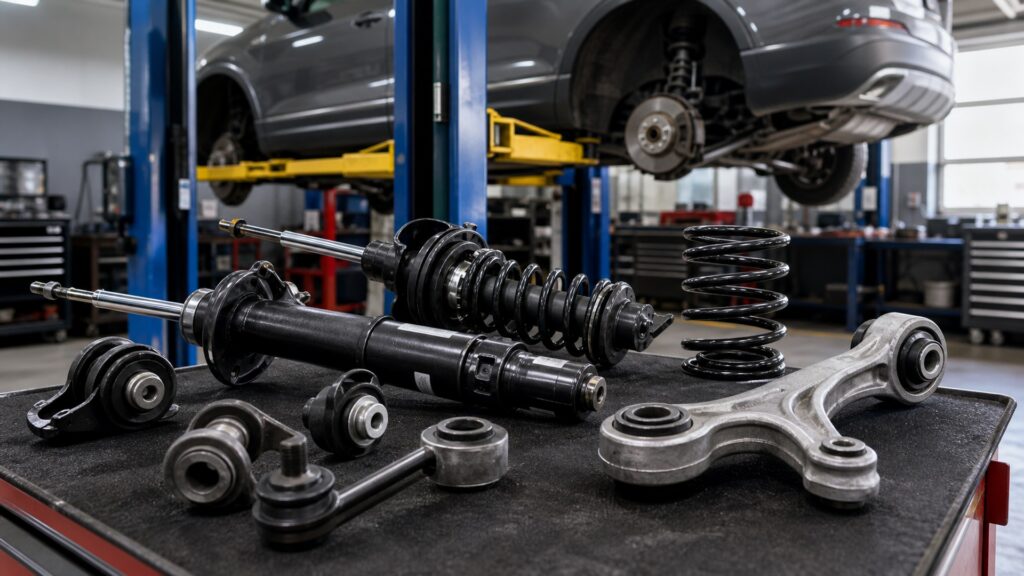
Suspension quality comes from controlled wheel travel, load support, motion damping, joint location, compliant isolation, and alignment working together.
Tip: When a vehicle feels unstable, record the exact event—single bump, repeated waves, braking, turning, crosswind, or load—because each excites a different suspension path.
These concepts separate support, motion control, wheel location, and geometric alignment.
Vehicle mass supported by the springs.
Wheel-end mass moving more directly with road input.
Force change required for a unit of spring deflection.
Resistance generated as suspension velocity moves fluid through a shock or strut.
Controlled elastic movement at a suspension mounting point.
Geometric relationship among wheel angles and vehicle centerline.
Tip: Do not call every suspension symptom a bad shock; identify whether the fault concerns load support, damping, joint constraint, bushing compliance, geometry, or structure.
Springs oppose vehicle weight and place arms, dampers, bump stops, and alignment near their designed operating range. Sag, breakage, incorrect rate, or excess load shifts that position and reduces travel in one direction.
Correct ride height is a geometry and travel requirement, not merely an appearance preference.
A spring stores energy and can continue oscillating. The damper converts suspension motion into heat through controlled fluid flow, reducing bounce and managing how quickly tire load and body attitude settle after bumps, steering, or braking.
Damping determines the motion history after the road input has passed.
Control arms and links carry loads while ball joints or pivots allow required rotation. Bushings permit selected compliance. Wear, deformation, or loose fasteners let toe, camber, caster, or axle position change unpredictably under force.
A wheel can align correctly at rest yet move incorrectly when braking or cornering.
Suspension geometry decides where the tire points and how load moves during acceleration, braking, and turning. Tire stiffness, wheel offset, bearing condition, steering joints, subframe position, and body damage can imitate or amplify suspension faults.
The symptom belongs to a load path, not automatically to the most recently replaced part.
After repair, confirm ride height, fastener position, alignment, steering-wheel center, warning status, tire clearance, and behavior on the event that exposed the fault. Recheck critical hardware when the procedure specifies it.
A quiet lift inspection is not enough; the vehicle must carry dynamic load predictably.
Suspension parts can restore wheel control only when the complete load path and alignment are sound.
Correct springs, damping, joints, bushings, and geometry keep wheel travel controlled and preserve more consistent tire loading over bumps and maneuvers.
Measured repair can improve tire life, steering precision, braking stability, ride control, and confidence without confusing stiffness with quality.
New shocks cannot correct a collapsed spring, loose joint, bent structure, unsuitable tire, shifted subframe, or incorrect alignment.
A static alignment cannot guarantee dynamic geometry when bushings, mounts, fasteners, or load-carrying structure move under force.
Suspension myths confuse comfort, stiffness, alignment, and component age with actual wheel control.
Springs normally carry the static load. Shocks or struts generate damping force as suspension moves, although a strut also forms part of the wheel-location structure. A sagging corner needs correct diagnosis.
Higher rates can reduce some body motion but may reduce compliance or tire-load consistency on rough surfaces. Geometry, damping, travel, tires, load, and calibration determine whether stiffness produces useful control.
Alignment can correct adjustable angles, but pressure, tire construction, rotation, imbalance, bent parts, loose joints, bushing movement, ride height, bearings, and driving conditions can produce wear that settings alone cannot solve.
Leakage severity and measured function matter, yet axle symmetry can affect transient response. Inspect both sides, springs, mounts, tires, and vehicle guidance before deciding whether a single-unit repair preserves balanced behavior.
Tip: Use measurements and event-specific behavior instead of assuming one part category explains every ride or tire symptom.
These answers cover struts, axle pairing, alignment timing, clunks, and safe warning signs.
Both can provide damping. A strut also serves as a structural suspension member locating the wheel and supporting steering or spring hardware in many layouts; replacement can therefore affect alignment and requires the specified procedure.
Dampers and some springs are commonly paired across an axle to preserve comparable response, but exact guidance and failure conditions matter. Joints or arms may be replaced individually when the remaining side tests within specification.
Alignment is appropriate when the procedure disturbs locating points, ride height changes, adjustable angles move, or measurements indicate a need. First correct loose or bent components; alignment cannot stabilize geometry that moves under load.
Loose or worn joints, bushings, mounts, sway-bar links, spring seats, dampers, subframes, steering parts, brakes, exhaust, or cargo can knock. Reproduce the event and load components correctly before ordering the loudest-looking part.
Steering wander, sudden ride-height change, tire contact, severe pull, loose wheel movement, broken spring, unstable braking, rapid tire wear, or a component near separation warrants prompt professional assessment and limited driving.
Suspension components matter because they support the vehicle, control motion, locate each wheel, filter vibration, and preserve usable tire load through changing road and maneuver forces.
Diagnose the complete load path, install and torque parts at the required positions, align the vehicle, and verify the exact dynamic event; comfort alone is not the pass criterion.
Use the vehicle-systems, reliability, and SUV-use explainers to place suspension load paths inside broader force, ownership, and clearance choices.
Trace how suspension, steering, braking, tires, and electronic controls share the vehicle's contact patches.
Assess how wear progression, inspection predictability, parts availability, and recovery time affect suspension-related reliability.
Apply ride height, load, tire, and body-motion reasoning when deciding whether an SUV's packaging suits the use case.
Choose a retailer
Prices checked regularly. We may earn a commission at no cost to you.