
Brake Drag
Unwanted braking force that remains after the command is released, creating heat, wear, pull, or reduced economy.
- Restricted hoses can retain pressure
- Seized slides can prevent release
- Parking mechanisms can remain applied
Use brake components when diagnosis identifies a defect in stopping, wheel release, hydraulic pressure, friction material, brake control, or parking retention. Pedal changes, leakage, grinding, pulling, drag, overheated wheels, brake warnings, or measured wear belong in that investigation.
Use ignition components when a spark-ignition engine has evidence of failed spark generation or delivery, such as a verified coil, plug, circuit, timing, or misfire fault. A no-start, rough idle, or warning lamp can have fuel, air, compression, electrical, or control causes too. The safe choice follows the failed function, not a maintenance-package upsell or a shared dashboard visit.
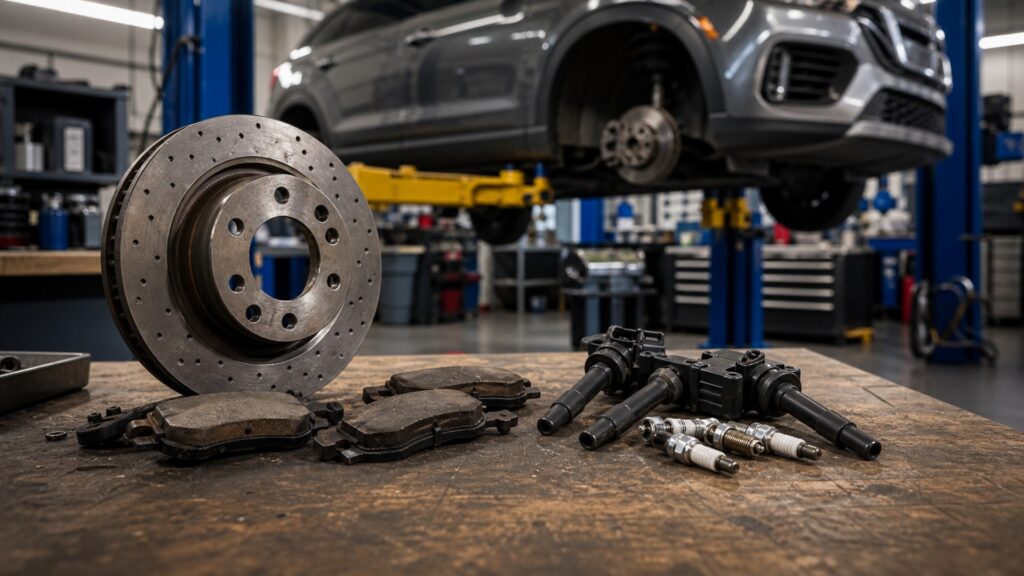
Brake parts answer defects in deceleration and wheel control; ignition parts answer proven spark or primary-circuit defects. Tests must establish the path before components are replaced.
Tip: If braking response changes, stop in a safe place and arrange qualified inspection rather than continuing a road test to collect more evidence. Ignition diagnosis never takes priority over uncertain stopping ability.
These terms keep stopping evidence separate from spark-generation evidence.
Unwanted braking force that remains after the command is released, creating heat, wear, pull, or reduced economy.
The usable pedal travel and firmness remaining when hydraulic and mechanical clearances are correctly controlled.
An electrical transformer that raises battery-system voltage enough to create a spark across the plug gap.
A sealed electrode assembly that initiates combustion by producing a timed spark inside a spark-ignition cylinder.
Control-module data estimating cylinders whose expected crankshaft acceleration contribution is missing or irregular.
A stored identifier for a monitored condition that exceeded diagnostic criteria under specified enabling conditions.
Tip: A diagnostic trouble code identifies a monitored condition or circuit; it does not authorize replacing the named component without following the system's test path.
A braking investigation follows command, assist, pressure, wheel-end movement, friction, temperature, ABS, tires, and parking function. Measured defects in that chain justify matching brake components and procedures.
The required repair restores stopping control, not simply silence.
Ignition diagnosis checks whether the correct spark energy arrives at the correct cylinder and time. Misfire under load can expose insulation, gap, connector, supply, driver, or plug faults.
Replacing coils by code number alone skips competing fuel, air, and compression causes.
Severe brake drag can make the vehicle feel underpowered, while an engine misfire can reduce propulsion. Both can illuminate warnings. Wheel temperatures, free rotation, pedal response, misfire data, fuel trims, and compression tests separate them.
The same driver complaint can originate on opposite sides of the force balance.
Loss of pressure, grinding, smoke, severe pull, long travel, or inadequate parking hold can remove control immediately. An ignition fault can also create hazards or catalyst damage, but it does not make uncertain brakes acceptable.
Prioritize safe control while preserving diagnostic evidence.
Brake work ends with leak, pedal, clearance, warning, parking, torque, bedding, and controlled-stop checks. Ignition work ends with stable spark operation, misfire data, code monitors, starting, load behavior, and catalyst protection.
A successful engine repair cannot sign off the brakes, or vice versa.
Brake and ignition parts may be serviced together for convenience, but diagnosis, urgency, fitment, and proof remain independent.
Inspection or testing identifies hydraulic leakage, friction wear or damage, restricted release, caliper or drum malfunction, rotor limits, assist failure, brake-control faults, parking defects, imbalance, or overheating.
The exact repair restores pressure integrity, free movement, friction, heat capacity, warning operation, wheel-slip control, and parking retention and then passes controlled verification.
Testing proves that a spark plug, coil, connector, primary circuit, driver command, timing input, insulation path, or application error causes a no-start or misfire in a spark-ignition engine.
Do not replace ignition parts for diesel combustion systems without equivalent hardware, and do not replace brake parts for unrelated engine faults. Codes, mileage, and package discounts are not root-cause proof.
Brake-versus-ignition myths encourage unrelated tune-up bundles, code-based guessing, and risky continued driving.
The light can represent many emissions and powertrain conditions. Misfire codes do not prove coils or plugs because fuel delivery, air leaks, compression, timing, wiring, sensors, or mechanical faults can create similar data.
Noise can arise from wear indicators, contact, rust, shields, hardware, contamination, glazing, rotor condition, parking mechanisms, wheel bearings, or debris. Inspect and measure the complete wheel end before selecting parts.
An ignition fault can reduce engine torque, but brake drag can also make acceleration sluggish and create heat. Compare wheel release and temperature with engine data before ordering either category.
A vehicle may move with leaking, overheated, imbalanced, worn, or partially failed brakes yet lack dependable emergency stopping. Changed pedal, warnings, grinding, smoke, severe pull, or fluid loss requires immediate safe response.
Tip: Keep the complaint attached to its physical function and require repair-specific evidence before selecting either component family.
These answers address dashboard lights, rough running, brake drag, scheduled replacement, simultaneous service, and verification after repair.
Usually not by itself. Codes describe a detected condition and enabling context. Use freeze-frame data, circuit tests, mechanical checks, related-module faults, service information, and symptom reproduction to establish the failed component and cause.
Yes. Residual wheel-end friction converts propulsion energy into heat and can reduce acceleration or economy. Confirm temperature, free rotation, hydraulic release, caliper or parking movement, bearings, tires, and alignment before choosing parts.
Follow the exact engine's maintenance schedule, plug specification, operating conditions, and inspection guidance. Scheduled replacement can be appropriate without a misfire, but it does not justify coils or unrelated parts absent evidence.
Yes when each is independently due or diagnosed. Combining appointments may reduce inconvenience, but keep separate findings, estimates, application checks, procedures, warranties, and post-repair verification so one service never masks the other.
Brake repair needs pressure, leakage, movement, torque, warnings, parking, bedding, and controlled-stop checks. Ignition repair needs starting, misfire, load, fault, wiring, and monitor verification. Record results before returning the vehicle.
Use brake components when evidence identifies a defect in deceleration, hydraulic pressure, friction, wheel release, brake control, or parking retention; use ignition components only when testing proves a spark-generation or delivery fault.
Classify the complaint by physical function, prioritize uncertain braking as a no-drive safety issue, and use system-specific measurements. A warning lamp, mileage interval, sluggish feel, or parts bundle cannot substitute for root-cause diagnosis.
Related explainers deepen the brake mechanism, fitment controls, and diagnostic workflow needed to separate a safety-critical stopping fault from an engine-control or ignition problem.
Trace the brake command, pressure, friction, heat, ABS, and parking stages that generate stopping symptoms.
Verify dimensions, hydraulics, hardware, sensors, and parking interfaces after a brake fault is proven.
Use scan data as one layer of diagnosis rather than treating a code as a parts order.
Choose a retailer
Prices checked regularly. We may earn a commission at no cost to you.