
Friction Tunnel
An automatic wash that uses rotating or hanging media to contact the vehicle while it moves through stages.
- Can remove bonded road film
- Media condition affects abrasion risk
- Clearance and loose trim require review
Use deliberate car care instead of an automatic wash when the finish, contamination, protection system, or inspection goal requires control over chemistry, wash media, contact pressure, sequencing, and drying. That control matters on corrected paint, matte finishes, delicate trim, fresh coatings, film edges, and vehicles carrying abrasive road grit.
An automatic wash can still be the better decision when safe home runoff is impossible, freezing weather makes driveway work hazardous, underbody salt removal is urgent, or time constraints would otherwise mean no cleaning. The real choice is not enthusiast care versus laziness. It is a risk trade among surface contact, chemical strength, water quality, wastewater handling, equipment condition, and the consequences of delaying maintenance.
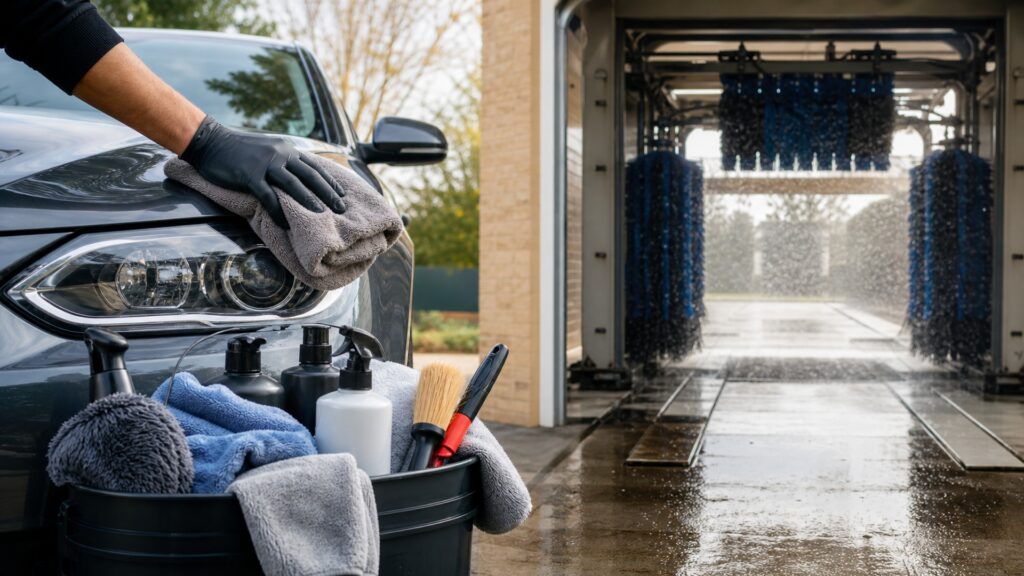
A sound decision weighs what must be removed, what can be damaged, how water will be managed, and whether the available process can finish safely.
Tip: Before choosing a wash, identify the highest-risk contaminant and the most vulnerable surface; the answer can change between winter salt, loose dust, bug residue, matte film, and fresh paint protection.
These terms describe the contact, water, and site-management differences behind the decision.
An automatic wash that uses rotating or hanging media to contact the vehicle while it moves through stages.
An automatic process relying mainly on chemical action and pressurized water instead of contacting brushes.
A hand process using clean media, lubrication, small sections, and frequent soil release.
Collection and treatment that permits some commercial wash water to be reused in selected stages.
A bonded mixture of fine soil, oils, tire residue, salts, and traffic contaminants that rinsing may not remove.
Physical wiping used to remove residual water after washing.
Tip: A well-run automatic wash and a careless hand wash can reverse assumptions; judge the actual process rather than the sign above the bay.
Loose dust may leave with a thorough rinse, while oily road film, insects, salt, and mineral deposits demand different chemistry or contact. Treating every dirty vehicle identically either leaves residue or applies unnecessary force.
Cleaning force should follow the bond holding contamination, not the owner's preferred ritual.
Soft or corrected paint shows fine abrasion readily. Matte surfaces, paint-protection-film edges, wraps, exposed seals, antennas, and loose accessories may impose chemical, pressure, temperature, or clearance limits.
The wash must be compatible with every exposed material, not only the clear coat.
A detailer can dedicate media by zone, vary dwell, inspect progress, avoid damaged areas, and stop when risk changes. An automatic system gains consistency and speed but applies a standardized path to many vehicles.
Customization has value only when the operator uses it to reduce unnecessary contact and chemical exposure.
Home wash water can carry detergent, grit, oil, metals, and road contamination toward storm drains. Commercial facilities may collect, treat, discharge, or reclaim water under managed systems, making them preferable where runoff cannot be contained responsibly.
A paint-safe technique is incomplete when its wastewater path transfers the problem to a waterway.
Salt, bird waste, insects, and some fallout become more damaging with time. If a careful hand process is not feasible, a compatible touchless or reputable commercial wash may reduce exposure sooner, even if later detailed cleaning remains necessary.
The comparison is between available outcomes today, not a perfect detail that never happens and an imperfect wash that does.
Hand detailing offers customization; automatic washing offers speed and managed infrastructure, with risks that depend on the actual system.
The vehicle has a sensitive finish, fresh protection, film edges, heavy localized contamination, or an inspection goal that demands selective chemistry and contact.
Clean tools, shade, suitable water, safe runoff, and enough time are available to complete rinsing and drying without shortcuts.
Home runoff would enter a storm drain, temperatures make washing unsafe, or urgent salt removal cannot wait for ideal detailing conditions.
Choose touchless or a well-maintained compatible system when shared friction media, clearance, coatings, wraps, or accessories make a tunnel unsuitable.
Wash-method myths usually assume that equipment category alone determines scratches, cleaning strength, or environmental responsibility.
Dirty mitts, insufficient rinsing, low lubrication, repeated bucket contamination, pressure on grit, and poor towels can mar paint quickly. Hand washing is safer only when its added control is paired with disciplined technique.
Automatic systems include friction tunnels, touchless bays, and hybrids with different media and chemistry. Equipment condition and vehicle compatibility matter; a category-wide claim cannot describe the contact each facility actually applies.
Avoiding shared contact can reduce one abrasion source, but stubborn traffic film may remain and stronger detergent can challenge waxes, sealants, trim, or sensitive materials. Inspect the vehicle rather than equating no brushes with complete cleaning.
Wash water can move detergent, metals, oils, salts, and sediment into storm drains. Commercial collection or reclamation may be environmentally preferable when home runoff cannot reach an approved sanitary or pervious route.
Tip: Inspect media, chemistry, water path, surface condition, and operator technique before declaring one method universally safer.
These answers address winter use, touchless systems, coatings, underbody cleaning, and safe home wash-water management.
It can be when the coating maker permits the chemistry and process. Touchless systems avoid brush contact but may use stronger cleaners; friction tunnels add media contact, so inspect behavior and maintenance guidance.
Prompt removal matters, especially underneath and in seams. A commercial wash with effective underbody rinsing may be more practical than frozen driveway work, followed by detailed inspection when conditions allow.
It may handle routine loose contamination, but bonded road film, tar, minerals, and localized deposits can remain. Periodic controlled contact, decontamination, or professional work is often needed based on inspection rather than schedule alone.
Follow local requirements. Keep detergent and contaminated water away from storm drains, minimize product, and direct permitted runoff toward an appropriate pervious area; otherwise use a facility designed to collect and manage wastewater.
Check vehicle restrictions, media condition, conveyor clearance, retractable equipment, drying contact, complaints, and compatibility with film or accessories. No brief inspection can guarantee performance, but obvious neglect is a meaningful warning.
Use detailing instead of an automatic wash when selective chemistry, clean dedicated contact, finish inspection, and controlled drying materially reduce risk for the vehicle in front of you.
Use a compatible commercial process when managed wastewater, weather, speed, or underbody cleaning outweighs customization. The best method removes the current threat without creating a larger surface, safety, or runoff problem.
Use the general detailing sequence, foam-prewash mechanics, and towel guide to improve the controlled option rather than treating hand washing as self-validating.
Use the full inspection-to-maintenance sequence when a controlled detail is justified.
Understand what a foam cannon contributes before assuming thick foam replaces rinsing or contact.
Match towel structure, cleanliness, and task separation to drying and residue removal.
Choose a retailer
Prices checked regularly. We may earn a commission at no cost to you.