
Evidence Requirement
A defined need to preserve retrievable information about an event for later review.
- It names the scene and time
- It does not guarantee legal weight
- Retention and export are part of it
Use a dash camera when the missing outcome is a retrievable account of the road scene before, during, or after an event. That choice is about camera coverage, continuous recording, timestamps, file retention, storage health, and export—not about improving music, speech, bass, or cabin sound.
Use a car audio system when the actual problem is source quality, channel routing, amplifier headroom, speaker coverage, low-frequency extension, noise, mounting, or cabin acoustics. The two projects may share electrical supply and trim routes, but they serve different outputs. Choosing by the evidence requirement or listening requirement prevents an electronics purchase from solving the wrong problem.
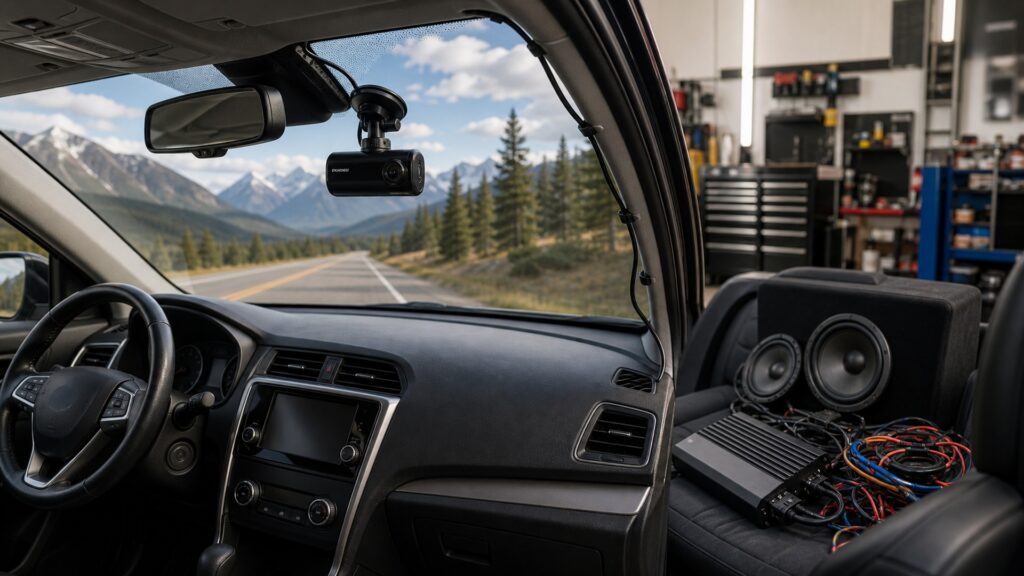
The decision begins with the artifact at the end: a preserved video file for later review, or controlled acoustic output at the listener's seat.
Tip: Complete this sentence before choosing equipment: after the project, I must be able to retrieve this file or hear this defined result under these conditions.
These terms keep a recording project from being confused with the vehicle's sound-producing chain.
A defined need to preserve retrievable information about an event for later review.
The portion of the exterior environment included by camera position, lens angle, orientation, and obstruction.
Protection or copying of a relevant recording before ordinary loop behavior can reuse its storage space.
The source, integration, processing, amplification, wiring, transducer, and cabin path that produces sound.
Competition between systems for power, grounding, data, wireless spectrum, trim space, sightlines, or service access.
A test of the promised end result rather than the presence of installed equipment.
Tip: Give the primary requirement one measurable output before considering products that contain both microphones, speakers, or screens.
A dash camera is the appropriate scope when the decision depends on video that still exists after the moment. Specify front, rear, cabin, or side coverage; ordinary and parking states; retention window; time accuracy; and a practical export method before selecting hardware.
Recording scope is justified by a persistent evidence requirement, not by the appeal of another screen.
When the problem is weak output, distorted channels, missing bandwidth, noise, tonal imbalance, staging, or unsafe load behavior, the cause lies in the source-to-cabin audio chain. A recording camera cannot supply amplifier power, suitable speakers, enclosures, or acoustic tuning.
A camera microphone and warning speaker do not perform the distributed audio-system job.
Some dash cameras record cabin sound, issue spoken alerts, or show playback; some receivers show camera images or save limited data. Those secondary functions do not change which system owns continuous evidence or sound reproduction across the cabin.
A component belongs to the project whose required output it can actually deliver and verify.
Using both is reasonable when recording and listening outcomes are independently valuable. Plan source-side fusing, current capacity, grounds, accessory timing, parking draw, cable separation, wireless access, windshield placement, microphone routes, airbags, and trim service before installation.
Coexistence succeeds when neither system degrades the other's power, noise, view, or serviceability.
Retrieve an intact, correctly timed sample file to accept a dash-camera project. For audio, verify the stated source, channels, clean level, frequency role, retained cues, and listening-seat result. Add the other system only when it has its own unmet outcome.
A clear acceptance test prevents one electronics project from expanding into another without evidence.
Recording and sound reproduction can coexist, but value comes from satisfying two distinct outcomes rather than buying the broader feature list.
A retrievable road or parking record is the central requirement and its field of view, continuity, storage, and export can be tested.
The existing audio system already meets the listening requirement.
The complaint concerns source, amplification, speakers, bass, noise, installation, or cabin acoustics rather than missing evidence.
Video cannot change the electrical or acoustic boundary causing poor sound.
These myths assume any vehicle electronic device can substitute for another if it includes a screen, microphone, speaker, or power cable.
Its microphone may capture incident audio and its speaker may provide prompts, but neither replaces the receiver, processing, amplification, distributed speakers, enclosures, or cabin tuning required for controlled music and speech reproduction.
A receiver may show a reversing or accessory camera without continuous recording, supported storage, event retention, timestamps, or export. A visible live image is not a persistent road record unless the exact system explicitly records it.
Feature counts mix unrelated jobs and ignore the required artifact. Start with retrievable video or defined acoustic output, then evaluate only the coverage, storage, electrical, signal, and integration capabilities needed to pass that outcome.
They can compete for battery capacity, accessory timing, grounds, cable routes, wireless connections, trim space, microphones, and service access. Separate functions still need one coordinated installation and a complete sleep-state and noise test.
Tip: Judge the product by the end output named in the requirement.
These answers help separate evidence needs, audio complaints, shared cameras, coexistence, and the acceptance tests for each choice.
Choose one only if future retrievable road evidence is the unmet outcome. Define required coverage, operating states, retention, timestamp accuracy, export, and privacy first; no camera can recover an event that occurred before installation.
Only if the exact receiver system also performs the required continuous recording, timestamping, retention, protection, and export functions. Many camera inputs display live maneuver views and never create a persistent file for later review.
Use audio scope when the proven problem is source access, channel routing, amplifier capability, speaker condition, frequency coverage, unwanted noise, mounting, or cabin response. Define the listening result and test the responsible handoff before purchase.
Yes. Power converters, shared grounds, poor routing, USB supplies, and wireless links can couple interference into sensitive audio paths. Use supported wiring, control cable placement, and verify every audio source with the recorder in each operating state.
For the camera, retrieve continuous files with correct time, coverage, and export. For audio, verify clean source-to-seat output, channel roles, retained prompts, and stable sleep behavior. Then test both operating together for conflicts.
Use dash cameras instead of car audio systems when the missing result is persistent, retrievable road-event evidence rather than sound reproduction.
Choose by the end artifact, prove the relevant path, and coordinate power and installation if both outcomes matter. A camera file cannot repair acoustics, and a cabin sound system does not create continuous exterior video by implication.
These explainers develop the complete dash-camera mechanism, distinguish the two system scopes directly, and place both inside the vehicle-electronics architecture.
Follow how a dash camera turns a road scene into segmented, retained, and retrievable files.
Compare the recording and sound-producing systems by information path, output, failure evidence, and installation conflicts.
Map cameras, audio, displays, power, data, and driver interfaces across the broader vehicle-electronics system.
Choose a retailer
Prices checked regularly. We may earn a commission at no cost to you.