
Intake Restriction
Vacuum or pressure loss across the air-cleaning path as the engine requests increasing airflow.
- High load reveals limited supply
- Duct faults can imitate media loading
- Specified endpoints control service
Choose an engine filter when measurements or service evidence show that contaminated media, excessive restriction, leakage, wrong fitment, or compromised sealing is preventing the intake, lubrication, or fuel circuit from delivering clean flow. The test must identify which filter and which operating condition fail.
Choose ignition components when gasoline-engine combustion loses properly timed spark because plugs, coils, wiring, drivers, power, grounds, or timing inputs cannot create or deliver sufficient ignition energy. Similar symptoms do not erase the distinction. A lean mixture, weak fuel pressure, compression loss, sensor error, exhaust restriction, or voltage fault can imitate either path. Capture codes and operating data, reproduce the complaint safely, and prove the failed function before installing parts.
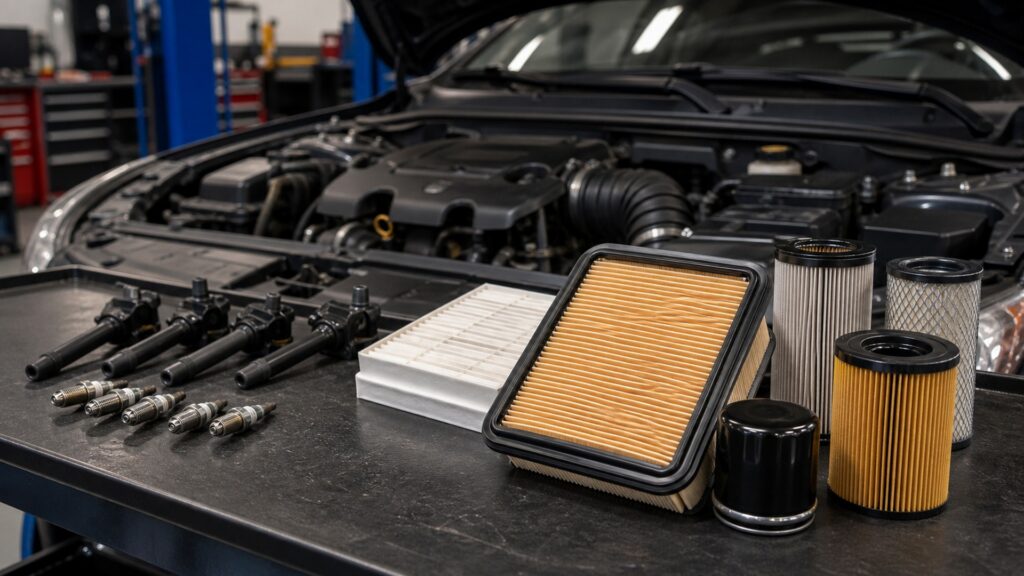
Filters are justified by restriction, pressure, contamination, or sealing evidence; ignition parts are justified by spark-circuit and cylinder-combustion evidence.
Tip: A misfire code identifies a cylinder or pattern detected by the controller; it does not automatically identify a spark plug or coil as the cause.
These terms keep filtration measurements separate from the evidence required to condemn ignition hardware.
Vacuum or pressure loss across the air-cleaning path as the engine requests increasing airflow.
The pressure loss across a fuel filter at a defined flow, temperature, and contamination state.
Diagnostic data estimating uneven crankshaft acceleration associated with failed combustion events by cylinder or time window.
Electrical energy released across a plug gap to initiate combustion under cylinder pressure and mixture conditions.
A captured set of operating values recorded when a diagnostic fault meets its storage criteria.
A targeted check that reproduces the failing condition and distinguishes the suspected component from alternatives.
Tip: Do not replace a scheduled filter merely to see whether a safety-relevant or catalyst-damaging misfire disappears; diagnose the active fault first.
A loaded air or fuel filter may support idle yet constrain the engine under acceleration, while an oil filter problem may appear during cold, high-viscosity operation or abnormal bypass. Measure the exact circuit instead of judging media color.
A demand-dependent symptom suggests a flow test, not a guaranteed filter diagnosis.
Coils and plugs may fail only with heat, cylinder pressure, moisture, or high voltage demand. Cylinder-specific counters, waveform or spark tests, inspection, and controlled component substitution can isolate the path.
Moving a coil is useful only when the symptom follows and the test does not introduce another fault.
Misfire monitors infer combustion from crankshaft motion. Injector faults, vacuum leaks, low compression, incorrect timing, contaminated fuel, or excessive exhaust backpressure can create the same pattern without a failed ignition component.
The code names the observed consequence; testing identifies its source.
Fuel systems can retain pressure and release flammable liquid; ignition circuits can produce high voltage; hot exhaust components can ignite spills; severe misfire can overheat a catalytic converter.
Diagnostic curiosity never overrides fire, shock, burn, or catalyst-damage limits.
After filter work, verify sealing and the original flow measurement. After ignition work, verify spark-circuit integrity, misfire counts, trims, codes, and performance under the conditions that exposed the fault.
A smoother idle cannot prove an oil filter is correct, and a cleared light cannot prove a coil is sound.
Engine filters answer documented contamination or flow problems; ignition components answer documented spark-generation or delivery problems.
The exact air, oil, or fuel element is due by documented interval or fails fitment, seal, restriction, pressure-drop, media-integrity, contamination, or bypass checks for its circuit.
Replacing the filter directly addresses the measured failure and related pumps, ducts, housings, fluids, sensors, and mechanical conditions have been evaluated.
Cylinder-specific evidence shows a plug, coil, wire, driver, connection, power feed, ground, or timing input cannot deliver appropriate spark under the failing condition.
Neither category is justified when fuel delivery, air leakage, compression, valve timing, exhaust restriction, system voltage, software, or sensor plausibility better explains the data.
Parts-cannon myths turn overlapping driveability symptoms into automatic shopping lists.
Misfire detection reflects uneven combustion, which can result from spark, fuel, air, compression, timing, mechanical, or electrical faults. Inspect plug condition and test ignition while also following evidence from trims, pressure, and compression.
Restriction depends on media loading, moisture, deformation, housing and duct condition, and airflow demand. Appearance is incomplete; use the specified interval, severe-duty guidance, or an appropriate restriction measurement for the exact application.
It can when excess filter pressure drop is proven, but a weak pump, restricted pickup, regulator fault, voltage loss, leak, contaminated tank, or incorrect test method can produce similar low-pressure readings.
A controlled swap can show whether a cylinder-specific fault follows a coil, but connectors, boots, plugs, injectors, compression, wiring, and intermittent heat conditions still need consideration. Record results and avoid damaging terminals.
Tip: Preserve the sequence from symptom to operating data to system test to component proof, especially when continued misfire can damage the catalyst.
These answers address misfire codes, hard starts, low power, diesel applications, and circumstances that require professional testing.
Severe restriction can change airflow and load behavior, but modern controls may compensate within limits. Misfire still requires code, trim, airflow, ignition, fuel, and mechanical evidence rather than assuming a visibly loaded filter is causal.
Cylinder-specific misfire that follows a coil, abnormal spark waveform, damaged plug, insulation tracking, missing coil command, or voltage failure supports ignition. Confirm fuel, compression, and wiring evidence before condemning the component.
Compression-ignition diesels do not use spark ignition for normal combustion, so gasoline-style coils and plugs are not candidates. Diagnose fuel filtration, pressure, injectors, glow systems, compression, air handling, controls, and exact architecture.
Yes. Complete overdue maintenance using correct parts while diagnosing the active symptom independently. A scheduled filter replacement should not be credited with fixing misfire unless the measured failure and post-service confirmation support that conclusion.
Seek qualified help for flashing malfunction lamps, fuel leakage, high-pressure fuel work, persistent misfire, uncertain oil pressure, catalyst overheating, high-voltage hybrid systems, or tests requiring scopes, pressure transducers, programming, and specialized safety procedures.
Use engine filters instead of ignition components when verified restriction, pressure loss, contamination, sealing, fitment, or scheduled-service evidence belongs to an air, oil, or fuel circuit.
Use ignition parts for proven spark-generation or delivery faults. Because misfire and power loss have many causes, capture operating data and confirm the failed function before replacement.
Related explainers provide filtration mechanics, exact filter fitment, and diagnostic-data discipline for resolving symptoms that cross air, fuel, lubrication, ignition, and mechanical systems.
Follow media, seals, restriction, pressure, and bypass through each engine filtration circuit.
Check hidden interfaces and calibration so an apparently correct filter does not create the symptom.
Use codes, live data, freeze frames, and confirmation tests without treating scan results as parts orders.
Choose a retailer
Prices checked regularly. We may earn a commission at no cost to you.