
Rowing Catch
The compressed start position of a rowing stroke.
- It sets up the drive phase.
- Mobility and timing affect the position.
- It has no equivalent on a stationary bike.
Choose an exercise bike over a rowing machine when the decision is really about coordination. A bike keeps the rider seated over a pedal circle; a rower asks for a catch, drive phase, finish, and recovery slide on every stroke.
The rower can be a strong choice when that sequence is desired. The bike becomes the cleaner answer when the user wants simpler pacing, less technique learning, easier sharing, or a room layout that cannot comfortably handle a long seat rail.
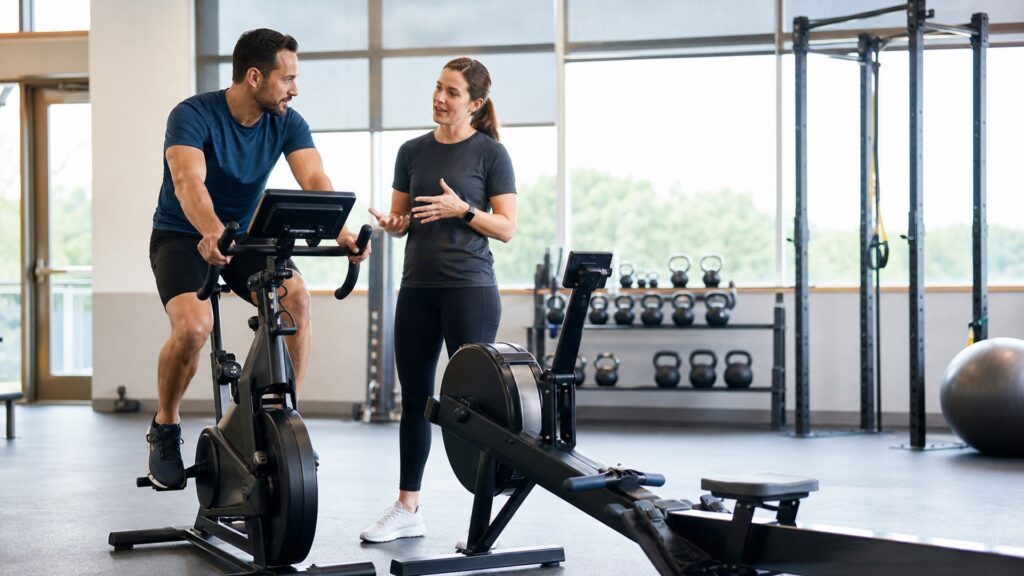
This comparison turns on coordination, control language, space, and session purpose rather than a universal ranking.
Tip: If the reader does not want to learn or monitor stroke phases, that is a legitimate reason to prefer the bike.
These definitions connect the main idea to the variables, limits, and practical signals readers need to compare options.
The compressed start position of a rowing stroke.
The effort portion of a row where legs, torso, and arms contribute in sequence.
The return along the rail before the next catch.
A rower setting that changes airflow feel on many machines.
Pedal revolutions per minute on the exercise bike.
The bike seat carrying much of the rider's weight.
Tip: Compare cadence with stroke rhythm carefully; they are pacing languages from different machines.
The bike reduces the task to staying positioned and turning the pedals. A rower adds ordered body movement, so the first decision is whether that added coordination is useful or in the way.
The bike wins when simpler motion control is the reason for choosing equipment.
A bike resistance control changes the load felt through the pedal circle. A rowing damper changes the feel of airflow or drag, while the stroke itself still determines much of the work.
Understanding the control language prevents a false apples-to-apples comparison.
A rower needs space for the sliding seat and handle path. A bike still needs access and height clearance, but many models fit into a smaller use zone.
The better machine may be the one the reader can keep ready to use.
For low-friction warmups or steady seated work, the bike's narrower task can be an advantage. For users who want to practice a coordinated pull, the rower offers a different kind of engagement.
The decision should match the session, not a vague idea of full-body effort.
General equipment logic cannot decide back pain, knee pain, rehabilitation suitability, or calorie outcomes. Those claims need evidence and personal context.
The responsible boundary is equipment fit and movement demand, not universal safety.
The bike-versus-rower decision is useful when it stays close to motion, setup, and learning demands.
It clarifies why a bike may suit quick, repeatable seated sessions while a rower may suit technique-rich pull sequences.
It separates bike resistance from rower damper settings so readers do not compare unlike controls.
It cannot prove which machine will burn more calories or be better for a person's body.
Pain, rehabilitation, and training prescriptions require individual assessment beyond equipment comparison.
Common shortcuts and misunderstandings can make the topic seem simpler than it is.
Rowing involves more coordinated movement, but seriousness depends on the session and the user. A bike can be the better tool for a defined purpose.
The damper changes airflow feel. Stroke rate, force, rhythm, and technique still shape rower output in ways a bike dial does not copy.
Pedaling is simpler, but saddle position, cadence control, and smooth force application still affect the ride.
A larger movement pattern helps only when the user wants and can manage it. Otherwise it can be unnecessary complexity.
Tip: Treat strong claims as starting points for comparison, not final answers.
Concise answers to common questions readers may have after the main explanation.
Choose the bike when seated pacing, easy sharing, compact placement, or reduced technique learning matters more than practicing a rowing stroke.
Choose the rower when the coordinated catch-to-recovery sequence is the desired feature and there is enough room and attention for it.
Often yes, because it loads the same pedal circle. Rower feel depends more on stroke mechanics and damper interpretation.
A bike can be simpler for quick warmups. A rower can also work, but it asks for more coordinated movement from the start.
No. Equipment differences are relevant, but pain, injury history, or rehabilitation needs should be handled with qualified guidance.
Use the bike when the decision calls for seated cadence, simpler controls, and less dependence on stroke timing.
Use the rower when the sliding pull sequence is the activity the reader deliberately wants, not merely because it sounds more complete.
Use these Review Streets paths to connect the explainer to related categories, comparisons, and next decisions.
Use this for the bike-side mechanism behind the comparison.
Read this to focus on the pedal-circle movement that separates bikes from rowers.
Use this broader guide to compare low-impact machines without making unsupported body claims.
Choose a retailer
Prices checked regularly. We may earn a commission at no cost to you.