
Protection Objective
A measurable reduction in carpet exposure, abrasion, moisture, staining, residue, odor, or cleaning effort.
- Locate the protection objective
- Observe protection objective changes
- Verify the protection objective
Choose floor protection when the unresolved problem is carpet wear, grit, mud, water, salt, stains, pet contamination, or cleaning burden. The appropriate product receives those loads, holds them within a replaceable surface, stays anchored, and leaves the vehicle for controlled cleaning.
Choose interior comfort when the unresolved problem concerns pressure, posture, contact temperature, airflow, glare, noise, touch, reach, or fatigue. A cushion or shade cannot replace a footwell reservoir; a liner cannot correct seat support or solar load. If a thick floor product changes foot position or a comfort product changes pedal reach, the categories share a fit problem that must be solved before either benefit is accepted.
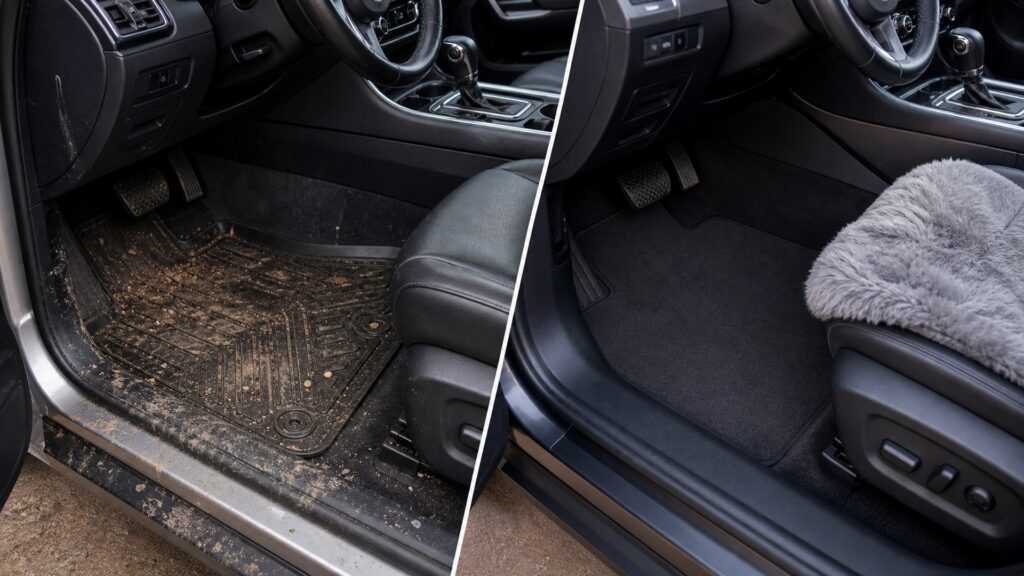
The decision separates contamination, occupant response, fit, safety, maintenance, and proof.
Tip: Purchase protection for material control and comfort for occupant response after shared fit constraints are resolved.
These definitions convert vague cabin dissatisfaction into two different specifications.
A measurable reduction in carpet exposure, abrasion, moisture, staining, residue, odor, or cleaning effort.
A defined improvement in posture, pressure, temperature, airflow, glare, noise, touch, reach, or sustained tolerance.
The route by which solids, liquids, chemicals, or wear move from shoes, cargo, pets, or weather toward cabin materials.
The pattern of body-support force across contact surfaces and time, affected by shape, posture, material, and movement.
Heat gained or lost through radiation, airflow, conduction, humidity, clothing, surfaces, and vehicle climate systems.
A repeatable observation showing the named outcome improved while required vehicle functions and safety boundaries remained intact.
Tip: State what changes, where it acts, and how success will be observed.
Trace shoes, weather, cargo, and pets to the affected floor. Specify solids, liquid volume, chemistry, abrasion, edge coverage, retention, cleaning, and underlying carpet condition rather than buying on appearance.
Protection is justified when a replaceable layer interrupts the contamination path.
Identify body location, trip duration, seat position, climate, clothing, motion, sound, glare, and control reach. Correct vehicle adjustment and underlying faults before adding material that changes posture or temperature.
Comfort is justified when a specific human response improves without compromising vehicle interfaces.
A deep liner or stacked mat can alter heel height and pedal transitions; seat pads can alter thigh angle, belt routing, head position, and reach. Fit both categories to the same occupant and seating position.
The categories meet wherever added material changes the occupant-vehicle relationship.
A liner may hide a leak, while a cushion may mask collapsed foam; neither fixes failed climate control, damaged seals, water entry, unsafe seat structure, or abnormal mechanical noise. Repair the source before accessorizing.
Accessories should manage expected use, not conceal vehicle faults.
Protection proof checks capture, leakage, retention, removal, and carpet condition. Comfort proof checks posture, pressure, temperature, noise, reach, stability, and symptoms over enough time to expose tradeoffs.
Buy both only when two independent gaps remain and combined fit passes.
Foam, textile, rubber, or reflective layers do not define the category; placement, load, geometry, attachment, and measured outcome do.
Expected contamination or wear reaches the floor and a stable removable barrier controls it.
Cleaning and replacement burden improve without altering control clearance.
A specific occupant-response problem persists after normal vehicle adjustment and repair.
A compatible intervention preserves restraints, airbags, controls, visibility, and stable posture.
These myths treat cleanliness, softness, or cost as sufficient decision evidence.
Additional thickness may soften one contact while reducing anchor engagement, pedal clearance, heel stability, drying, and containment geometry. If foot support is the goal, evaluate posture and control transitions rather than treating mat height as cushioning.
A cushion can redistribute seat pressure but does not intercept wet footwear, grit, salt, or heel abrasion below. Floor contamination still needs a retained, removable barrier with appropriate coverage and capacity.
Protection says nothing about seat pressure, temperature, glare, airflow, noise, reach, or fatigue. A pristine floor and an uncomfortable driving position can coexist because the outcomes arise from separate physical interfaces.
Two accessories can hide a water leak, HVAC problem, collapsed seat, abnormal noise, or unsafe geometry while adding thickness and maintenance. Diagnose the source, then buy only for remaining, testable protection or comfort gaps.
Tip: Route the complaint to the physical system that produces it.
These answers turn contamination and comfort complaints into a category decision.
Choose floor protection with compatible material, sufficient walls or absorbency, stable anchors, safe pedal clearance, and a practical removal path. Empty and dry it before capacity fails, and inspect beneath for leakage or salt residue.
Begin with seat, steering wheel, pedal, mirror, and head-restraint adjustment plus appropriate professional advice for persistent symptoms. Any support accessory must fit the occupant and preserve belt geometry, airbags, controls, visibility, and stable posture.
Some materials can change reflected or transmitted sound slightly, but that secondary effect does not establish acoustic comfort. Identify the noise source, frequency, path, vehicle condition, and listening goal before crediting a floor covering.
Use both when a documented contamination load and a separate occupant-response problem remain after diagnosis. Install compatible products, test combined thickness and movement, preserve safety interfaces, and maintain separate acceptance criteria for each outcome.
For protection, inspect captured material, leakage, movement, cleanout, and carpet. For comfort, use the adjusted cabin during a representative trip and record posture, pressure, temperature, reach, stability, and any new interference.
Protection manages material; comfort manages occupant response.
Choose from the unresolved outcome, repair underlying vehicle faults first, preserve control and restraint geometry, and require a category-specific acceptance test. Two purchases are warranted only when two independent needs survive that process.
These explainers show how the barrier handles contamination and how comfort variables act across the occupant-cabin interface.
Follow contamination through wear, capture, containment, retention, and cleanout.
Follow posture, pressure, thermal, airflow, acoustic, tactile, and reach conditions through the cabin.
Compare both categories by inputs, evidence, shared boundaries, and maintenance.
Choose a retailer
Prices checked regularly. We may earn a commission at no cost to you.