
Containment Need
A requirement to intercept, hold, and remove solids or liquids before they spread into cabin materials.
- Locate the containment need
- Observe containment need changes
- Verify the containment need
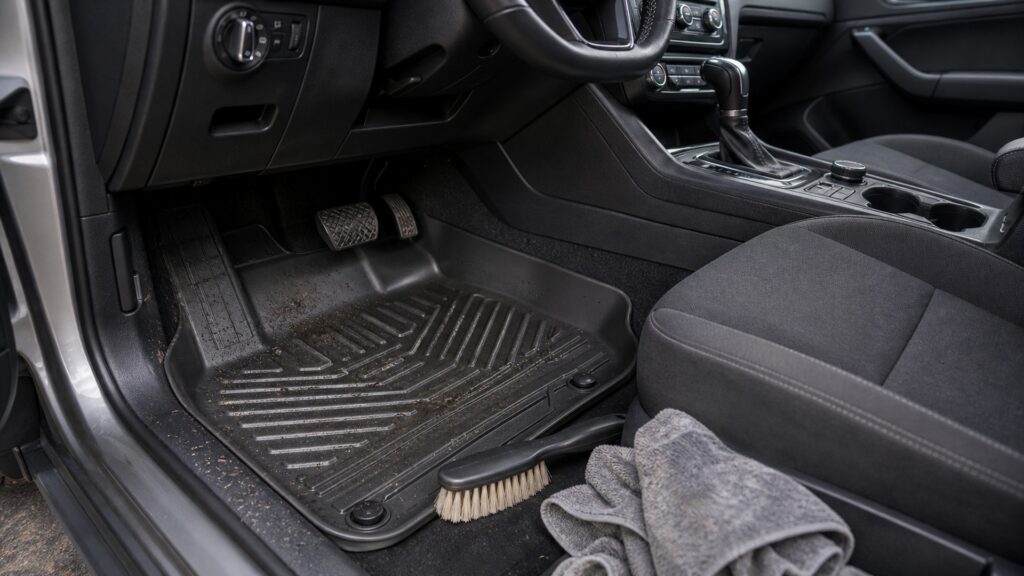
Use floor protection when shoes, weather, work, pets, or cargo introduce grit, water, salt, mud, oils, abrasion, or stains at the cabin floor. The required outcome is a stable, removable barrier that captures material before it reaches carpet and can be emptied without spilling.
Use interior organization when the problem is loose objects, inaccessible essentials, mixed cargo, charging cables, documents, waste, or repeated searching. Organizers create bounded locations and retrieval paths; they do not replace a liquid reservoir or wear layer. If items and contamination collect together, solve both needs independently while keeping every footwell, seat track, restraint, vent, and exit clear.
The decision distinguishes contamination, storage, restraint, retrieval, shared space, and proof.
Tip: The right category follows what must be controlled: dispersed contamination or discrete objects.
These definitions separate a dirty floor from a disordered cabin.
A requirement to intercept, hold, and remove solids or liquids before they spread into cabin materials.
A requirement to assign discrete objects a stable, accessible location during vehicle motion and normal use.
Restraint or enclosure that limits movement of an item during braking, turning, impact, entry, and exit.
The combined shoes, contamination, coverings, and objects occupying space near an occupant's lower legs and controls.
The reach, sight, opening, and hand movement required to locate and obtain a stored item without unsafe distraction.
The sequence of removing captured material, cleaning, drying, inspecting, and restoring the protector to service.
Tip: Name the thing, its path, and the required end state.
Loose material disperses, embeds, dissolves, or leaks, so it needs surface capture and containment. Discrete objects retain shape and need compartments, closures, or restraint sized to their mass and access frequency.
The physical form of the cabin input selects the control strategy.
Vehicle-shaped mats and liners receive heel force, trap grit, contain finite liquid, and leave the cabin for cleaning. Fit, anchors, capacity, and pedal clearance determine whether they perform safely.
Protection succeeds when contamination leaves with the removable layer.
Console trays, pockets, bins, dividers, cargo organizers, and cable routes assign items to bounded spaces. Location must suit reach, frequency, restraint, visibility, and emergency access without inviting in-drive searching.
Organization succeeds when objects remain located and accessible under vehicle motion.
Under-seat boxes, hanging pockets, cable bundles, and floor bins can press liner walls, block air outlets, enter seat tracks, or migrate into foot areas. Combined products need clearance through all adjustments.
No convenience gain justifies a new obstruction or loose-object path.
For protection, introduce a safe representative load, inspect containment, remove it, and check underlying carpet. For organization, brake and turn normally, then verify item retention, access, closure, visibility, and noise.
Two needs require two tests because clean carpet does not prove controlled objects.
Raised edges may temporarily catch a loose item, but they do not provide designed restraint or retrieval; an organizer can hold bottles yet cannot protect carpet from uncontained leakage.
The primary load is grit, liquid, salt, mud, abrasion, or staining at the floor.
A compatible covering can remain retained and clear of controls.
The primary problem is object location, restraint, sorting, access, or cable routing.
A stable mounting location exists outside controls, restraints, vents, and exits.
These myths let a visible container or floor edge stand in for the wrong physical control.
A bin contains only what enters it and may tip, leak, or move. Wet shoes and scattered grit load the whole foot-contact area, which needs a retained barrier shaped to the vehicle floor.
Loose cardboard, towels, bags, or trays can slide, bunch, absorb liquid, obscure leaks, and enter pedal or seat paths. Protection requires compatible geometry, stable retention, durable surface behavior, and controlled removal.
Coins, bottles, tools, and electronics can migrate under feet, pedals, seats, or trim. Store discrete objects in a bounded organizer designed for their size, mass, closure, mounting, and retrieval frequency.
Excess compartments can consume useful space, encourage overloading, hide items, increase cleaning effort, obstruct controls, and slow retrieval. Use the fewest stable locations that support actual contents and a clear access plan.
Tip: Match containment, restraint, and retrieval to the input.
These answers route mixed cabin complaints to protection, organization, or both.
Use retained floor protection with enough coverage, channeling, wall height, material compatibility, and removal capacity for the expected water or salt. Empty it before overflow and inspect the carpet for hidden moisture.
Use an organizer or routing method that prevents entanglement, connector strain, loose movement, heat buildup, and interference with controls. Place frequently handled devices where retrieval does not require unsafe reaching or searching.
Only where the vehicle and products provide stable, noninterfering support outside occupant foot areas, pedals, seat tracks, vents, restraints, and exits. Test movement with realistic contents and confirm it cannot deform liner walls.
Pair a vehicle-fit cargo liner for dirt and liquid with separately restrained containers or dividers for discrete items. Verify load limits, hatch closure, seatback movement, tie-down access, and spill-free removal of both systems.
List contaminants and objects separately, trace where each enters and moves, test existing control, then specify one barrier outcome and one storage outcome. Install both only when their combined fit and access remain safe.
Use protection for contaminants and organization for discrete objects.
Classify the cabin load before shopping, preserve occupant and vehicle clearances, and demand separate contamination and motion-retrieval tests. A clean floor and a controlled object inventory are complementary results, not interchangeable promises.
These explainers turn the barrier decision into material, retention, capacity, and vehicle-level checks.
Trace wear, grit, liquid, retention, and cleanout through the floor barrier.
Check contour, anchors, pedals, seats, vents, trim, and removal on the exact vehicle.
Place storage, protection, comfort, visibility, and control accessories within the whole cabin system.
Choose a retailer
Prices checked regularly. We may earn a commission at no cost to you.