When to Use Ignition Components Instead of Brake Components

Choose ignition components when evidence follows combustion events: one cylinder accumulates misfires, coil current or secondary behavior is abnormal, spark demand rises under engine load, or the engine stumbles while the vehicle is not braking. Choose brake components when the fault follows pedal application, wheel rotation, friction temperature, hydraulic pressure, or measured stopping performance.

This is a diagnostic routing decision, not a contest between two parts bins. A flashing engine warning with power loss can threaten the catalyst; a soft pedal, pulling stop, grinding, smoke, or overheated wheel can threaten control. Stabilize the immediate hazard, capture when the symptom occurs, then test the energy path that actually changes at that moment.

By: Review Streets Research Lab
Updated: September 1, 2026
Explainer · 8-12 min read
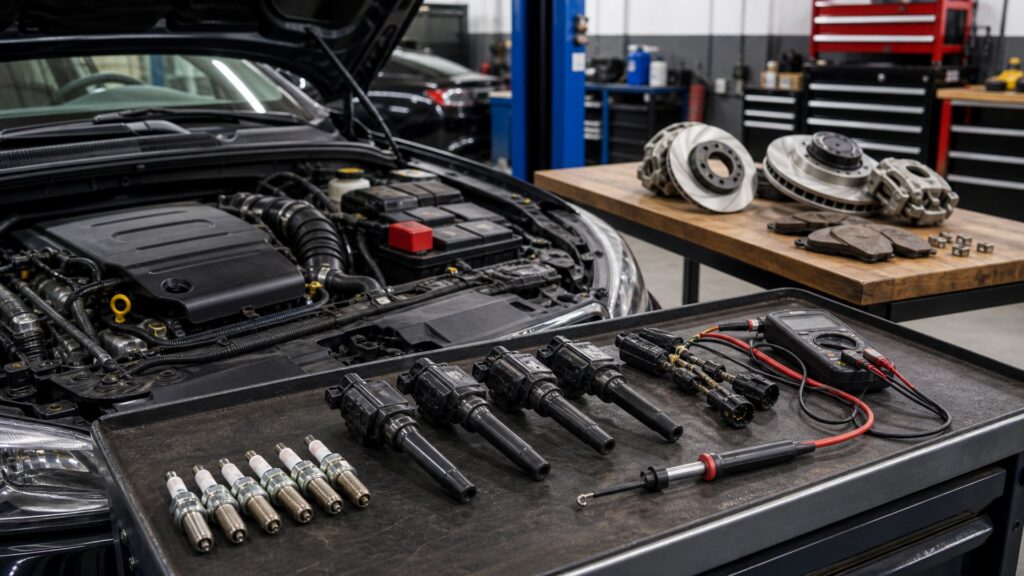
ignition components instead of brake components explainer hero image for Review Streets
What You'll Learn

Route the Complaint by the Event That Triggers It

Engine torque production and wheel deceleration create different timelines, temperatures, measurements, and safety priorities.

  • Ask whether the pedal was applied
  • Separate road speed from engine speed
  • Compare cylinder misfire counts
  • Measure wheel temperature carefully
  • Inspect warning-lamp behavior
  • Confirm the repair in its own event

Tip: If stopping ability, pedal feel, smoke, or a glowing wheel is abnormal, do not road-test for ignition performance until the brake hazard is controlled.

Definitions

Key Concepts That Define Ignition Components or Brake Components

These terms turn vague reports such as shaking or loss of power into testable ignition or brake evidence.

Cylinder Misfire

A combustion event that contributes less crankshaft acceleration than expected because spark, fuel, air, compression, or timing is inadequate.

  • Counters identify event distribution
  • Load can expose weak spark
  • Ignition is one possible cause

Firing Demand

The voltage required to ionize the spark-plug gap under the pressure, mixture, temperature, and geometry present during an event.

  • Acceleration raises chamber pressure
  • Gap growth increases demand
  • Leakage may appear first

Pedal Pulsation

A repeating force or movement felt through the brake pedal as hydraulic pressure or controlled anti-lock action varies.

  • Rotor variation can contribute
  • ABS activity has context
  • Engine vibration can be mistaken

Rotor Runout

Side-to-side deviation of a rotating brake disc relative to its intended plane at a specified measurement location.

  • Hub condition affects readings
  • Fastener torque can distort
  • Specification decides significance

Friction Temperature

Heat generated where pads and rotors or shoes and drums convert vehicle motion into thermal energy.

  • Dragging raises one wheel
  • Repeated stops raise all corners
  • Safe measurement needs distance

Stopping Distance

The roadway length required to slow from a defined speed under stated surface, tire, load, and control conditions.

  • Tires influence the result
  • Pedal response changes confidence
  • Public-road testing is unsafe

Tip: Record engine speed, vehicle speed, pedal state, selected gear, warning lamps, and temperature together; that timeline often resolves the category before parts are removed.

Start with Pedal State

A Brake Fault Changes with Deceleration Command

Grinding, a low or hard pedal, pulling, smoke, or vibration that begins with pedal pressure belongs in a brake safety check. The ignition system does not generate hydraulic force or friction at a wheel.

  • Inspect fluid loss safely
  • Compare wheel drag
  • Check friction thickness
  • Measure rotor or drum condition

Pedal-linked evidence routes the vehicle to brakes even when engine vibration is also present.

Follow Engine Events

A Misfire Tracks Cylinders and Crankshaft Acceleration

Ignition investigation gains priority when misfire counts rise by cylinder, coil charging or spark patterns fail, and hesitation follows throttle or engine load without a braking command.

  • Preserve freeze-frame data
  • Compare cylinder contribution
  • Test coil power and command
  • Check plug and boot condition

A misfire code directs testing; it does not prove the coil is the cause.

Separate Engine Speed from Wheel Speed

The Frequency of the Shake Identifies Its Source Family

A combustion disturbance often follows engine rpm and may be felt while stationary. Brake judder usually follows wheel rotation and pedal force, though driveline and tire faults can complicate the pattern.

  • Reproduce stationary symptoms safely
  • Note frequency through gear changes
  • Inspect wheel-speed correlation
  • Avoid guessing from the steering wheel

The speed domain narrows the search before expensive components are selected.

Treat Heat as Location Evidence

Catalyst Overheat and Wheel Overheat Demand Different Responses

Active misfire can send fuel into a catalyst, while dragging friction can concentrate heat at one wheel. Both require stopping, cooling, and controlled diagnosis, but their heat sources are far apart.

  • Heed flashing engine warnings
  • Do not touch hot brake parts
  • Compare wheel temperatures remotely
  • Check catalyst-risk conditions

Heat is urgent evidence; its location determines which system is unsafe.

Prove the Chosen Repair

Combustion Quality and Stopping Control Need Separate Release Tests

Ignition work ends with stable supply, timed spark, normal misfire behavior, and controlled engine load. Brake work ends with sound hydraulics, correct friction installation, free rotation, and safe stopping response.

  • Repeat the original trigger
  • Check for new warning lamps
  • Inspect for leaks or arcing
  • Document system-specific measurements

A vehicle may require both repairs, but neither result validates the other system.

Quick Reality Check

Choose the System Whose Event Changes

The decisive clues are pedal application, engine versus wheel frequency, localized heat, measured electrical or hydraulic behavior, and the safety consequence of continued operation.

Ignition Components Fit the Evidence When

The disturbance follows cranking, throttle, cylinder load, engine rpm, moisture, heat soak, coil command, spark demand, or cylinder-specific misfire data while braking input remains irrelevant.

Tests show a failed plug, boot, coil, connector, supply, ground, or control path after fuel, air, compression, and timing evidence are considered.

Brake Components Fit the Evidence When

Pedal travel, hydraulic pressure, friction noise, wheel drag, rotor or drum variation, pad or shoe condition, localized wheel heat, pulling, or stopping behavior changes with a brake command.

Immediate brake hazards outrank a drivability road test. Conversely, a flashing severe-misfire warning should end repeated loaded operation because catalyst damage and heat can escalate quickly.

Common Myths

Misconceptions About Ignition Components or Brake Components

Drivers often use the same words—shake, drag, weak, hot, warning light—for failures generated at entirely different ends of the vehicle.

Steering-wheel shake always means front brakes

Wheel and tire imbalance, suspension looseness, road surface, driveline behavior, and engine vibration can reach the steering wheel. Brake components become likely only when the shake reliably follows braking and measured wheel-end evidence supports it.

A misfire code means an ignition coil is required

Misfire detection measures crankshaft contribution, not coil guilt. Fuel delivery, air leaks, compression, timing, wiring, plugs, injectors, and mechanical faults remain possible. Test the cylinder and compare evidence before selecting parts.

If the car slows poorly, the engine must be weak

Acceleration and deceleration are different functions. Engine power may affect speed buildup, but brake hydraulics, friction, tires, road surface, load, and assist determine stopping. Any reduced braking response requires immediate brake inspection.

Replacing both systems is the safest shortcut

Unnecessary ignition work can create connector or thread faults, while unnecessary brake work can disturb sealed hydraulics or friction bedding. Control hazards first, then repair only the system that fails repeatable, system-specific tests.

Tip: Anchor each description to pedal position, engine speed, wheel speed, cylinder data, heat location, and the exact moment performance changes.

FAQ

Frequently Asked Questions About Ignition Components or Brake Components

These answers address overlapping vibration, warning lights, safety triage, and cases where both systems may genuinely need work.

Can a brake problem cause an engine warning light?

Some stability and brake controls share data with the engine controller, but a warning relationship does not prove friction or ignition failure. Read all modules, preserve codes, inspect network context, and test the reported event.

Can an ignition misfire feel like brake judder?

Yes. Engine torque fluctuations can shake the body during deceleration or at a stop. Note pedal input, transmission state, engine rpm, wheel speed, cylinder counts, and whether the vibration occurs while stationary.

Which warning signs require stopping immediately?

Stop safely for lost braking, fluid leakage, smoke, grinding with reduced control, severe pulling, an overheated wheel, or a flashing engine warning with major power loss. Arrange inspection instead of extending the test drive.

What if vibration occurs only while braking downhill?

Begin with brake heat, friction condition, rotor or drum measurements, wheel torque, hydraulics, tires, and suspension. Also monitor engine state if downshifts alter the vibration, because overlapping driveline forces can mislead.

Can both ignition and brake repairs be needed?

Yes. Maintenance history and test results may reveal separate faults. Document each complaint, control the brake hazard first, diagnose combustion independently, and require a distinct post-repair proof for stopping performance and engine operation.

Bottom Line

Use ignition components when the failure follows cylinder combustion, coil charging, spark demand, engine load, or heat soak; use brake components when it follows pedal force, hydraulics, wheel friction, drag, or stopping performance.

Triage immediate safety first, build a synchronized event timeline, and confirm each system with its own measurements. Similar sensations do not make ignition and brake parts interchangeable, and one successful repair does not certify the other.

Next Steps

Name the Trigger before Naming the Part

Related explainers provide the internal ignition sequence, the brake energy path, and scan-data discipline needed to route a vague complaint without guessing.

How Brake Components Work

Trace hydraulic force, friction contact, heat conversion, and wheel-speed control during braking.