
Cylinder-Specific Misfire
Uneven combustion repeatedly associated with one cylinder by crankshaft-speed analysis or direct testing.
- It narrows but does not prove cause
- Load can expose the pattern
- Mechanical faults remain possible
Use ignition components when evidence shows a spark-ignition path cannot charge, contain, time, or discharge electrical energy correctly. Cylinder-specific misfire that follows a coil, abnormal primary current, damaged plug, excessive gap, insulation tracking, missing command, or failed power and ground can justify that path.
Use engine filters when measurements identify excessive intake restriction, fuel pressure drop, oil-flow protection problems, contaminated media, leakage, wrong fitment, or scheduled service. Neither category owns every hard start or power loss. Fuel injectors, pumps, unmetered air, compression, valve timing, exhaust restriction, system voltage, sensors, and calibration can imitate both. Preserve codes and freeze-frame data, reproduce the fault safely, and confirm causation before replacement.
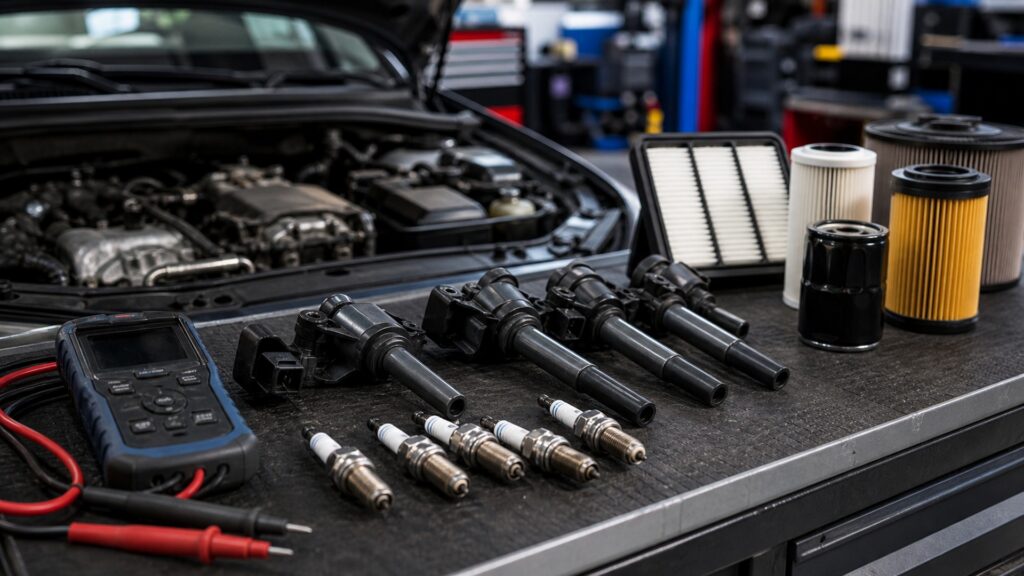
Ignition is supported by cylinder and electrical evidence; filtration is supported by pressure, restriction, contamination, sealing, or documented service evidence.
Tip: A flashing malfunction lamp can signal catalyst-damaging misfire; reduce load and follow vehicle guidance rather than continuing a road test to gather more data.
These terms distinguish a failed spark event from a constrained engine-fluid path.
Uneven combustion repeatedly associated with one cylinder by crankshaft-speed analysis or direct testing.
The measured rise of primary current during dwell, revealing supply, resistance, inductance, switching, and saturation behavior.
The secondary voltage required to ionize the plug gap under its current pressure, mixture, temperature, and geometry.
Pressure loss through the air-cleaning path as the engine requests greater airflow.
Controller correction applied to fueling from oxygen-sensor feedback and operating models.
Potential overheating when unburned fuel reaches the catalyst during sustained severe misfire.
Tip: A component swap is evidence only when the fault follows cleanly and connectors, plugs, injectors, compression, and operating conditions remain controlled.
A single-cylinder miss points toward that cylinder's plug, coil, injector, compression, wiring, or mechanical condition. A shared filter usually influences several cylinders, especially as total flow demand rises.
Cylinder ownership narrows the tree without completing it.
Voltage drop, current ramp, command timing, resistance, inductance, heat, and connector integrity reveal whether a coil receives and stores suitable energy. Secondary tracking may divert the discharge after charging succeeds.
Electrical evidence is stronger than replacing the easiest coil.
A loaded air or fuel filter may allow idle but limit operation as flow rises; oil behavior changes with viscosity, temperature, and bypass. Test the specific circuit at the condition that reveals it.
A filter's appearance cannot establish the pressure available downstream.
Misfire monitoring sees combustion consequence. Injectors, low fuel pressure, vacuum leaks, valve leakage, head-gasket faults, cam timing, sensor error, or exhaust restriction can make ignition parts look guilty.
The most convincing symptom still needs a causal mechanism.
After ignition work, verify misfire counts, timing, trims, and load response. After filter work, verify pressure, restriction, sealing, and flow. Stop when catalyst temperature, fuel leakage, or oil pressure becomes unsafe.
Successful confirmation is brief, controlled, and matched to the original event.
Cylinder and electrical evidence must beat filtration, fuel, air, compression, timing, exhaust, voltage, and control alternatives.
The fault follows a plug or coil, waveform or circuit tests fail specification, insulation tracking is visible, gap or plug condition is causal, or command, power, ground, and timing evidence isolate the path.
The repair restores combustion under the failing pressure, heat, speed, and load without masking an injector, mechanical, mixture, or control problem.
Exact interval, restriction, differential pressure, contamination, water, media damage, seal leakage, wrong fitment, or bypass evidence identifies an air, oil, or fuel element.
Neither category should be forced when data points to battery voltage, pumps, injectors, intake leaks, compression, valve timing, exhaust restriction, sensors, wiring, or software.
Misfire repair becomes expensive when codes are read as invoices and routine filter age is treated as causation.
The code localizes uneven combustion, not its cause. Plug, injector, compression, valve, wiring, mixture, coolant entry, and mechanical faults can affect one cylinder. Confirm that the failure follows or tests within the ignition path.
A shared intake filter usually influences total airflow rather than one cylinder alone. Distribution leaks or runners can differ, but a repeatable single-cylinder pattern requires plug, coil, injector, compression, and local mechanical testing.
Wrong fitment, gap, torque, cracked insulators, damaged boots, loose terminals, coil faults, driver problems, or contamination during installation can persist or begin after service. Verify part numbers and actual operation.
Clearing removes evidence and resets monitors; it does not demonstrate stable combustion. Reproduce the original load safely, review counters and pending faults, confirm related data, and complete required readiness or drive procedures.
Tip: Use controlled cylinder comparison, electrical measurement, fluid-flow testing, and alternative-cause elimination before deciding which part family earns the repair.
These answers cover coil swaps, filter appearance, intermittent heat faults, diesel engines, and cases where both maintenance and repair are justified.
When cylinders use interchangeable coils and the procedure is safe, moving one suspected coil can show whether the misfire follows. Preserve plug, connector, injector, compression, and operating-condition evidence so the conclusion remains valid.
Yes. Higher cylinder pressure raises breakdown demand, while heat, dwell, supply voltage, gap, and insulation affect available energy. A marginal system may idle smoothly yet misfire during boost, heavy load, or rapid acceleration.
Complete documented maintenance with the correct element, but diagnose the active misfire independently. Do not claim causation unless pressure or restriction was abnormal and the original symptom resolves under controlled post-service testing.
Conventional diesels use compression ignition rather than timed spark, so gasoline coils and plugs are not candidates. Test fuel filtration, pressure, injectors, glow support, compression, air handling, timing, emissions systems, and exact architecture.
Stop for flashing catalyst warnings, fuel leakage, oil-pressure loss, arcing, smoke, overheating, unsafe road behavior, or procedures requiring unavailable high-voltage, fuel-pressure, waveform, lifting, or programming equipment. Preserve data and seek qualified help.
Use ignition components instead of engine filters when cylinder and electrical evidence proves a failure in coil charging, timing, insulation, plug discharge, or secondary delivery.
Use filters for documented contamination-control or flow faults. Because power loss and misfire have many causes, make spark and flow compete under the same failing condition before replacing either.
Related explainers provide the complete ignition mechanism, exact fitment controls, and competing filter-diagnosis logic needed for hard-start, hesitation, and misfire decisions.
Trace position sensing, dwell, magnetic storage, secondary voltage, gap breakdown, and combustion feedback.
Confirm plug and coil geometry, thermal behavior, electrical control, insulation, and torque.
See the inverse decision from the filter side using restriction, pressure, contamination, and spark evidence.
Choose a retailer
Prices checked regularly. We may earn a commission at no cost to you.