
Portable Cord Set
EV supply equipment packaged for transport and connection to an appropriate receptacle.
- The control box remains in the power path
- Weight needs strain relief
- Portability does not certify an outlet
A portable charging cord fits drivers who need a movable backup, charge at several verified locations, or can replenish routine travel from a modest circuit. Its value is flexibility: one safety-certified unit can ride with the vehicle and connect without permanently assigning wall space, although every outlet and circuit still becomes part of the charging system.
Wall-mounted equipment fits frequent home charging when predictable cable placement, higher current, outdoor durability, access control, or connected scheduling matters. The boundary is not portability alone. It is whether the available supply, repeated plug cycles, daily energy deficit, exposure, installation, and recovery plan make a movable connection dependable enough for regular use.
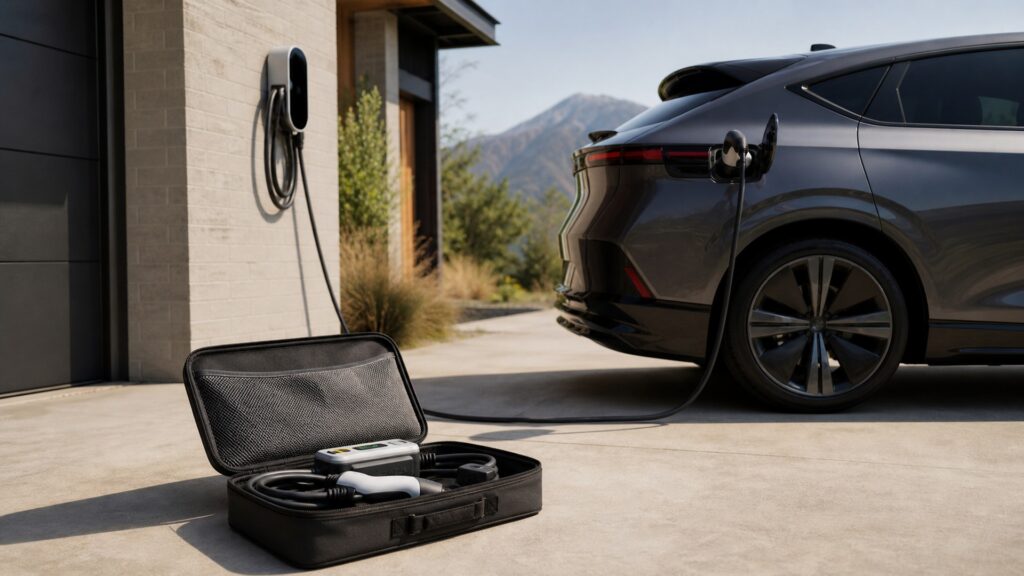
The useful comparison follows the entire current path and the frequency with which people handle it.
Tip: Before relying on a new location, have its circuit and receptacle evaluated for the intended continuous load; a plug that accepts the connector may still be unsuitable for hours of charging.
These terms define the electrical and handling differences that actually change the decision.
EV supply equipment packaged for transport and connection to an appropriate receptacle.
Supply equipment secured to a building surface and connected by plug or permanent wiring.
Electrical demand expected to persist for hours and therefore requiring branch-circuit sizing rules.
A branch circuit reserved for the charging load rather than shared with unrelated devices.
Loss of contact pressure or damage caused by heat, contamination, repeated insertion, or poor support.
Placement that protects the lead and connector from tight bends, vehicles, water, doors, and walking paths.
Tip: Record the circuit, breaker, conductor, receptacle, plug, current setting, and enclosure ratings as one installation rather than treating the cord as an isolated appliance.
Start with miles driven, vehicle efficiency, usable charging hours, and the lowest current limit in the circuit-to-battery chain. A portable Level 1 or portable Level 2 unit works when the overnight energy delivered reliably restores the normal deficit with reserve for unusual trips.
A slower connection is adequate when dwell time is long and the daily deficit is small; it is inadequate when missed recovery accumulates across several days.
Portable equipment transfers more responsibility to each host outlet. Loose contacts, shared loads, improvised adapters, undersized conductors, damaged grounding, or weather exposure can create heat and fault risk even when the charger itself is listed and operating normally.
The least visible connection often determines reliability, so outlet history and circuit inspection matter more than convenient reach.
A fixed unit gives the cable, connector, and electronics a known home. That reduces transport damage, trunk contamination, repeated receptacle wear, and setup friction, while a portable unit remains valuable as a backup that is inspected and packed deliberately.
Convenience becomes a safety feature when it encourages complete insertion, proper storage, and consistent inspection rather than rushed daily improvisation.
Outdoor use requires ratings for the complete arrangement, not merely a weather-resistant connector. The control box, receptacle cover, plug interface, cable route, drainage, mounting height, and vehicle position must tolerate precipitation and physical contact without creating a locked-in hazard.
A wall mount can organize exposure, but only correct siting and installation make the fixed location safer.
Choose portable equipment for travel, emergency reserve, rentals, seasonal parking, or low daily demand at known circuits. Choose a wall unit when charging is frequent, current is higher, cable routing needs permanence, multiple users need predictable access, or utility scheduling justifies integration.
The right answer can be both: fixed equipment for routine energy and a compatible portable set for rare, verified locations.
Portable and fixed equipment can both charge safely; their risk moves to different parts of the installation and handling routine.
A transportable cord can support several inspected locations, preserve options for renters, and provide a backup when its current demand fits the available circuit.
Lower daily energy needs may not justify permanent high-current equipment when long dwell time already restores the battery.
Fixed placement improves cable storage, strain relief, repeated access, and optional network control, but installation quality still controls electrical safety.
Neither format overrides the vehicle's charging limit, branch-circuit capacity, weather requirements, or prohibitions on adapters and extension leads.
These myths confuse a movable enclosure with a universally compatible source.
A matching blade pattern shows geometry, not conductor condition, circuit loading, grounding, contact pressure, weather protection, or installation quality. Long charging sessions can expose defects that short household loads never reveal.
Mounting does not determine power. Supply voltage, circuit current, EVSE setting, cable rating, connector, vehicle onboard charger, battery conditions, and negotiated limits establish the actual AC charging rate in practice.
Adapters add interfaces and may defeat temperature sensing, grounding assumptions, enclosure protection, or manufacturer limits. Use only vehicle and equipment-approved arrangements on a circuit verified for the continuous charging demand.
Travel exposes plugs, pins, seals, cables, and control boxes to moisture, grit, impact, tight packing, and strain. Inspect before each use and retire equipment showing heat damage, cracks, corrosion, or loose parts.
Tip: Judge the exact circuit, connection, current, environment, and handling routine before trusting either format.
These answers resolve everyday installation and travel boundaries that the format label cannot settle.
Yes, when its manufacturer permits routine use and the dedicated circuit, receptacle, support, weather protection, cable route, and current setting are correct. Repeated plug handling and connection temperature still need regular inspection.
Carry it when travel flexibility or emergency backup outweighs losing convenient home access. Store it clean, dry, loosely coiled, protected from cargo, and accompanied by only the approved adapters and instructions.
Often, but permission and electrical suitability still apply. A portable unit avoids some permanent mounting, yet adding a receptacle, changing a circuit, routing cable across common space, or charging outdoors may require owner approval.
Stop charging for unusual warmth, odor, buzzing, discoloration, soft plastic, intermittent power, a loose plug, tripped protection, moisture, or damaged contacts. Disconnect safely and have the installation evaluated before reuse.
Only if connector compatibility, current limits, scheduling, cable reach, and daily energy needs all work without unsafe repositioning. A listed load-sharing system may be more dependable when both vehicles require regular simultaneous access.
Portable and wall-mounted EV chargers differ mainly in duty cycle, connection control, handling, and installation permanence—not in a simple hierarchy of safety or speed.
Use portable equipment where verified circuits and modest demand make mobility valuable; use fixed equipment where repeated charging benefits from dedicated placement, durable cable management, and integrated control.
These related explainers extend the choice into circuit design, charging level, and permanent-versus-plugged installation.
Build the charging decision around parking, electrical capacity, dwell time, utility rules, and a repeatable home routine.
See how Level 2 changes the energy recovered during the same parking window without guaranteeing the vehicle's maximum rate.
Compare permanent wiring with a receptacle connection after deciding that fixed equipment fits the location.
Choose a retailer
Prices checked regularly. We may earn a commission at no cost to you.