
Arrival State of Charge
The battery estimate when the vehicle reaches its regular parking location.
- It defines energy needed overnight
- Daily variability matters
- Reserve policy changes the target
Home EV charging matters because it moves energy replenishment into the hours when a vehicle is already parked. Instead of treating charging as a separate trip, an owner can connect after arrival, schedule around departure or utility rates, and begin most days with a planned energy reserve. That routine is often more important than maximum charging speed.
The routine depends on the property. Electrical-service capacity, panel location, parking rights, conductor route, outlet or hardwired connection, weather exposure, cable reach, lighting, accessibility, fire separation, network coverage, and utility programs can change cost and usability. A good plan starts with daily energy and dwell, uses qualified installation and safety-certified equipment, and preserves a backup when home power or parking is unavailable.
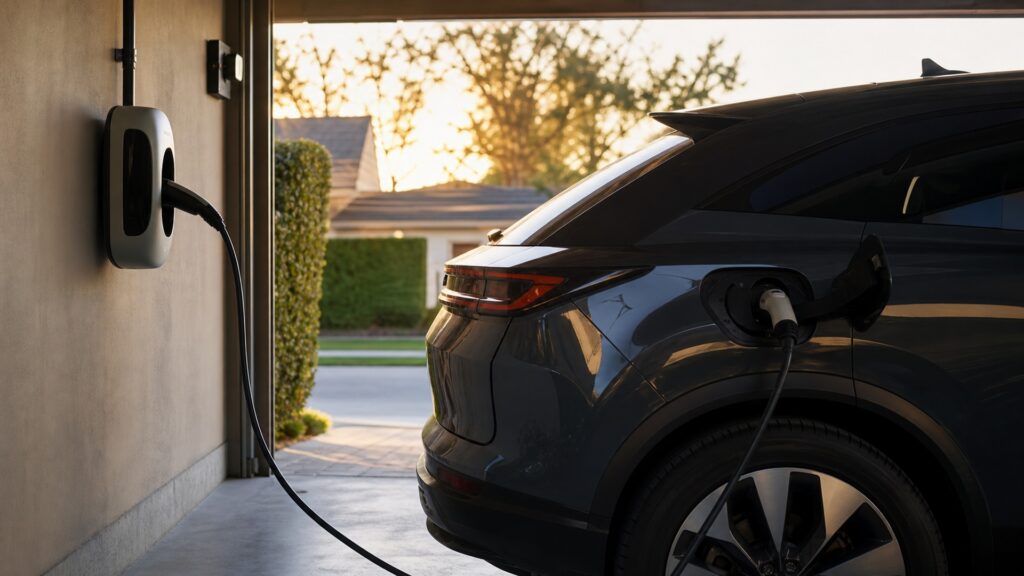
Home charging works when the electrical site, parking space, connector, schedule, vehicle settings, household loads, and backup plan reliably close the daily energy gap.
Tip: Walk the entire cable route with the vehicle parked in every normal orientation; reject plans that cross sidewalks, pinch doors, create trip hazards, or require tight connector strain.
These terms connect household infrastructure with the driver's repeatable charging behavior.
The battery estimate when the vehicle reaches its regular parking location.
The reliable connected time between parking and the next expected departure.
An electrical assessment of existing and proposed loads against the service and panel capacity.
A utility tariff with electricity prices that vary by time period.
Automated adjustment of charging timing or current based on grid, utility, site, or user conditions.
Hardware and practice that support the connector and cable between sessions and during charging.
Tip: The installation is not complete until the vehicle can connect without stretching, coiling dangerously, blocking access, or exposing a plug connection to unsuitable weather.
The repeated task is to replace energy used since the previous connection, not fill the entire battery. Actual seasonal efficiency, commute variation, charging losses, desired reserve, and the shortest realistic dwell determine whether Level 1, lower-power Level 2, or more capacity is justified.
A home system succeeds by meeting nearly every ordinary departure, not by imitating the fastest public charger.
An electrician determines available capacity, breaker and conductor needs, protection, distance, voltage drop, mounting, and permits. The physical plan also covers wall strength, vehicle port location, garage or outdoor rating, impact protection, drainage, lighting, and accessibility.
Buying the EVSE first can lock the project into the wrong current, cable length, enclosure, or connection method.
Charging can be scheduled in the vehicle, wall equipment, utility platform, or all three. Overlapping timers, incorrect clocks, daylight-saving changes, departure preconditioning, and managed-charging events can produce an unexpected low state of charge.
Smart charging is useful only when the driver knows which system has authority and how to recover before departure.
Hours of current expose poor contact and damaged hardware. Outdoor installations need appropriate ratings and placement; plug-connected systems add a receptacle and plug interface; cables need support away from wheels, doors, standing water, and walking paths.
Daily convenience depends on a mechanically protected electrical path that remains sound through seasons and repeated mating.
Multifamily residents may need approvals, metering, assigned spaces, network access, and cost allocation. Households should also know nearby public options, portable cordset capabilities, outage behavior, and whether another vehicle shares the circuit or connector.
Home charging is most valuable when it reduces dependence without pretending the property or grid can never become unavailable.
Home charging converts long private dwell into energy while shifting responsibility to the property's electrical and access system.
A well-sized installation can replace ordinary driving energy overnight, schedule lower-cost periods, and support preconditioning while connected.
Consistent cable placement and access can make charging a short arrival habit instead of a recurring search for public infrastructure.
Renters, multifamily residents, street parkers, limited services, detached parking, or shared spaces may face approvals and cost structures closer to public charging.
Home equipment does not eliminate public charging, outages, travel planning, maintenance, battery limits, or the need to verify every departure target.
These myths treat the garage as automatically ready and the largest circuit as automatically best.
Outlet type does not prove dedicated wiring, sound contacts, correct protection, grounding, capacity, or suitability for hours of continuous load. Have the circuit assessed and stop for heat, odor, discoloration, looseness, or repeated trips.
Most sessions replace only the day's use and may target a vehicle-recommended state of charge below full. Required energy, next trip, reserve, battery guidance, and dwell time matter more than reaching 100 percent.
Extra nameplate power may exceed the vehicle, service, routine, or utility window while increasing installation cost. Future flexibility has value, but conduit, load management, or modest capacity can preserve it more efficiently.
Savings depend on the tariff, demand rules, enrollment, schedules, household loads, utility events, and correct clocks. Competing vehicle and EVSE timers can miss the intended window or leave insufficient departure energy.
Tip: Build from daily energy, property rights, qualified electrical capacity, and a tested routine before selecting a wall unit.
These answers address Level 1, outdoor installation, renters, cable length, and charging during outages.
Yes. DOE guidance notes that many drivers can meet daily needs overnight on a dedicated 120-volt circuit. Actual mileage, efficiency, dwell, losses, climate, and schedule determine whether the lower power remains sufficient.
Listed outdoor-rated equipment installed for the location can be used safely, including in rain, according to DOE guidance. Correct enclosure, mounting, drainage, impact protection, cable handling, and qualified electrical work remain essential.
Start with parking rights, landlord or association approval, metering, panel access, cost allocation, permits, incentives, accessibility, and future residents. A shared or networked installation may be more appropriate than a private unmanaged circuit.
Long enough to reach the inlet in normal parking positions without tension, driving over it, blocking a walkway, tight bends, or unsafe coiling. Excess length still needs supported, accessible storage within the equipment limits.
Ordinary grid-connected charging stops without site power. Backup generation, storage, or bidirectional systems require specifically engineered transfer, isolation, capacity, vehicle, and utility arrangements; never energize household wiring through an improvised connection.
Home EV charging matters because it turns existing parking time into predictable departure energy through a routine designed around the property and the vehicle.
Size from daily need, assess the electrical site before equipment purchase, plan cable geometry and weather, choose schedule authority, inspect connections, and maintain a tested backup.
These explainers develop the two installation choices that follow the home energy calculation: Level 2 capacity and hardwired versus receptacle-connected EVSE.
Calculate whether Level 1 or Level 2 provides enough recovery margin for actual miles, dwell, climate, and schedule.
Compare hardwired and plug-connected installations by current, interfaces, portability, maintenance, weather, and replacement.
Review the circuit, EVSE signaling, vehicle conversion, battery controls, connectors, and gear that make every session possible.
Choose a retailer
Prices checked regularly. We may earn a commission at no cost to you.