
Stroke Sequence Practice
Using the rower to practice catch, drive, finish, and recovery.
- It requires attention.
- It is the rower's defining task.
- It differs from bike cadence.
Use a rowing machine instead of an exercise bike when the desired activity is the coordinated sliding stroke itself. The rower asks for catch timing, leg drive, body swing, handle pull, finish control, and recovery rhythm; the bike narrows the task to seated crank cadence.
That extra sequence can be the reason to choose the rower. It can also be the reason not to. The decision should turn on whether stroke practice, handle-driven load, and rail movement serve the intended session.
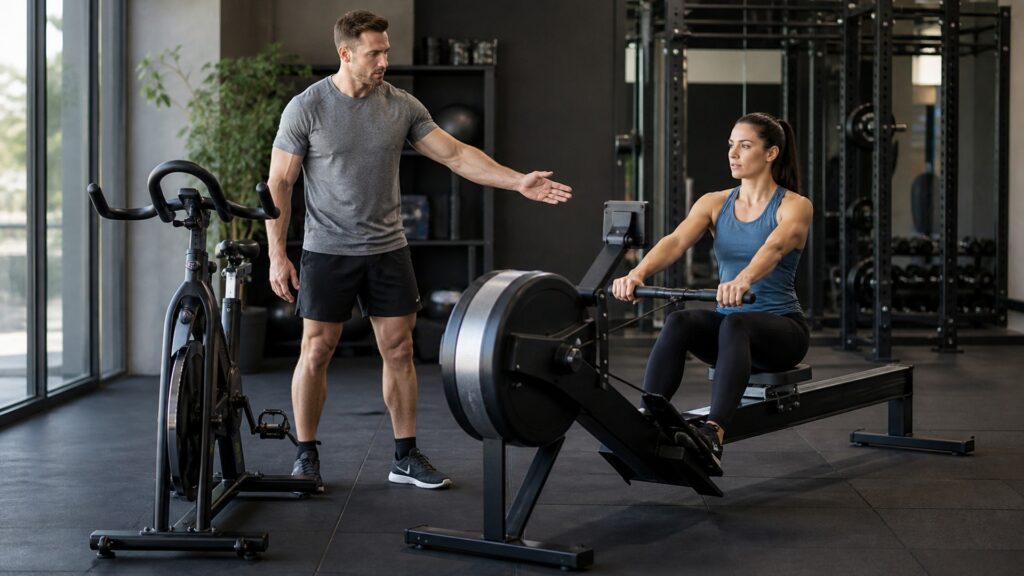
This guide explains when rowing's added coordination is useful enough to choose over the bike.
Tip: Choose the rower when the stroke sequence is the feature, not merely because it sounds more complete.
These definitions connect the main idea to the variables, limits, and practical signals readers need to compare options.
Using the rower to practice catch, drive, finish, and recovery.
The push from the feet during the rowing drive.
The force through the rower handle.
The bike's pedal revolutions per minute.
The active space used by the sliding seat.
The meaning of airflow settings on some rowers.
Tip: Keep stroke rate, split, and damper separate from bike cadence and resistance.
The strongest case for the rower is wanting the catch-to-recovery sequence. If the session should include braced feet, sliding seat travel, and handle-driven load, the bike cannot provide that same task.
The rower wins when the reader wants a stroke to practice, not just cardio time.
Rowing asks the user to pay attention to order and rhythm. That demand is useful for deliberate practice but less ideal when the goal is low-distraction seated pacing.
The same coordination that makes rowing appealing can make it the wrong tool for some sessions.
A rower often needs more active length than an exercise bike because the seat travels. The bike may be easier to leave ready in tight spaces.
Choose the rower only if the room supports the stroke without constant friction.
A rower's split, stroke rate, damper, and drag language do not translate cleanly to bike cadence and resistance levels.
The decision is clearer when each machine's feedback stays in its own language.
If the reader wants a compact seated machine, easier multitasking, quick warmups, or less technique management, the bike may be the better fit.
A true decision boundary names when not to choose the rower.
The rower-over-bike decision works when the reader wants a coordinated stroke and has space for the rail.
It shows why rowing can be chosen for technique-rich sessions rather than generic superiority.
It explains why bike simplicity can still be the correct answer.
It cannot prove higher calorie burn, better health outcomes, or suitability for pain or rehabilitation.
Individual context and instruction matter outside this comparison.
Common shortcuts and misunderstandings can make the topic seem simpler than it is.
More coordination helps only when it serves the session.
The bike can be chosen for defined pacing, space, or role reasons, not only skill level.
Damper changes rower feel and must be interpreted with stroke output.
It has a specific sliding stroke, which is useful for some goals and inconvenient for others.
Tip: Treat strong claims as starting points for comparison, not final answers.
Concise answers to common questions readers may have after the main explanation.
Use the rower when stroke sequence, handle-driven load, and technique attention are desired features.
Use the bike when seated cadence, compact placement, or simpler low-distraction pacing matters more.
Yes, the catch-to-recovery sequence makes timing more central than on a bike.
Often it needs more active length because of the sliding rail, though designs vary.
No. It is a movement and use-case comparison, not an outcome claim.
Use a rowing machine instead of an exercise bike when the coordinated sliding stroke is the feature the reader wants to practice and support.
Stay with the bike when the better answer is seated cadence, compact setup, quick starts, or less technique attention.
Use these Review Streets paths to connect the explainer to related categories, comparisons, and next decisions.
Use this for the mechanical rower-side explanation behind the decision.
Read this to compare the bike's simpler crank mechanism against rowing.
Use this to examine the stroke sequence before choosing a rower.
Choose a retailer
Prices checked regularly. We may earn a commission at no cost to you.