
Repairable Tread Area
Central crown portion where a small puncture may remain eligible for demounted professional repair.
- It excludes shoulder and sidewall
- Angle and diameter still matter
- Prior repairs can disqualify the area
Use a tire repair kit instead of a spare when the evidence points to one small central-tread puncture, the tire was not driven flat, the wheel and sidewall are intact, the kit is compatible, and inflating from a protected position is safer than lifting the vehicle. The result remains temporary.
Choose the spare when damage cannot be sealed—within the spare's own pressure, load, speed, and distance limits—and when jacking can be done on firm, level ground away from traffic. Sidewall cuts, bead separation, bent wheels, large injuries, or rapid unexplained loss defeat most kits. If neither option can be used safely, roadside assistance is the correct third branch.
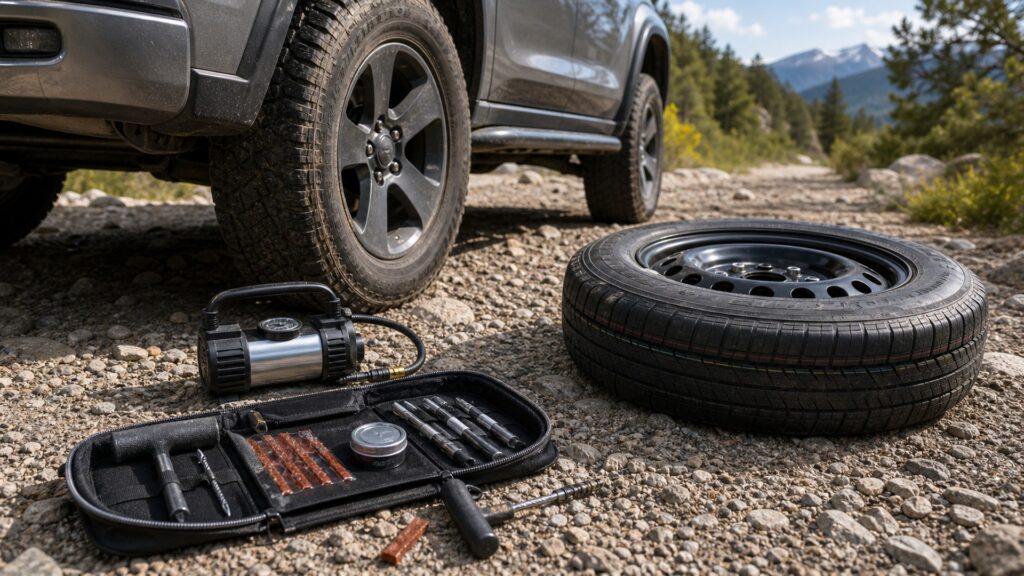
The fastest tool is the one matched to the failure and scene. Work through tire structure, wheel integrity, underinflated travel, roadside position, and follow-up distance before committing.
Tip: Before touching a wheel or puncturing object, identify a protected exit path and the point at which falling pressure, vehicle movement, compressor heat, unstable ground, or traffic will end the attempt.
These decision terms describe the branches that a generic 'flat tire' label hides.
Central crown portion where a small puncture may remain eligible for demounted professional repair.
Air escape where the tire bead should seal against the wheel.
Compact spare engineered for restricted pressure, speed, distance, and load conditions.
Distance, speed, load, and pressure experienced after inflation was lost.
Ability of the surface to support the jack and vehicle without sinking, slipping, or tilting.
Shortest credible route to a facility capable of internal tire and wheel inspection.
Tip: Vehicle and tire-maker instructions control; some mobility systems use sealant, run-flat construction, special sensors, or no spare, each with different limits.
A straight, small object in the central tread with slow, identifiable leakage is the strongest kit candidate. Shoulder, sidewall, bead, valve, wheel, impact, large, irregular, or multiple injuries point away from external sealing.
A repair kit wins by matching one narrow failure—not by being easier to retrieve.
Even a repairable puncture becomes questionable after significant low-pressure travel. Repeated sidewall flex creates heat and can damage cords or liner surfaces that remain invisible until the tire is demounted.
When the tire's history is uncertain, the spare preserves the damaged casing for assessment instead of loading it again.
Changing a wheel exposes the driver longer, raises the vehicle, and concentrates load at a jack point. Firm level ground, wheel chocks, correct tools, adequate clearance, and separation from traffic are prerequisites.
A mechanically suitable spare is not the safer option on a collapsing shoulder or beside a live lane.
Compact spares lose air unseen and may have restrictions with large brakes, all-wheel drive, towing, or driven axles. Lug-key availability, wheel fastener condition, jack compatibility, and cargo access can end the plan.
A spare that cannot be installed correctly is cargo, not redundancy.
A plugged or sealed tire needs pressure monitoring and demounted inspection; a temporary spare needs its own speed, distance, handling, and load discipline. Weather, time, service availability, and route geometry affect both.
The decision ends at qualified service, not when the warning lamp turns off.
The kit avoids lifting; the spare tolerates more damage. Injury evidence and roadside exposure determine which advantage matters.
The leak is a small central-tread puncture, the casing has not run low, pressure can be verified, and the vehicle can remain on the ground in a protected position.
Service is close, the kit is compatible, the compressor can finish the inflation, and the driver will treat the result as temporary.
Structural, shoulder, sidewall, bead, wheel, valve, large, multiple, or uncertain damage lies outside the kit's role.
Fit the ready spare only on stable ground with correct tools; otherwise protect the scene and call assistance rather than accepting a rollover, traffic, or jacking hazard.
These myths treat the kit and spare as interchangeable convenience products.
A spare handles many injuries a kit cannot, but installation may expose the driver to traffic or unstable jacking. A simple tread puncture can be safer to inflate and seal from a protected position.
Manufacturers may omit spares for packaging, mass, or cost reasons, not because every tire failure became sealable. Sidewall, wheel, bead, valve, and impact damage still require another mobility plan at the roadside.
Run-flat construction supports limited travel under specified conditions, but it still has speed, distance, load, and inspection limits. Damage severity, pressure history, replacement availability, and vehicle guidance continue to govern the next step.
Temporary spares alter grip, braking, stability control, differential behavior, and ground clearance. Their high inflation pressure and stated speed, distance, load, and axle restrictions must be followed until the full-size assembly is restored.
Tip: Their real trade is broader mechanical coverage versus lower roadside exposure, with both constrained by condition and follow-up rules.
These answers cover all-wheel drive, TPMS, sealant-only kits, missing puncture objects, and situations where neither option is appropriate.
Only as the vehicle manual allows. Tire circumference differences can affect differentials and control systems, so some vehicles restrict axle position, require moving another wheel first, or specify extremely limited distance.
Do not assume a tread leak. The problem may involve the valve, bead, wheel, hidden inner sidewall, or structural impact damage. Inflate only if instructions permit and the assembly can be observed safely.
It can complicate cleaning, inspection, balancing, valve service, and TPMS work, and some products or tire makers restrict use. Disclose the exact sealant promptly so the technician can apply the correct service policy.
Treat the factory mobility kit within its stated injury, temperature, pressure, speed, and distance limits. Maintain roadside-assistance and communication alternatives for damage the sealant cannot address, including sidewall or wheel failure.
Call when traffic, ground, weather, lighting, injury, fire, missing tools, seized fasteners, uncertain damage, or physical limitations make the task unsafe. Moving the vehicle may require professional loading rather than temporary tire mobility.
Use a tire repair kit instead of a spare for an eligible central-tread puncture when the casing is undamaged, pressure can be stabilized, and avoiding roadside lifting reduces exposure.
Use a ready compatible spare for nonsealable tire damage when the vehicle can be lifted safely; when either branch fails its safety conditions, protect the scene and obtain assistance.
The related explainers deepen puncture screening, tire-and-wheel failure mechanics, and the roadside warning needed when neither mobility option is safe.
Learn how tread location, injury size, innerliner damage, plug or sealant behavior, compressor capacity, and internal inspection govern kit use.
Trace how pressure, carcass structure, beads, wheels, load, heat, and runout determine whether the assembly remains serviceable.
Create approaching-driver warning and safer occupant positioning while assessing whether roadside work is possible.
Choose a retailer
Prices checked regularly. We may earn a commission at no cost to you.