
Puncture Repair Area
Central tread region where a small straight-through injury may be eligible for professional repair.
- Shoulder and sidewall flex differently
- Belt-edge damage can spread
- The manufacturer may impose narrower limits
A tire repair kit matters because a small tread puncture can disable an otherwise sound vehicle far from service. The right tools can locate the leak, remove a simple object, seal the injury temporarily, and restore enough pressure for cautious travel—without lifting the vehicle or removing a wheel at the roadside.
That usefulness has a hard boundary. Cuts, sidewall or shoulder injuries, bent wheels, bead leaks, large holes, internal damage from running flat, and unexplained rapid loss are not kit problems. Industry guidance for a proper repair requires tire removal, internal inspection, injury filling, and innerliner sealing. A roadside kit is therefore a mobility bridge, not proof that the tire is repaired.
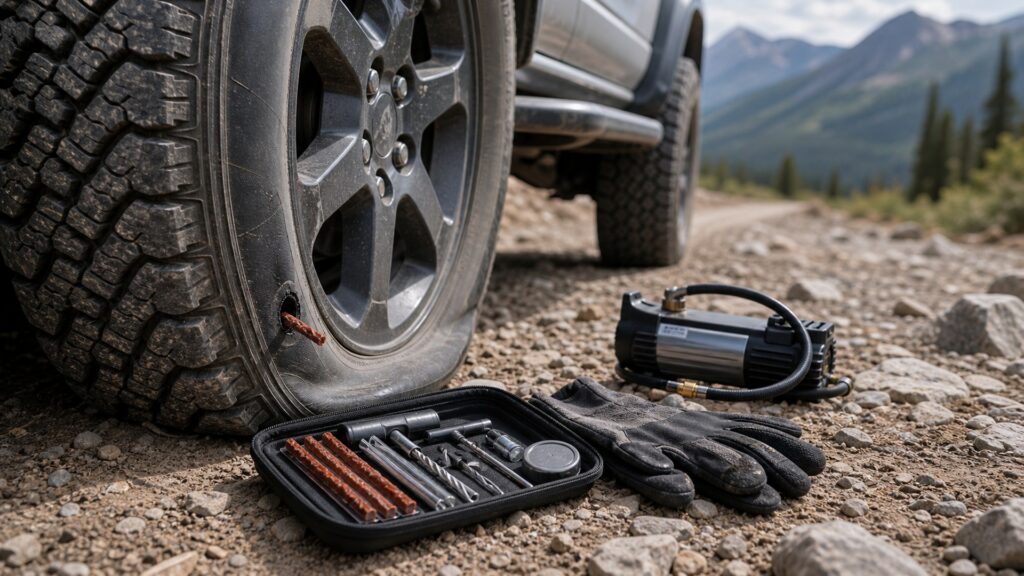
The injury location and the tire's recent history decide whether a roadside seal is reasonable; the tool sequence begins only after the damage screen.
Tip: Mark the injury and record the sealant or plug used. A technician needs that information to find the puncture, inspect the inner liner, and decide whether a standards-based repair remains possible.
These terms separate a roadside air-loss intervention from a complete tire repair.
Central tread region where a small straight-through injury may be eligible for professional repair.
Air-retaining layer on the inside of a tubeless tire.
Professional repair that fills the injury channel and seals the innerliner, often with a one-piece patch-plug.
Cord-like material inserted from outside to slow leakage through a tread puncture.
Liquid or aerosol material intended to coat or plug a leakage path while adding or retaining inflation.
Structural or thermal harm accumulated while a tire operates with little or no inflation pressure.
Tip: Repair policies vary by tire maker, speed rating, run-flat design, prior repairs, and service; the tire must be demounted before hidden damage can be ruled out.
A nail-sized central tread puncture behaves differently from a shoulder cut, sidewall bulge, bead leak, cracked wheel, or impact break. The latter failures involve highly flexed structure, sealing surfaces, or wheel integrity that a roadside plug cannot restore.
The kit matters most when it helps the driver say no to an unsafe repair attempt.
Heat and repeated deflection rise sharply as pressure falls. A tire driven underinflated can suffer liner abrasion, cord fatigue, bead damage, or separation even after the puncture is sealed and the casing reinflates normally.
Holding air after inflation does not erase damage created before inflation.
External plugs mechanically occupy the puncture channel; sealants seek the leak through escaping air and deposit material. Each has limits for injury size, geometry, temperature, contamination, and product-specific compatibility.
The roadside objective is controlled mobility to inspection, not restoration of the tire's original status.
A compressor must overcome leak rate and inflate the vehicle's tire volume without overheating. The pressure gauge reveals whether the seal stabilizes, continues to fall, or fails under movement; the door-placard cold pressure remains the normal target.
Inflation confirms a pressure condition at one moment, not the integrity of the casing.
Tell the technician where the injury was, how far the tire ran low, what material entered it, and whether sealant was used. A demounted inspection can reveal liner damage and determine whether the puncture fits the tire maker's repair policy.
A good emergency repair ends with an honest professional assessment, not a forgotten plug.
Its value comes from screening out structural damage while restoring short-term mobility for a simple tread puncture.
The injury is small, singular, in the allowed tread area, and the tire was not driven far or fast while severely underinflated.
The applied material holds placard pressure during a cautious check, and the driver proceeds directly to demounting and internal inspection.
Sidewall, shoulder, bead, wheel, run-flat, impact, exposed-cord, large or irregular injuries require another mobility option or roadside assistance.
A seal that leaks, a compressor that overheats, a tire that vibrates, or any uncertainty about hidden damage is sufficient reason to stop driving.
These myths confuse restored pressure with restored tire structure.
Pressure retention only shows that the current leak path is restricted. It does not reveal innerliner abrasion, cord damage, moisture in the belt package, secondary injuries, or whether the puncture lies inside the manufacturer-approved repair area.
Repair eligibility depends on diameter, angle, location, prior repairs, tire design, and run-low history. Industry guidance requires demounting and a combination repair for eligible injuries; shoulder and sidewall punctures are excluded.
Compatibility and service burden vary by formulation and sensor design. Sealant can contaminate components or complicate cleaning, so disclose its use promptly, follow the product instructions, and let the service provider inspect affected hardware.
Air supply cannot restore severed cords, a split sidewall, displaced bead, bent wheel, or impact break. Continuing to inflate structural damage can increase risk, especially when the tire cannot be observed from a protected position.
Tip: A roadside kit should narrow risk and distance to service, not convert an unknown casing into a permanent repair by assumption.
These answers address plug duration, repairable locations, sealant, TPMS, and the pressure checks required before limited travel.
There is no universal safe distance. Treat an outside repair as temporary, follow its instructions, reduce speed and load as directed, monitor pressure, and reach a qualified tire service facility as soon as conditions permit.
USTMA guidance generally limits passenger and light-truck repairs to small injuries in the tread repair area, after demounting and inspection. Tire manufacturers may add restrictions for size, angle, run-flat construction, speed rating, or previous repairs.
Only after the injury is identified, the vehicle is safely positioned, and the chosen kit requires removal. An embedded object may slow leakage; extracting it without a workable repair can turn a manageable seep into rapid deflation.
Use only products approved for the tire and TPMS arrangement, and follow vehicle instructions. Even compatible sealant should be disclosed because the sensor, valve, rim, and tire interior need cleaning and inspection during follow-up service.
Use the vehicle manufacturer's cold pressure on the door placard or manual, not the tire sidewall maximum. Account for heat, confirm with a reliable gauge, and recheck soon because a temporary seal can change under movement.
Tire repair kits matter because they can turn an eligible tread puncture into controlled, short-distance mobility while preserving a path to proper internal repair.
Their most important function is the damage screen: location, size, run-low history, pressure stability, wheel condition, and service access decide whether the tools should be used at all.
The related explainers deepen the kit-versus-spare decision and connect temporary pressure recovery to the complete tire-and-wheel system.
Use damage type, roadside exposure, tire construction, wheel condition, load, and service distance to decide between a kit and a spare.
Understand how pressure supports the carcass, how the bead seals to the wheel, and how heat and load expose damage.
Plan a second mobility option, compressor capacity, lighting, communications, and professional assistance before a puncture occurs.
Choose a retailer
Prices checked regularly. We may earn a commission at no cost to you.