
Cranking Voltage
Battery-terminal voltage observed while the starter and vehicle electronics draw current to rotate and start the engine.
- Load creates meaningful evidence
- Cable loss changes delivered voltage
- Temperature affects interpretation
Choose a vehicle battery when the failed event is electrical: cranking voltage collapses, modules reset, reserve disappears, a loaded electrical test fails, or the battery cannot accept or retain charge after the charging circuit and unwanted drains are evaluated. Those findings describe stored-energy delivery, not fluid cleanliness.
Choose an engine filter when measured restriction, differential pressure, contamination, water separation, damaged media, bypass behavior, or a clean-side sealing fault impairs the exact air, oil, or fuel circuit. A slow start can involve both paths—weak voltage reduces cranking speed, while poor fuel delivery or compression delays combustion—so capture electrical and flow evidence during the same start before replacing either category.
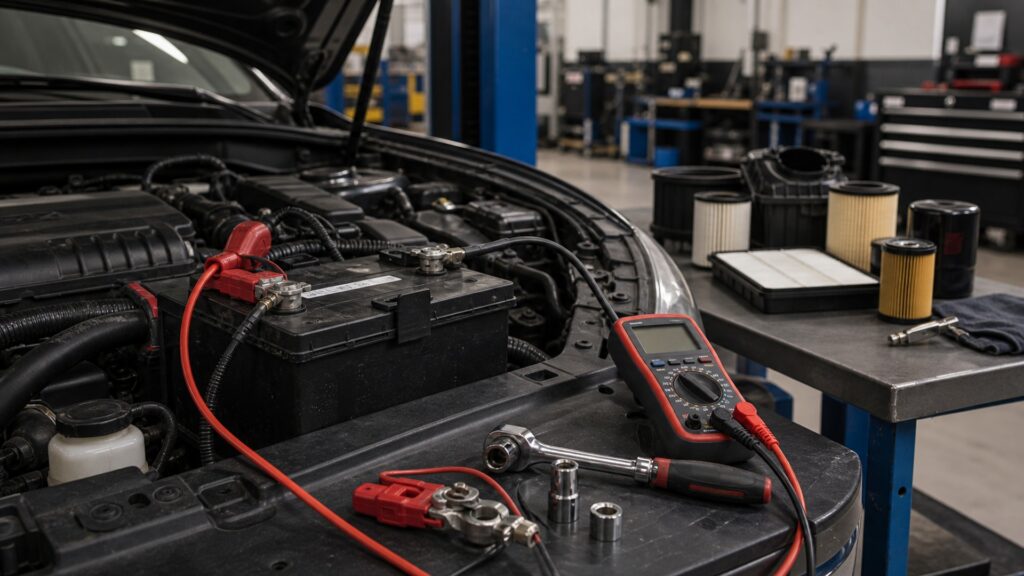
Voltage, current, and charge identify battery work; pressure, flow, contamination, and sealing identify filter work.
Tip: Charge and stabilize a low battery before condemning it, but preserve the original readings and determine why charge was lost rather than erasing the complaint.
These terms separate electrical depletion from restricted or contaminated engine flow during a hard-start investigation.
Battery-terminal voltage observed while the starter and vehicle electronics draw current to rotate and start the engine.
Electrical current consumed after the vehicle should have entered its designed key-off sleep state.
The battery's response to controlled charging at its present chemistry, temperature, age, and state of charge.
Opposition to air or liquid flow across an element at a defined flow, temperature, and measurement location.
The interface that prevents unfiltered air or liquid from bypassing media and reaching protected downstream components.
A pressure-responsive path allowing fluid around selected filter media when differential pressure exceeds its designed threshold.
Tip: Do not let an overdue maintenance sticker substitute for measurements; a due filter and a failed battery can coexist without causing one another.
A weak battery or high-resistance connection can slow the starter while dimming lamps, resetting clocks, dropping modules, or corrupting communication. The shared supply disturbance is broader than one engine stream.
A shared voltage collapse supports electrical testing before scheduled filter replacement.
An intake element affects airflow and restriction; an oil filter affects lubricating flow and contaminant control; a fuel filter affects supply pressure, cleanliness, and sometimes water separation. None stores starting energy.
The word filter is too broad to diagnose until the working medium is identified.
During a hard start, record voltage, current, cranking speed, module status, fuel pressure, and relevant airflow or synchronization data. The sequence shows whether rotation slowed first or combustion inputs failed despite normal speed.
The order of change is stronger evidence than the driver's description of hesitation.
Low temperature slows battery chemistry and may thicken oil, raising starter load and filter differential pressure. Heat accelerates battery aging while affecting seals, fluids, and intake density. Record temperature before interpreting either system.
A winter complaint can contain two mechanisms that require separate proof.
After battery work, verify charge retention, loaded delivery, cable loss, charging, and sleep current. After filter work, verify pressure, restriction, sealing, leakage, fluid level, and downstream cleanliness under relevant demand.
A successful engine start is a milestone, not a complete certification of either system.
The useful distinction is not old part versus new part; it is stored electrical delivery versus the condition of a specific air, oil, or fuel stream.
Loaded voltage, capacity, resistance, charge retention, terminal condition, cable drop, module stability, charging output, sleep current, or architecture-specific battery data fails a documented criterion.
The complaint affects multiple electrical loads or cranking behavior and remains attributable to the battery path after starter demand, charging support, wiring, grounds, and abnormal drains are considered.
Measured restriction, differential pressure, flow loss, contamination, water collection, media damage, bypass behavior, sealing, fluid compatibility, or exact service guidance identifies the air, oil, or fuel element.
Do not select either category from age, a maintenance reminder, one generic code, or a single jump-start. Fuel pumps, starters, compression, injectors, sensors, fluids, controls, and wiring can imitate both.
Maintenance schedules and jump-start success create tempting shortcuts: replace the overdue filter or declare the battery fixed without identifying the failed quantity.
External power can overcome discharged state, cable loss, slow cranking, or repeated starting attempts without identifying why. Test the stabilized battery, connections, starter current, charging system, and key-off draw before assigning the root cause.
Extreme restriction or intake damage can affect operation, but fuel pressure, ignition, compression, timing, sensors, temperature, cranking speed, and electrical supply remain possible. Measure restriction and starting data instead of using mileage alone.
Battery voltage can influence pump speed during cranking, but a battery cannot remove a clogged element, repair a weak pump, seal a regulator, or correct contaminated fuel. Stabilize supply, then test the fuel circuit directly.
Air, oil, and fuel filters have separate schedules, access risks, and condition evidence. Unnecessary service can introduce dirt, leaks, wrong fitment, or disturbed seals. Perform due maintenance without presenting it as the electrical repair.
Tip: Use the original event to measure electrical delivery and the relevant fluid circuit before changing conditions or installing parts.
These answers address jump starts, cold weather, charging, filter reminders, and the measurements that settle a hard-start decision.
Yes. Low cranking speed can reduce pump output, airflow, injection quality, and control stability, making an existing engine issue more visible. Stabilize electrical supply, then repeat pressure, flow, and combustion tests before assigning filter blame.
Not directly, but prolonged or repeated cranking caused by poor air or fuel delivery can consume stored charge. Recharge and test the battery while diagnosing the restriction or supply fault as a separate causal path.
Begin with safety, architecture, stored codes, battery state, loaded voltage, cable drops, and cranking speed because unstable supply can invalidate later data. Then test spark, fuel pressure, air, compression, timing, and exact filter conditions.
Once cranking speed and sensor supply are adequate, low pressure belongs to lubrication diagnosis: level, viscosity, pickup, pump, clearances, filter specification, bypass, leakage, and measurement accuracy. Stop operation if genuine pressure is unsafe.
The battery meets architecture-specific loaded criteria, connections have acceptable voltage drop, charging and sleep current are normal, modules remain stable, and the original cold or hot starting event repeats without abnormal depletion or warnings.
Use vehicle batteries when measured voltage, current, capacity, charge, connection, or module-stability evidence identifies a stored-electrical-energy problem. Use engine filters when pressure, flow, contamination, media, bypass, or sealing evidence identifies a specific fluid stream.
Capture both paths during the original start, correct immediate electrical instability before interpreting dependent data, and give each repair its own release test. A maintenance interval or jump-start result is not a component verdict.
Related explainers provide the battery mechanism, the filter flow map, and the diagnostic data practices needed to separate weak supply from restricted engine inputs.
Trace how chemical energy becomes cranking current and low-voltage system support.
Follow air, oil, and fuel through media, seals, differential pressure, and intentional bypass paths.
Preserve codes, freeze frames, and synchronized live data without treating them as automatic component verdicts.
Choose a retailer
Prices checked regularly. We may earn a commission at no cost to you.