
Risk Objective
A specific unauthorized event, loss consequence, notification need, or recovery problem that the proposed security layer is meant to address.
- Scope must be bounded
- Evidence supports priority
- Controls should match exposure
Choose a vehicle security system when the missing result concerns unauthorized entry, start authorization, deterrence, remote notice, or recovery support. First document what the factory vehicle already monitors and what evidence shows a remaining gap. A new alarm cannot correct an undefined fear, and more devices may add nuisance triggers or parked-current demand.
Choose a stereo head unit when the unmet result concerns source selection, phone integration, navigation display, audio processing, controls, or retained camera and vehicle information. A head unit may display a security status or play a warning, but that interface does not make it an immobilizer. When both products show resets or sleep problems, diagnose their shared power and network dependencies before buying either.
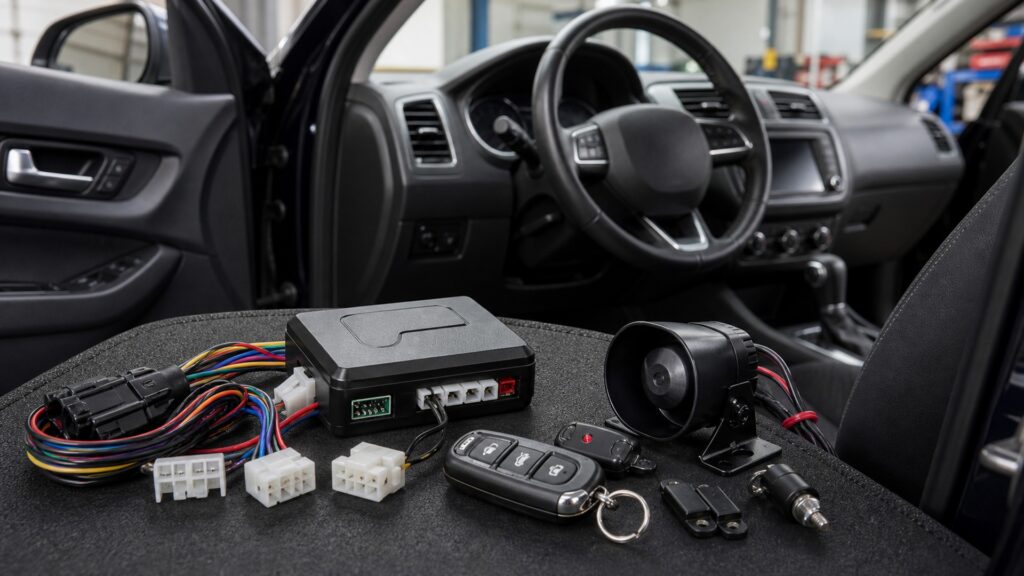
The decision separates protection outcomes, entertainment outcomes, shared faults, compatibility, and acceptance evidence.
Tip: Purchase the product that owns the missing result after existing capability and common faults have been tested.
These terms prevent a visible dashboard feature from substituting for a security outcome.
A specific unauthorized event, loss consequence, notification need, or recovery problem that the proposed security layer is meant to address.
The dashboard component that selects media, supports controls and phone functions, and routes audio or visual information.
An authorization function that prevents normal starting or operation when a recognized credential condition is absent.
A supported module or connection preserving factory controls, cameras, warnings, amplifiers, or vehicle settings after equipment changes.
Electronics translating power, data, commands, or status between equipment and a vehicle without transferring system ownership.
A recorded demonstration that the selected product resolves the named gap without damaging required functions, sleep state, or recovery.
Tip: State the required result before naming hardware.
A vehicle-security purchase can address monitored openings, tilt, impact, credential control, start authorization, remote notification, or recovery support. Match the layer to exposure and confirm existing factory capability before adding overlap.
A protection feature is justified by the risk it controls and the evidence it can provide.
A replacement receiver can add compatible sources, processing, displays, phone functions, or retained interfaces. Those functions improve daily interaction and cabin audio but do not inherently monitor entry or validate starting credentials.
A better dashboard interface is not a substitute for access control.
Security modules and head units often share the battery, chassis ground, data networks, and accessory-state information. Common resets, noise, failed wakeups, or battery depletion may point to the shared layer rather than either product category.
Diagnosis prevents a new purchase from inheriting the original electrical fault.
Either installation can disturb factory functions if interfaces are incomplete. Exact year, trim, key type, amplifier, telematics, camera, control, and network coverage must be confirmed before equipment selection.
Compatibility is the set of functions that remain correct after the change.
Security proof uses zones, credentials, alarms, notification, authorization, faults, sleep, and recovery. Head-unit proof uses sources, channels, calls, controls, retained features, noise, startup, and shutdown under normal cabin use.
The better purchase is the one that closes its named gap without borrowing success from the other category.
A receiver may show camera images, lock status, or a notification, yet sensing and authorization still depend on separate vehicle and security controllers.
A documented unauthorized-entry, start-control, notification, or recovery gap remains after factory capability is tested.
The vehicle supports a safe interface, manageable parked load, and an authorized recovery process.
The actual gap is media compatibility, phone behavior, navigation display, processing, controls, or audio output.
No additional security layer is justified by a specific risk and acceptance plan.
These myths steer purchases toward the most visible dashboard component instead of the stage that owns the result.
The screen may display status or camera video, but it does not automatically supply perimeter sensors, credential logic, alarm decisions, immobilization, supervised outputs, remote delivery, or recovery. Verify the controller behind every displayed feature.
Overlapping sensors and controllers can increase false alarms, wiring complexity, battery load, credential confusion, and service difficulty. Add only the layer that controls a documented risk and can be tested without weakening factory protection.
Cranking voltage, ground resistance, accessory wiring, data-interface faults, sleep-state problems, or a security module may reset the receiver. Measure the shared supply and isolate added equipment before condemning the head unit.
Remote start, lock control, immobilizer authorization, alarm arming, takeover, and shutdown can follow different rules. Confirm the exact vehicle, credential, interface firmware, safety interlocks, and authorized recovery sequence for every requested function.
Tip: Match the product to a named physical or information outcome.
These answers establish a purchase sequence for protection, dashboard functions, and shared faults.
Name the unauthorized event, protected boundary, parking context, consequence, desired local response, remote-notification expectation, immobilization role, legitimate users, service mode, parking duration, and recovery method before comparing products or installers.
List required sources, phone platforms, controls, cameras, vehicle information, amplifier interfaces, processing, channel outputs, display behavior, retained warnings, startup, shutdown, and reference listening material instead of asking only for a newer screen.
Begin with battery condition, voltage during crank, fuses, grounds, accessory circuits, interface modules, network sleep, and prior wiring. Correct the common electrical problem before judging security reliability or receiver quality independently.
Yes, when supported interfaces preserve factory functions and the combined current, network, audio-priority, control, and mounting behavior passes testing. Independently validate security states and head-unit functions before exercising their shared transitions.
Write one sentence describing the missing outcome, identify the system that physically produces it, test the existing chain at that stage, and require a vehicle-specific demonstration before accepting a proposed replacement or addition.
Use a vehicle security system instead of a stereo head unit when a defined protection, authorization, notification, or recovery outcome is missing. Use receivers for media, phones, displays, processing, and controls.
Inspect factory capability and common electrical dependencies first. Then require separate acceptance evidence so a working screen never stands in for security, and a sounding alarm never stands in for audio performance.
These explainers convert the chosen protection outcome into vehicle-specific interfaces and observable behavior.
Check architecture, sensors, outputs, parked current, credentials, and authorized recovery on the exact vehicle.
Define arm, disarm, entry, trigger, alarm, notification, immobilization, and reset as observable states.
Trace media, phone, processing, control, and retained-feature needs through the head-unit chain.
Choose a retailer
Prices checked regularly. We may earn a commission at no cost to you.