
Armed-State Coverage
The doors, closures, cabin zones, movement conditions, and authorization events monitored after the system enters its protective state.
- Boundaries must be named
- Exclusions remain visible
- Coverage can vary by mode
Security-system fit is a relationship among the vehicle, credentials, sensors, controller, outputs, parked power supply, and authorized recovery path. A product can physically enter the cabin yet remain incompatible with the vehicle network, starting authorization, factory alarm logic, or low-power sleep strategy. Fitment therefore begins with architecture, not bracket size.
The installed system must recognize intended openings and motion without confusing normal vibration, pets, towing, charging, or service work for intrusion. Its wiring must not compromise safety circuits, and every legitimate user needs a tested way to arm, disarm, start, and recover the vehicle. A fit decision is complete only when those states remain predictable after installation.
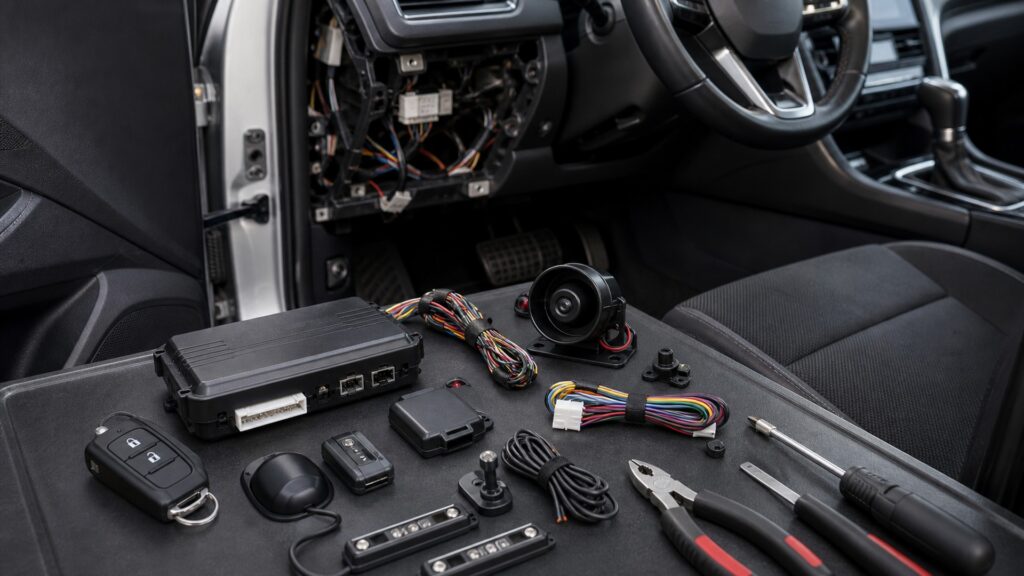
The evaluation covers architecture, sensing geometry, output interfaces, parked energy, credentials, and authorized recovery.
Tip: A compatible label is only the start; each protected boundary needs a vehicle-level acceptance test.
These terms identify the interfaces that decide whether the installation belongs in a particular vehicle.
The doors, closures, cabin zones, movement conditions, and authorization events monitored after the system enters its protective state.
The ability of keys, fobs, phones, cards, or codes to authorize disarming and starting without conflicting with factory logic.
The physical location and orientation that let a sensor observe its intended event while limiting vibration, heat, moisture, or accidental contact.
The supported electrical path used for a horn, siren, lights, notification module, or other response after a valid controller decision.
The parked electrical allowance available to factory modules and added equipment without creating unacceptable battery depletion.
An authorized procedure that prevents nuisance operation during maintenance, transport, washing, battery work, or legitimate recovery.
Tip: Document ownership, connection, and fallback for each interface.
Modern vehicles may combine body controllers, immobilizers, telematics, multiplexed wiring, and factory alarms. The added system must use supported interfaces and avoid treating a shared data wire like a simple switched circuit.
The vehicle architecture determines which security actions are safe to request.
Door pins, shock sensors, tilt sensors, glass sensing, and interior motion devices observe different physical changes. Placement, sensitivity, panel stiffness, airflow, and ordinary cabin activity determine useful separation from nuisance triggers.
Sensitivity cannot compensate for a sensor aimed at the wrong phenomenon.
A siren or light output attracts attention; an immobilizer or authorization path controls starting. Their voltage, current, timing, supervision, and failure consequences differ, so one successful alarm test cannot validate both.
Response fit depends on what the controller drives and what failure leaves behind.
Security electronics operate while the vehicle is parked. Current draw, cellular registration, weak coverage, repeated wakeups, battery age, storage duration, and cold weather can reduce reserve or keep factory networks awake.
A useful monitor must not create the no-start event it was intended to guard against.
Owners, additional drivers, technicians, valets, and emergency situations create legitimate state changes. Enrollment, revocation, manual key access, battery replacement, towing, and service override must remain understandable and recoverable.
Fitment succeeds when legitimate access stays reliable without weakening normal protection.
Overlapping devices without defined ownership can multiply nuisance alarms, battery demand, and diagnostic ambiguity while leaving a real opening or authorization path unprotected.
Every monitored boundary produces the expected state and response under a written parked test.
The vehicle returns to normal sleep, starts with authorized credentials, and exposes faults clearly.
A showroom demonstration does not prove cold-weather reserve, long-storage behavior, or cellular coverage.
An alarm sound does not prove immobilization, notification delivery, or recovery readiness.
These myths mistake physical installation or a loud output for system-level compatibility.
Universal hardware may still need vehicle-specific data interfaces, output isolation, credential behavior, mounting space, and programming. A connector match alone cannot prove network compatibility, safe immobilization, factory-alarm coexistence, or stable sleep current.
Sound level says little about protected openings, sensor discrimination, credential reliability, notification delivery, current draw, or recovery. A quieter but correctly placed and supervised system can provide more dependable information and fewer nuisance events.
A factory fob may command locks while security arming, immobilizer authorization, remote start, panic, and telematics follow separate rules. Verify each requested function on the exact year, model, trim, firmware, and credential set.
One successful start does not expose intermittent voltage loss, network wakeups, bypass-module faults, duplicated credentials, unsafe cut circuits, or failure after a battery event. Test start authorization, denial, shutdown boundaries, faults, and recovery separately.
Tip: Test sensing, authorization, response, power, and recovery as different obligations.
These answers convert fitment questions into specific checks before and after installation.
Record year, make, model, trim, engine, transmission, key type, push-button or keyed start, factory alarm, immobilizer, remote start, telematics, relevant options, prior modifications, and current diagnostic faults before selecting interfaces.
Place each device according to its sensing method, orientation limits, temperature range, moisture exposure, panel behavior, and service access. Then test intended events and normal vibration at several sensitivity settings before fixing the location.
Measure battery condition first, allow every module to complete its sleep sequence, record stabilized current, repeat after arming and notifications, and compare the observed load with expected parking duration and vehicle-specific service guidance.
The owner should have an authorized revocation and replacement path that removes the missing credential without disabling valid users. Confirm identity requirements, remaining-key behavior, emergency entry, programming records, fees, and recovery timing beforehand.
Verify every opening, motion condition, credential, arm and disarm method, start authorization, siren or light output, notification route, fault indication, sleep state, service override, battery interruption, and authorized recovery on the finished vehicle.
Vehicle-security fitment matters because architecture, sensors, outputs, credentials, parked power, and recovery can be individually compatible or individually wrong. Each interface deserves its own evidence.
Choose only supported components, preserve factory safety behavior, and document legitimate access before handoff. The completed installation should protect defined boundaries without creating nuisance alarms, battery depletion, or uncertain recovery.
These explainers show where each interface sits in the security state machine and how its behavior should be observed.
Follow arming, authentication, sensing, controller decisions, responses, notification, and recovery.
Define visible states for arming, entry, trigger, alarm, immobilization, notification, and reset.
Review electrical, occupant, emergency, privacy, and failure controls before final handoff.
Choose a retailer
Prices checked regularly. We may earn a commission at no cost to you.