When to Use Weight Distribution Hitches Instead of Standard Ball Mounts

A standard ball mount transfers trailer forces through the receiver without spring bars. It is simpler when tongue load, axle distribution, receiver ratings, ride attitude, and steering response remain within the approved weight-carrying envelope.

A weight distribution hitch fits when the vehicle or hitch maker requires it, or measured tongue load creates front-axle unloading that approved spring-bar adjustment should correct. The receiver needs a weight-distributing rating, the trailer frame must accept brackets, tongue weight must match the bars, and the rig must be scaled. Over-tension can overload the front axle or reduce rear traction; a standard mount can be safer when loads are modest and geometry works.

By: Review Streets Research Lab
Updated: August 31, 2026
Explainer · 8-12 min read
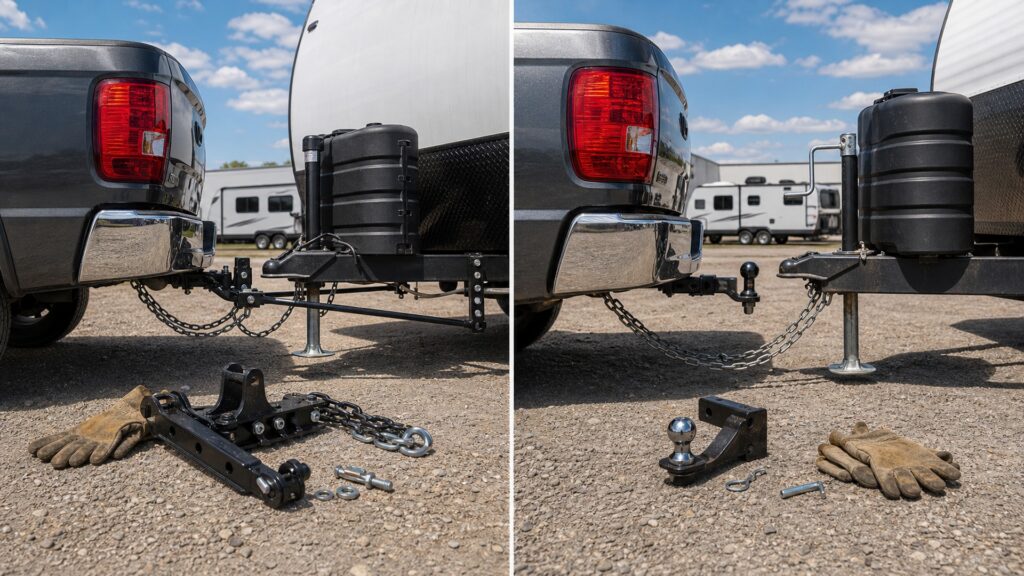
weight distribution hitches instead of standard ball mounts explainer hero image for Review Streets
What You'll Learn

Use the Scales to Decide Whether Redistribution Is Needed

Compare unhitched, coupled weight-carrying, and adjusted weight-distributing axle loads against the tow-vehicle maker's restoration target and every rating.

  • Measure actual loaded tongue weight
  • Record front and rear axle changes
  • Read weight-carrying and distributing receiver limits
  • Confirm trailer-frame bracket approval
  • Select bars for real tongue load
  • Verify final axles and articulation

Tip: Do not choose from rear squat alone. Self-leveling suspension or air springs can change body height while front-axle load remains altered, so fender measurements should support—not replace—scale evidence.

Definitions

Key Concepts That Define Weight Distribution Hitches and Standard Ball Mounts

These terms define the decision threshold rather than presenting weight distribution as automatic equipment.

Standard Ball Mount

A fixed or adjustable receiver insert carrying a hitch ball without spring bars between tow vehicle and trailer.

  • It transfers full coupling moment conventionally
  • Simplicity improves articulation and setup
  • Its own drop rise and rating must match

Weight Distribution Hitch

A ball-coupled system using spring bars to apply opposing moments between receiver and trailer frame.

  • It redistributes axle effects
  • It requires approved receiver and frame
  • Adjustment changes with loaded tongue weight

Front-Axle Unloading

Reduction in tow-vehicle front axle load caused by tongue force acting behind the rear axle.

  • It can change steering and braking response
  • Wheelbase and hitch overhang affect magnitude
  • Scale passes quantify the change

Receiver Mode

The marked hitch capacity that can differ between ordinary weight-carrying and approved weight-distributing operation.

  • Higher mode is not automatic
  • Vehicle limits remain unchanged
  • Extensions can reduce either rating

Spring-Bar Rating

The tongue-load working range assigned to the bars used to create redistribution leverage.

  • Bars too light may under-correct
  • Bars too stiff can over-transfer
  • Actual loaded tongue weight guides selection

Restoration Target

The vehicle maker's specified amount of front ride height or axle load to regain after coupling.

  • Full restoration is not universal
  • Measurements require consistent loading
  • Exceeding target can harm balance

Tip: The tow vehicle and hitch instructions control the acceptable front-axle restoration target.

Begin with Weight Carrying

See What the Trailer Actually Does to the Truck

Couple the loaded trailer on the standard ball geometry and measure front axle, rear axle, trailer axle, and totals. The result reveals whether payload, rear GAWR, receiver, or front unloading becomes limiting before any redistribution hardware is added.

  • Load passengers and cargo exactly for travel
  • Keep trailer cargo unchanged between passes
  • Record ball height and trailer attitude
  • Check every tire and wheel rating

Weight distribution cannot rescue an overloaded baseline.

Spring Bars Apply an Opposing Moment

Use Them Only When the Structure and Target Are Defined

Bars bend between the hitch head and trailer brackets, returning part of the tongue-load effect toward the front axle and trailer axles. Head angle, bracket or chain setting, bar stiffness, and hitch height determine the transfer.

  • Install only frame-approved brackets
  • Follow head-fastener torque and setup
  • Engage bars symmetrically
  • Keep hands clear of stored spring energy

Redistribution is controlled leverage, not suspension support.

When the Standard Mount Is the Better Tool

Low Tongue Load and Correct Axle Balance Reward Simplicity

A properly rated ball mount reduces weight, parts, noise, adjustment, ground-clearance limits, and articulation restrictions. If vehicle guidance permits weight carrying and scale results remain acceptable, adding stiff bars can create needless load transfer.

  • Use the shortest rated geometry practical
  • Match ball diameter shank and coupler
  • Secure the receiver pin and latch
  • Recheck trailer attitude after loading

More hitch hardware is not automatically more control.

Compatibility Can End the Decision

Frames, Surge Actuators, Extensions, and Sway Devices Need Approval

Thin trailer tongues, pole frames, hydraulic surge couplers, receiver extensions, certain couplers, and severe articulation can conflict with weight distribution. Every manufacturer involved must approve the exact combination and installation points.

  • Check bracket clearance before drilling
  • Verify surge-coupler movement
  • Account for backing and sharp turns
  • Reject stacked or improvised adapters

A theoretical axle benefit cannot justify incompatible hardware.

Final Setup Is a Scale Result and Road Check

Restore Only the Specified Share and Confirm Behavior

After adjustment, reweigh all axle groups, verify payload and ratings, check headlights and steering, then test low-speed braking and turning. Recheck after cargo, suspension, hitch height, bar, or trailer changes.

  • Record settings with scale tickets
  • Inspect bracket movement after initial miles
  • Confirm ground clearance through dips
  • Stop for binding porpoising or unstable response

The correct setting belongs to one loaded configuration, not the hitch forever.

Quick Reality Check

Use Redistribution for a Measured Need

A standard mount is sufficient when weight carrying is approved and axle effects are acceptable; spring bars answer a documented restoration requirement.

Choose Weight Distribution When

Vehicle guidance requires or permits it, measured coupling unloads the front axle beyond the specified target, and receiver, trailer frame, coupler, bars, and brackets are compatible and rated.

Scale passes show redistribution can restore the approved amount without exceeding front, rear, trailer, tire, payload, or component limits, and route articulation remains clear.

Choose a Standard Ball Mount When

Weight carrying is approved, actual loaded tongue weight and axle distribution remain within limits, steering and ride attitude are acceptable, and simplicity improves clearance, articulation, setup, and inspection.

Neither system corrects rearward cargo, too little tongue weight, insufficient payload, weak brakes, unstable sway, tire overload, wrong hitch height, damaged structure, or a trailer beyond the truck's towing envelope.

Common Myths

Misconceptions About Weight Distribution Hitches and Standard Ball Mounts

Selection myths use trailer weight or body squat as a shortcut for a decision that depends on axle load and approved structure.

Every heavy trailer needs weight distribution

Weight alone is not the complete trigger. Coupling geometry, actual tongue load, wheelbase, payload, axle change, vehicle requirements, receiver mode, trailer frame, and intended articulation determine whether redistribution is required and compatible.

A level truck proves weight distribution is correct

Self-leveling suspension, helper springs, or bar tension can create level bodywork while axle loads remain wrong. Use prescribed height checks and scale readings, then verify every axle, tire, and rating.

More spring-bar tension always improves steering

Excess transfer can overload the front axle, unload rear tires, stiffen pitch response, reduce traction, and stress hardware. Restore only the amount specified by the tow vehicle and hitch procedures.

Weight distribution increases payload or tow rating

Spring bars redistribute coupling effects but do not raise GVWR, GAWR, GCWR, payload, receiver attachment strength, trailer rating, tires, brakes, or manufacturer towing limits. The weakest original boundary still governs.

Tip: Measure the loaded combination and follow the restoration target before adding or removing spring-bar leverage.

FAQ

Frequently Asked Questions About Weight Distribution Hitches and Standard Ball Mounts

These answers address trailer-weight thresholds, air springs, surge brakes, sway control, setup measurements, and how cargo changes can move the decision from one hitch type to the other.

Is there a universal trailer weight requiring weight distribution?

No. Manufacturer requirements, actual tongue load, axle effects, wheelbase, receiver mode, frame compatibility, and jurisdiction matter. Use the tow vehicle and hitch instructions plus loaded measurements rather than a generic internet threshold.

Do rear air springs eliminate the need?

Air springs restore rear height and suspension travel but generally do not create the same moment that returns front-axle load. Follow all manufacturers and verify axle weights instead of judging only the body stance.

Can weight distribution work with surge brakes?

Only when the surge actuator, hitch, and spring-bar system explicitly permit it. Bracket friction or geometry can restrict coupler travel, so electric-brake assumptions cannot be transferred without documented compatibility from manufacturers.

Does weight distribution include sway control?

Some products integrate friction or cam-based sway resistance; others only redistribute load. Stable loading, speed, tires, alignment, hitch geometry, and driver response remain essential even when a separate control feature is present.

When must the setup be recalculated?

Recheck after meaningful changes in trailer cargo, tongue weight, tow-vehicle load, suspension height, ball height, receiver extensions, bars, brackets, tires, or hitch components. Use repeatable measurements and retain scale tickets.

Bottom Line

Use a weight distribution hitch instead of a standard ball mount when approved spring-bar leverage is needed to restore the tow vehicle's specified front-axle relationship and the complete installation is compatible.

Use the simpler ball mount when weight carrying is approved and measured axle effects remain acceptable; neither choice creates capacity, so scale the loaded rig and preserve every vehicle, tire, hitch, and trailer limit.

Next Steps

Let Axle Measurements Choose the Hitch

Related explainers deepen spring-bar mechanics, the complete towing load path, and sway control so redistribution is neither oversold nor mistaken for stability by itself.

Why Towing Capacity Matters

Confirm payload, GAWR, GCWR, receiver, tire, cooling, braking, and performance limits before choosing hitch mode.